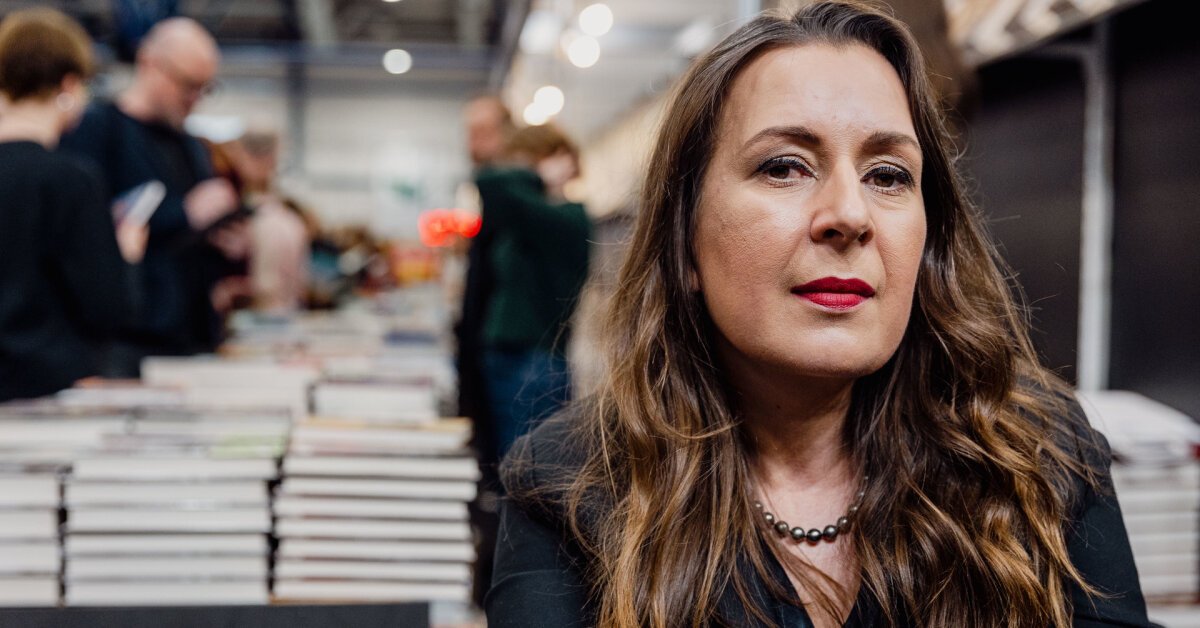
The writer K. Sabaliauskaitė spoke on the show in the run-up to Saturday’s protest on Cathedral Square, where she will speak against the amendments to the LRT law currently under consideration in the Seimas. The writer claims that these amendments are directed against free speech.
“This was confirmed by both the Venice Commission and the international institutions of journalists. (Protest) against the law that seeks to control editorial content. This is very important. It is trying to puff up, make stupid eyes and say that ‘no, no no, there will be more democracy here.’ But what does it mean when the Seimas clearly formulates that, say, it will be required that the informational content of the public broadcaster reflect and inform more about the regions? An alarm light goes on for every journalist. She would be just as fired up if she were told that the public broadcaster needs to report more on cities, agriculture or culture. Public information tools do not work like that: they inform about what is happening”, said K. Sabaliauskaitė.
According to the writer, the content cannot be regulated by any directives – the media must inform about current events.
“It is immediately visible that it is “dropped from above” as in Soviet times: both the collective farms (materials) and the materials industry must be prepared. Behind all this are either people who have very little education or have never worked in journalism. With all due respect to the teachers, I don’t know if a primary school teacher is qualified to comment or draw conclusions about how the media works in these troubled times and what the problems are with journalists. And the second group that is standing and that is pushing this law is pro-Russian actors connected to Russia. Characters like (Artūras) Skardžius, who has received loans from Russia, have all sorts of affairs and push Belarusian fertilizers. The question arises: where is the limit of our self-respect as Lithuanians, that we allow these characters to control us and set the tone”, said K. Sabaliauskaitė.
According to the writer, it is not appropriate to talk about polarization at this time, but it is better to focus on the public good – military and political security.
“The threat of war is lurking behind us,” she said.
According to K. Sabaliauskaitė, the reason for the tension between part of the society and the government is the habit of living in democratic conditions.
“A part of society cares about its community, knows its rights, and wants to create a rich Lithuania freely without being constrained by ideological shackles (…) But now we see a huge relapse into the Soviet, Russian mentality promoted by the ruling majority,” the writer said in the program.
According to the writer, the takeover of the LRT is now underway, and later there will be an amendment to the law on public information.
K. Sabaliauskaitė emphasized that it is not necessary for Russia to push through the borders of the Lithuanian state, but “it is enough to strangle and return to the structure of society that was in the Soviet era and turn it into a satellite country of Russia”.

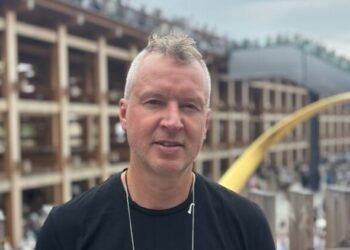
Skirmantas Lisauskas/BNS photo/Kristina Sabaliauskaitė
“It is enough to conquer minds. And now we see from those in power that many people in Lithuania are, as Česlov Miloš wrote, enslaved minds with deeply Sovietized brains. Those people had found themselves in that system, it was good for them to live there. I will not be afraid to say – they are mostly lazy mediocrity,” she said.
According to the writer, the Soviet system only encouraged adaptation and “getting a ration in the zoo”, rather than creative living.
K. Sabaliauskaitė emphasized in the program that when she was interested in the history of Russia, she noticed that the first target of dictators is always the free media, which is why the current situation in Lithuania seems extremely threatening to her.
“The Russians are very patient, very far-sighted, investing a lot in long-term erosion and destruction, but their weak point is that they are uncreative and work according to the same template. (…) There is only one thing that works: to give back through the nose, so that it doesn’t show up,” said K. Sabaliauskaitė.
The writer said that she is most worried about the situation in the regions.
“Will people be able to express their opinion there without fear of repression,” she said.

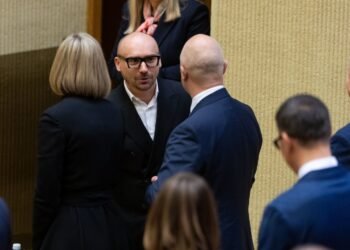
Patricija Adamovič/BNS photo/Kristina Sabaliauskaitė
According to the writer, if the protest does not affect the actions of the rulers, “we will live in Putinized Lithuania”.
“And we will recite Kubilinsky’s poems, we will praise the collaborators,” she said.
According to K. Sabaliauskaitė, the current situation in Lithuania is critical.
“We stand against Russia’s strategy and its collaborators, whom it has bribed with large sums of money through business schemes, etc. (Russia) is trying to putinize Lithuania, to bring it into voluntary lethargy,” she emphasized.