‘STEP-UP’:
Washington would ensure a strong enough posture to balance Beijing’s power, but partners must do their part for collective defense, Pete Hegseth said
-
By Jonathan Chin / Staff reporter
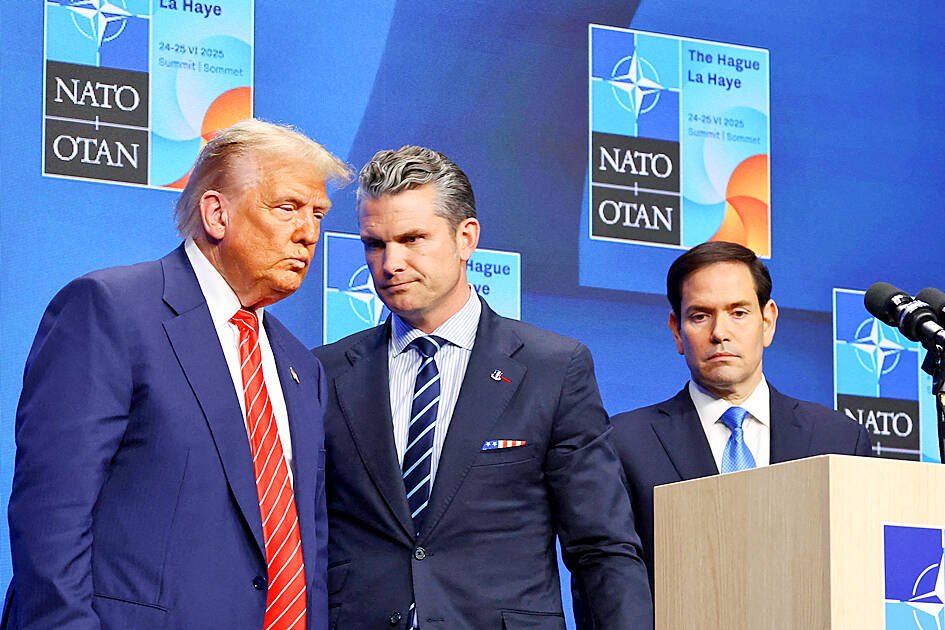
The US must ensure peace through strength to deter Beijing from interfering with Washington’s long-standing national interests in the Indo-Pacific region, US Secretary of Defense Pete Hegseth said.
“It is our job to make sure Beijing sees unquestionable US military strength that, if necessary, can back up our national interests,” he told a US Congressional hearing on Thursday.
“This means ensuring none of our allies are vulnerable to sustained, successful military aggression,” he said. “We insist… on China respecting our long-standing interests in the Indo-Pacific.”
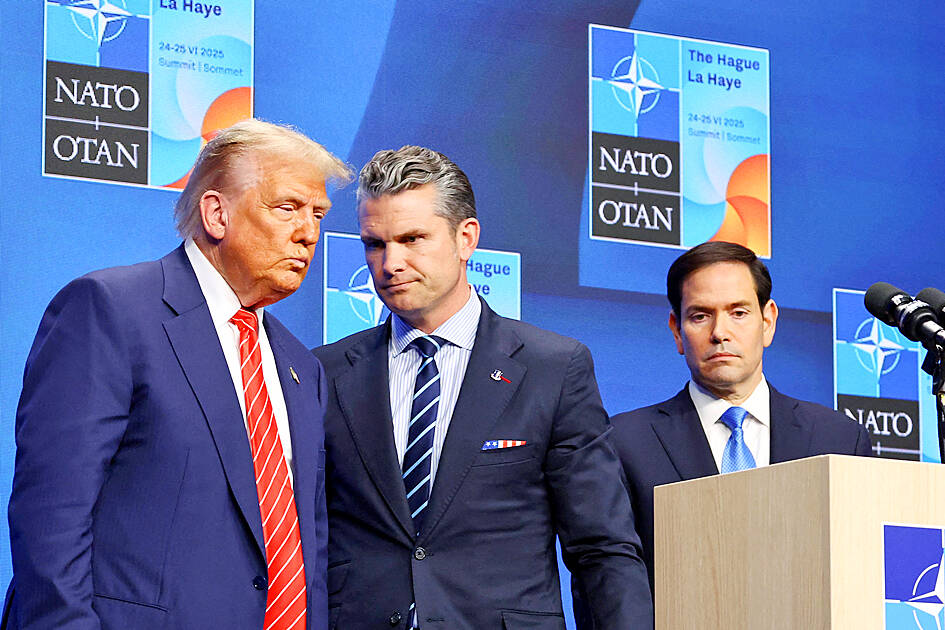
Photo: Reuters
Hegseth’s remarks came as the May 14 and 15 meeting between US President Donald Trump and Chinese President Xi Jinping (習近平) in Beijing nears, an event that has sparked trepidation in Taiwan and the nation’s supporters in Washington.
“We will be strong, but not confrontational… [We] are not trying to ‘strangle’ China’s growth, we are not trying to dominate or humiliate them, nor are we trying to change the ‘status quo’ over Taiwan,” Hegseth said.
He took part in hearings on the Trump administration’s proposed US$1.5 trillion defense budget for the fiscal year 2027 at the Armed Forces Committees of the US Senate and House of Representatives.
Second to homeland defense, deterring China in the Indo-Pacific region is the highest national security priority, Voice of America cited the US government’s report submitted to the committee as saying.
These priorities largely aligned with this year’s National Defense Strategy, the outlet added.
“Under President Trump’s leadership, relations between the United States and China are better and stronger than they have been in many years,” Hegseth said, adding that Washington does not seek confrontation with Beijing.
Trump and Xi had made a major breakthrough in trade, allowing both countries to develop their powerful economies, and the two countries would find more opportunities to improve ties in the upcoming leaders’ summit, he said.
The US Pentagon is committed to the same approach by “opening a wider range of military-to-military communications with the [Chinese] People’s Liberation Army — aimed at deconfliction and de-escalation,” Hegseth said.
The US Department of Defense’s policy is based on a “flexible realism [aiming] not at domination, but rather at a balanced relationship [and] a balance of power that will enable… all countries to enjoy a decent peace in the Indo-Pacific [region], where trade flows openly and fairly,” he said.
However, the US has “significant but scoped and reasonable” interests in the region, including ensuring itself and its allies are postured “strongly enough in the Indo-Pacific [region] to balance China’s growing power,” he added.
Hegseth called on US allies in the region to increase military spending as Washington shifts priorities to “homeland defense.”
“It is vitally important for America’s allies and partners to step up and do their part for our collective defense. This isn’t just a matter of doing right by Americans who are frustrated by years of allied free-riding. This is pragmatic. As we prioritize our homeland, hemisphere and the Indo-Pacific [region], threats persist in other regions — and our allies must step up,” he said.

![[Exclusive] S. Korean Embassy accused of mismanagement at K-Culture event in Pakistan](https://agentially.org/wp-content/uploads/2026/05/news-p.v1.20260503.d59ba4e8d0034a0895361c63bc538199_T1-75x75.png)