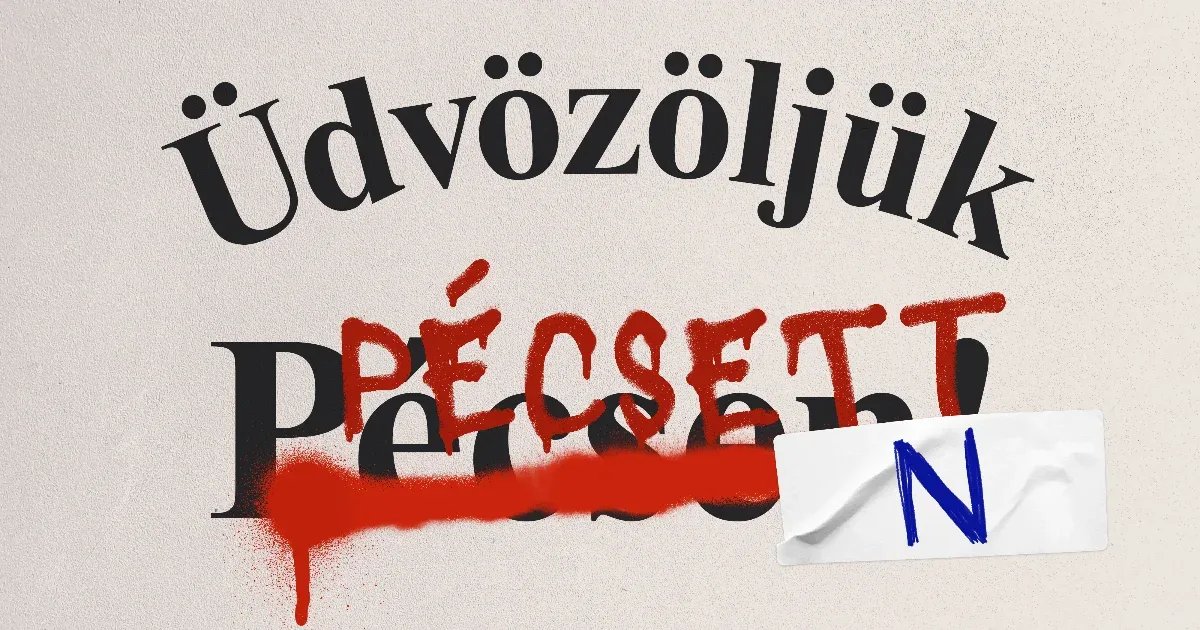
“123 competitors from eight associations took part in the Transdanubian regional mountain cycling championship in Pécs”, reported forty years ago the Pécs-based Danútúli Napló, which also reported in April 1986 that “long-forgotten, dusty looms are being found” and “they are weaving on them again in the villages around Pécs and the county seat”. But attentive readers of the Baranya County Committee of the MSZMP did not miss the fact that the latest issue of Jelenkor, “the literary and art magazine edited in Pécs”, was published with poems by, among others, Csorba Győző, Amy Károlyi, Dezső Keresző, Ottó Tolnai and Sándor Weöres, and they also learned that “there will be speech therapy counseling on April 22 at 2:30 p.m. and between 3:30 p.m. in Pécs, at Széchenyi tér 9, at the Baranya County Pedagogical Institute”.
Pécs vs. in Pécs case, an even more colorful picture is revealed to us if we continue the investigation in the Hungarian National Text Library, which contains more than one billion words. THE Pécsfor the search engine mentions 14,355 hits, among others, quoting details of texts by Gyula Illyés, László Németh, László Nagy, István Ágh, Bertha Bulcsú, János Pilinszky, László Bertók, Miklós Mészöly, György Petri, György Spiró, and Ottó Tolnai. And although they fall somewhat short of this in Pécs occurrences, the 5297 hits is still a high number, we can find, for example, the writings of Gyula Illyés, István Ágh, Anna Jókai, Bertha Bulcsú, György Moldova, and Magda Szabó.
How do I add you?
A few years ago one of the Pécs news portals he also dealt with the language dilemma, which he believed to be “eternal” and even called an “ancient urban problem”. In the article, János Pesti was interviewed, who argued, among other things, that in the 19th century the Pécs was the only way of using the word, which began to be replaced and supplanted only at the turn of the 20th century by in Pécs. The Pécs linguist explained this by saying that in the case of common names, the use of verbs referring to external and internal relations was much more common (the in/in and it is on/on/you), and over time it became more and more convenient and simple to add these suffixes to proper nouns.
Of course, the question immediately arises: where do the two types of addition come from? “In the old Hungarian language, there were two ancient rags that expressed a relationship referring to the place of action, happening or existence: the on and the t. These no longer exist independently, except in the case of the latter Pécs, Győröt, Vácott type shapes. However, these rags have been preserved in many more corporeal appendages that were created later, including them, such as a in/in or that on/on/on (for example the in Pécs shape), or in nouns (e.g. under, over, behind), in adverbs (e.g. everywhere, backwards) and in adverbial pronouns (e.g. here, there)” – university professor Mariann Slíz, lecturer at the Department of Hungarian Linguistic History, Sociolinguistics and Dialectology at ELTE BTK, gave a linguistic explanation to Telex.
Mouth of Pécs
Our newspaper’s Pécs-affiliated staff – born in the county seat of Baranya and/or living there for a long time, still returning today – reported markedly different memories, experiences and preferences when we turned to them for help.
“He’s not a real Pécs who doesn’t say he is Pécs” – declared Zsófia Hanga Aradi, who strengthens the Telex newsroom team, who does not tolerate contradiction, and who has a contradictory relationship with the two versions. “I grew up to Pécs, it was always the natural one, all my friends used it that way, a in Pécs I thought the shape was downright wrong. That’s why it was strange that when I joined Telex as an intern, they corrected the a in my article Pécset, and they said that the in Pécs the right one and done. I surrendered, but it still made me feel bad,” said our colleague, who, in addition to the bad feeling, was also worried about what his friends would say if they saw in one of his articles the in Pécs figure.
Katica Szente from Afters shared similar memories, who realized in the upper grades of elementary school that the Pécs there is another version at all. “When my Hungarian teacher said that both are correct, I was completely devastated. My mother always told me that Pécs, that’s why I never deviate from this figure, I’m not even willing to describe it in any other way.” Like Hanga, when Katica came to Budapest, she faced the Pécs with his rejection. “Someone told me that there is no need to be snobbish here. Before that, I was used to people politely asking me how we say: Pécs or In Pécs? Only in the capital did I come across the opinion that a Pécs how old-fashioned it is and why it cannot be abandoned. I like it, I think it’s special that it needs to be added in a different way, this is also the essence of the city.”
As many houses, as many customs
Zsombor Krász, in his twenties, the journalist of the economy column, is, however, more a in Pécs voted for. “Our generation has worn out the Pécs, I didn’t hear much from my friends in the Pécs Garden City district where I grew up, at least not for sure. In my circle of friends, we thought it was used by people who wanted to look smarter. Maybe someone in my group of friends says that, but he basically speaks more selectively,” said Zsombor, who says that personal preference also depends on who uses what in the family. For example, he has Swabian ancestry on his father’s side, and his closest relatives are those who moved to Pécs on his mother’s side.
Telex foreign policy journalist Ágnes Bozsó also called the family background an important factor. “My family is not rooted in Pécs. My father is from Tolna County, my mother is from the Great Plain, but I was born and raised in Pécs. Since my mother consistently Pécs still uses this shape to this day, I used to say so when I was a child, but then it turned out that ten years ago I switched to in Pécsre. I would date the abandonment of stamping from there, when I moved back to Pécs ten years ago after two years abroad, but it is probably since then that the Pécsthat I live in Budapest,” said Ági, who also shared his opinion with us that many a Pécsit is used out of some kind of defiance. “My mom said she only uses it because she thinks it’s so beautiful and archaic,” he cited a family example.
It really doesn’t matter
According to Mariann Slíz, the fact that even the telex colleagues have such different opinions clearly shows that usage is influenced not only by the place of residence, but also by other social factors. For example, who learned what in the family as a child, what he heard from other children, what he was taught at school, what he read about it later, which one the majority of his acquaintances use, etc. “If someone only hears it from older people Pécs form, then you may feel it is old-fashioned, while those who use it themselves and hear it in their family and acquaintance circles, do not agree with it,” explained the linguist.
According to him, the fact that a kind of superstition about correctness of language and so-called linguistic prestige is also connected to all of this contributes to the Pécs to a form that can also appear in school education: according to this a Pécs is correct, this is the original form, so educated people should use it. “This can then lead to a linguistic value judgment that a in Pécs those who use the shape are labeled as ignorant and uneducated, while others use what is known as a prestige variant, which is not primary for them Pécs people who use the figure may be considered to be mannered and pretentious.
However, from a linguistic point of view, both forms are equally correct,
so if we evaluate the question purely from a linguistic point of view, excluding the social aspects, it really doesn’t matter which form we use,” Mariann Slíz said.
After all of this, the question may also arise as to how it is distributed territorially Pécs and the in Pécs use. Do the people of Pécs and Baranya prefer one shape, and those living further away prefer the other? If there is such a difference, can it be established somehow, we asked the linguist. According to Mariann Slíz, the best way to do this would be to conduct a survey covering the entire country. However, according to him, it is impossible to say in advance what kind of result this would bring.