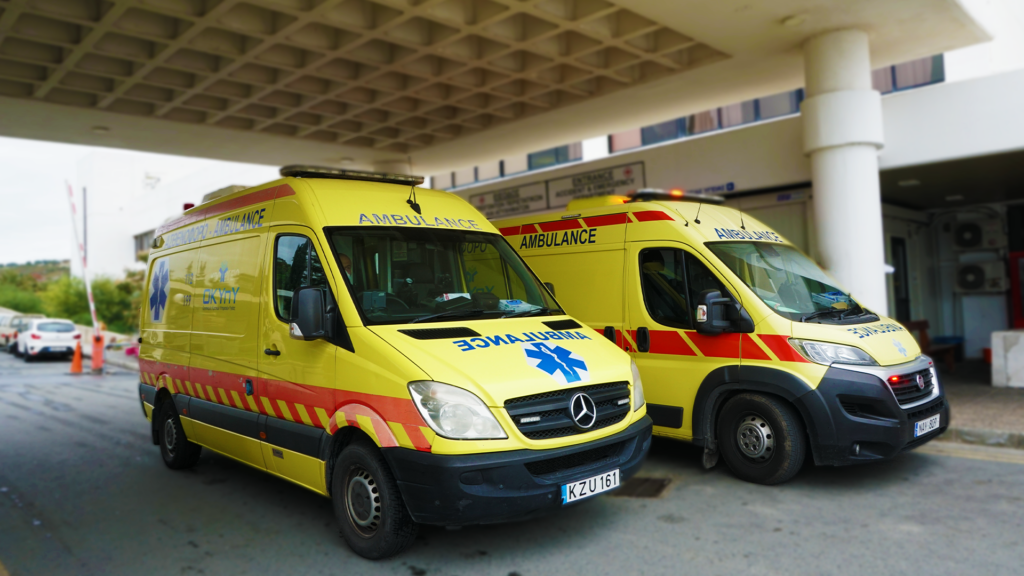
The “bill” for the millions of euros spent in recent years to upgrade the ambulance service will be ready by September OKYpY with the aim of claiming compensation from the state in view of its transfer to the under recommendation National Ambulance Agency.
At the same time, the Organization is called upon to shape its new operating framework after 2027, when it will itself take over the inpatient transport of patients, while, at the same time, it raises the question of financial autonomy, the fair compensation of public health services and the costs arising from on-call services, the maintenance of extra beds for security reasons of the local health system and the special status of seconded civil servants.
As he pointed out, speaking to “F”, the general financial director of OKYpY, Roberto Karahannas, before any discussion on the financial autonomy of public hospitals, it should be clarified what is the role they are asked to perform within the health system. “We must determine our requirements as a state and as a society from public hospitals and then clarify what we mean when we say we want autonomy,” he said.
First registration of costs and needs and then transport of the ambulances
“The Organization has invested several millions over the last six years to upgrade the service to meet the needs of Cypriot citizens with adequacy and quality.”
The Organization “will proceed in the next period of time to claim the investments it has made and the recording and costing which includes the specialized ambulancessystems, equipment, training and personnel to determine the size of the claim.’
At the same time, the Organization “must, from January 1, 2027, undertake the transport of patients between its hospitals to cover its own needs. And for this issue, a study is being done to record our needs.”
In this context “and once the two interrelated studies that are in progress are completed (costing and recording of needs), it will also be decided how the ambulance service will be transferred to the Ministry of Health”.
As Mr. Karahannas explained, “all scenarios will be examined on how to secure the ambulances, the necessary equipment, but also the necessary personnel with the aim of ensuring the smooth operation of the Organization after the creation of the National Ambulance Agency”.
He emphasized that OKYpY “recognizes the need for the operation of the National Agency”, but underlining that “the smooth operation of the Organization itself must be ensured at the same time”, which, as he said, “must be done smoothly and in cooperation with the Ministry of Health”.
The two studies are expected to be completed around the end of September.
Financial autonomy and role of OKYpY in the health system
Referring to the financial progress of the Organization, Mr. Karachannas underlined that OKYpY is working steadily towards financial autonomy. “It is easy to attempt economic autonomy while ignoring basic distortions that affect the functioning of the Organization and which OKYpY is trying to resolve through dialogue and documentation.”
As he explained, “the institutional role of OKYPY is to provide services both to beneficiaries of GeSY and to non-beneficiaries of GeSY, as well as public health services, and in this context it is in intensive dialogue with OAU for fairer compensation for the services it provides”. He noted, in fact, that “although in theory it could limit loss-making services to reduce deficits, as the private sector can easily do, this would negate the public nature of the Agency’s mission, as well as the universal access of patients to public hospitals.” As he characteristically stated, “unlike the private sector, OKYpY does not select cases, but accepts all patients, whether or not beds are available”.
This is also reflected in the statistics, since “while it has approximately 40% of the beds, it treats 75% of the country’s pathological and pulmonary cases, which mainly concern elderly patients, people with co-morbidities, chronic patients and cases of long hospitalization, as well as the very difficult, complex cases. The compensation the Agency receives is disproportionate to the actual cost of these services, as well as the key infrastructure it must maintain to provide them, which contributes significantly to the creation of operating deficits,” said Mr. Karahannas. And he explained: “OKYpY is obliged to maintain a sufficient number of beds even when they are not fully utilized in certain periods, as happens for example in the Famagusta Hospital, where the needs increase significantly during the summer months due to domestic or foreign tourism, while they decrease in the winter.”
Accordingly, “the Organization must maintain readiness for periods of infections, epidemics or pandemics in all hospitals, but without the relevant costs being compensated”. At the same time, “it is the only provider that maintains on-call services in all specialties and operates fully staffed clinics on a continuous basis, which means there are always doctors available.” Something like this is not done in the private sector and there is no demand from the private sector to do it.” Despite the fact, that is, he said, “that we have different requirements from public hospitals and we demand that a safety net be maintained for patients, the compensations from the OAU are not proportionate”.
Personnel issues and additional operating costs
The general financial director of OKYpY also made special reference to the issues concerning seconded civil servants, sick leaves and light work status, pointing out that unlike in the private sector, where such cases are covered by social insurance, at OKypY they burden the Organization itself with tens of millions of euros, both due to absences and overtime of staff called to cover the gaps.
As he stated, “these data are not taken into account in the pricing of the Organization by the state, which leads to a distorted picture of its financial results. It is unfair to present OKYpY as a deficit organization, when the reasons for the deficits are known. Only if all these parameters are taken into account can correct decisions be made for the future of the Organization and its true financial picture be captured”.
At the same time, he reminded that an action plan is in progress based, among other things, on the axes of increasing revenues and reducing expenses and is being implemented through agreements.
He stated that the Ministry of Health treats the Organization’s positions positively and that “an agreement has already been reached for public health services, which is in the legal and technical control stage. There is also a positive response from the OAU, to which documented evidence has been submitted for the relevant claims of the Organization and a continuation of the dialogue is expected”.
As far as the Ministry of Finance is concerned, “there are difficulties mainly in matters concerning the status of employees”, however expressing the assessment that solutions will be found.
As far as the upgrading of public hospitals is concerned, apart from the accreditation, tens of millions of projects are underway in all the hospitals. “With the completion of the Organization’s action plan, the goal is to become the first choice for the Cypriot patient and when this is done, then OKYpY will definitely become autonomous.”