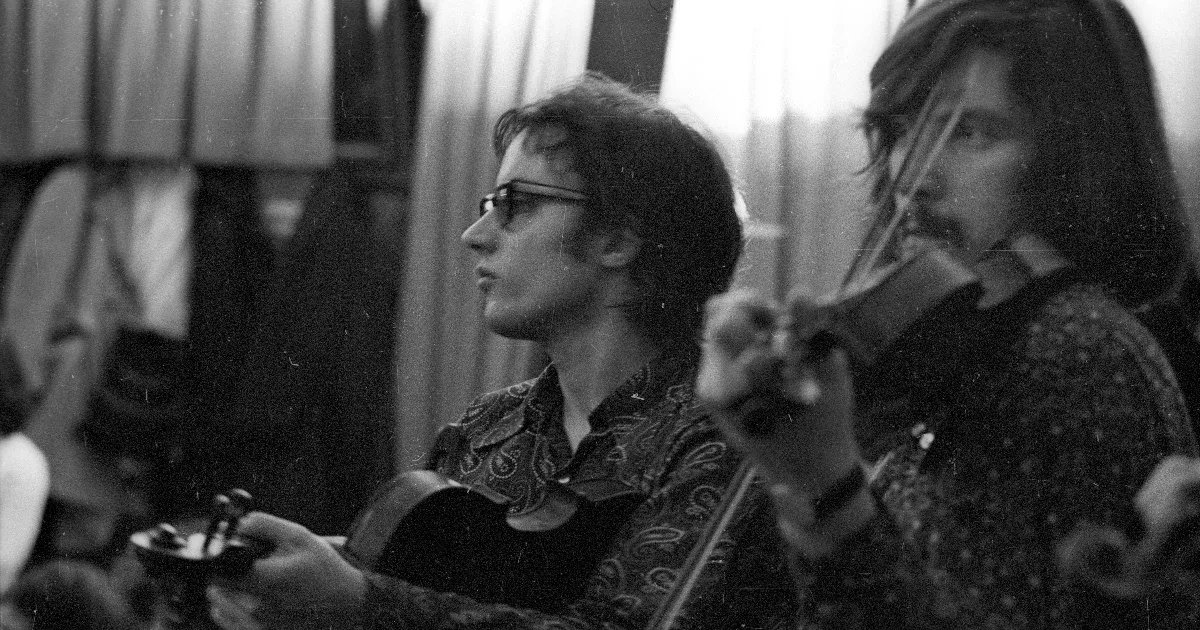
Not even 24 hours had passed since the Primate rounded off the final note at this year’s Dance Hall Meeting, the dancers hugged each other when Ferenc Sebő passed away. I think he waited until everyone got home safely, and then sat down next to Béla Halmos to counter the edge of the cloud.
I was born in 1977, from my childhood television memories I remember a guy in a yellow leotard, singing among high school students, whose trapeze pants were stronger than his glasses. This is how I met Seb for the first time as a music composer. He was one of the few who set the melody to the poems of Sándor Weöres, Attila József, and László Nagy. Poems are the essence of life put into words, and they become even more re-experienced and re-experienced through music. And what is perhaps even more important: memorable and passable. Perhaps this transferability is the link between the poem set to music and folk music. And the key to Ferenc Sebő’s track.
In many interviews, he told how he came into contact with folk music. Together with Béla Halmos, they participated in a construction camp where they excavated the ruins of Aquincum as members of an international team. In the evening, next to the campfire, the guitar was brought out and someone from each nation played and sang their own music. Bulgarians, Russians, Slovaks, Poles, Serbs from the countries of the socialist camp at the time. When it came to Sebőés, they realized that they didn’t know much to show. Although at that time there was already a lot of folk music collected, recordings by Bartók, Kodály, Lajtha, the phonograph cylinders were resting somewhere, folk music was no longer very alive, and concretely dead in an urban environment. Sebo and Halmos did not let the matter rest. The music recorded in the five-line system, the recordings of the songs, on the other hand, only raised more questions. There were no records of the way folk music was played. I was missing the flavor, the flavor that makes music, even dance music, out of a series of sounds at different frequencies.
Practice makes perfect
This was followed by the realization that these types of music can still be heard live in Transylvania, in this region that has been closed off forever and thus preserves its traditions. You can learn this instrumental game at the last second. How the double bass or cello gives the pulsation with a short string, what chords are played on the three-stringed viola, what the violin or violins play. It is decorated differently in prime Kalotaszeg than anywhere else. Then, of course, it happened again that someone thought they saw something shiny through the peep hole in the door, and after entering and in the light of the lamp, they found themselves in a treasure trove.
I don’t know if Ferenc Sebő was upset that folk art and folk music robbed him of his career as an architect. I don’t think so. The dance hall movement is not the only one to his credit, but perhaps it is not an exaggeration to say that his name is the first thing that comes to mind. This year’s Dance House Meeting was the forty-fifth, it took place with two thousand participants, over three days, and fifteen thousand people danced, played music, and had fun. 1972 is usually mentioned when it all started.
My parents’ generation is sick. As a private, my father sat on one of the tanks going to Czechoslovakia. They listened to Rolling Stones, Joplin, Zepp, Hendrix. If you look through the discolored paper pictures and slides of Western hippies, you will see embroidered vests, trapeze pants, and Indian leather jackets. The folk influence on the entire beat generation is clear. When the Sebős return from Transylvania, they don’t just smuggle music through tapes and into their ears and fingers. They have a woven satchel on their shoulders, a kislajbi, they have dirt on them, and a hat on their head. Before it was cool. In America, young people rebelled against the hypocritical petty bourgeoisie, against the faceless, arrogant, super-capitalist state machine that sent them into a senseless war. At home, even the hypocritical petty bourgeoisie could not be created (although there might have been a demand for it), because we were building socialism. The Sebős may have rebelled, but in his reminiscences he usually cuts this short.
According to the legend surrounding the first dance hall organized in the Writers’ Shop, the state defense tried to interrupt it and round up everyone. According to Sebő, there was indeed someone there from the warding off, but he slept through the whole thing under the piano. The authorities didn’t really know what to do with this whole folk music thing, but everything was suspicious and dangerous for them, where the youth gathered spontaneously and had a good time. They don’t shake themselves like a neurotic to the sound of distorted guitars, they just spin around on the dance floor and sing about pigeons, flowers and love.
They don’t party until then!
However, dance halls became regular, which is particularly important because there is no folk music without dance, and vice versa. One makes sense with the other. The music used in folk music, the dance movements often provide the key to it, and the Bartókés did not write this down next to the sheet music. The gestures of the dancers seen in the archival, silent film recordings did not fall into place without the music. The Bihari ensemble initially rehearsed with a piano accompaniment. You can imagine the exploding euphoria when the two groups, the folk musicians and dancers, finally found each other.
Táncháztalokzók are staples on the shelves of those who collect Hungarian folk music on CD recordings. The Sebő ensemble appears on the first four records, and later others were given the opportunity. More and more people played better and better folk music. As dance halls developed into a movement, more and more bands were formed, and they even slowly began to specialize in landscape units. Hungarian folk music has proven that it is not just a fad that loses its power and just passes away. There’s a good chance there’s someone sitting by today’s campfire who knows “Where were you last night, titbird?” or something else.
Music can and should be written for every poem. Sebő expressed this idea many times. If the rebellion has already been mentioned, I think we can find it in the artist who made Attila József and László Nagy hum. But what kind of rebellion is it if, at the same time, Balassi also accompanies stanzas on a reel? The power of all times can never have anything to do with free thought, the spirit. A spontaneously spoken word cannot be put back into a person, but it cannot be taken out of the other’s ear either. Uncle Fodor “Neti” Sanyi, Primate of Kalotaszeg, tells the story of György Szomjas in his moviethat in Romania at the balls, late, when everyone had a lot of pálinka – also in the sekuses – it happened several times that the Hungarian Anthemwrapped in t verbunkos.
I would like to believe that this was enough for Sebo. He did not build a monument of himself later either, rather he was a midwife at the birth of the House of Traditions. It is an often-spoken cliché that someone stays with us forever, but this is really true for Ferenc Sebő. There are traces of his feet after every dance in the barn, on the board. It is there in the resin stuck to the violin, in the lime on the wall behind the horse. In the first breath before every song.
“Just tell me, my rose, which way you’re going,
I will plow it with my cute plow,
Bé also casts it with a single pearl,
I will rake it with my thick tears.”
(Szekler folk song)