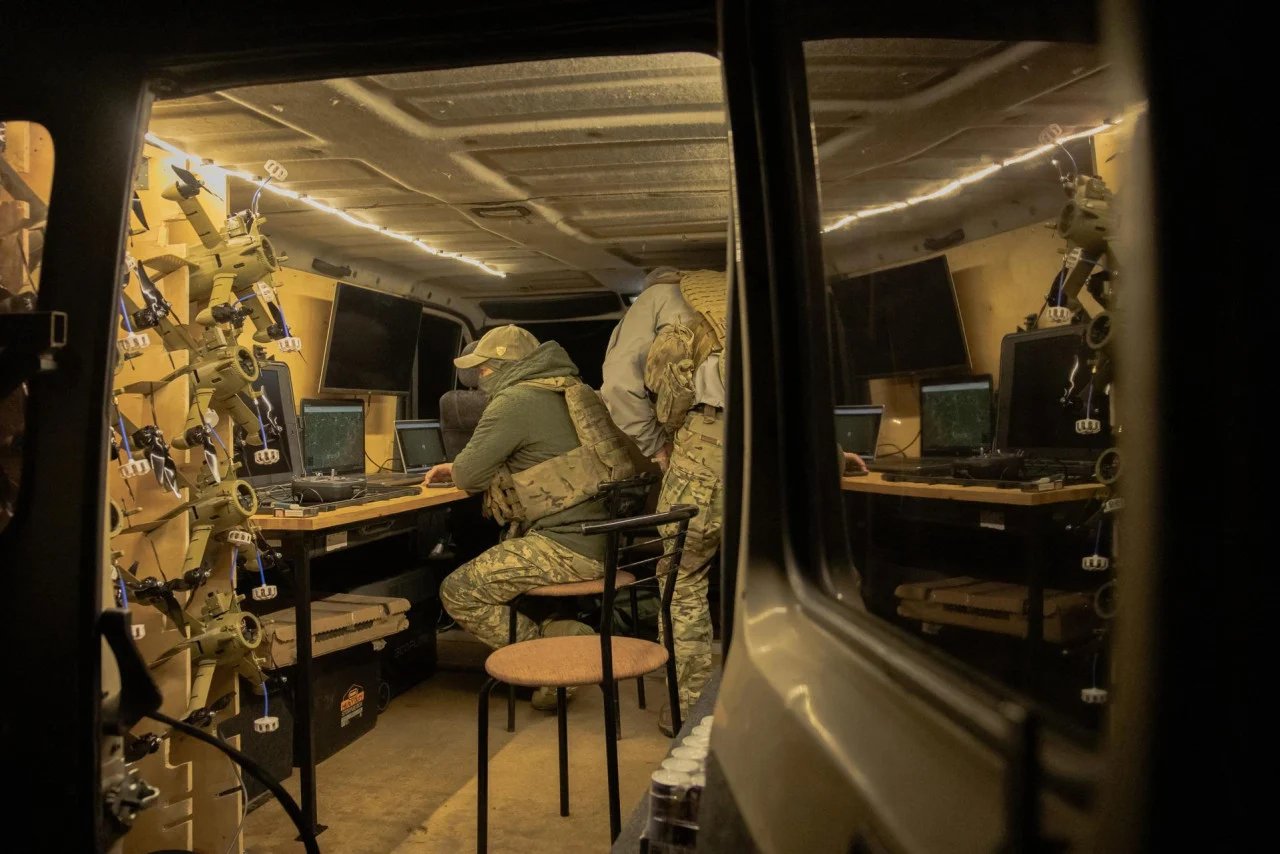
Ukrainian forces, relying on drones as their main offensive platform, claim to be killing more Russian soldiers today than ever before in the history of modern warfare – but the Kremlin, led by Vladimir Putin, shows no sign of letting up. In a recent address, Robert Brovdi Magjar, commander of the Ukrainian Army’s Unmanned Systems Forces, described the war as entering a new phase: from small rooms filled with monitors, drone operators are daily sending explosive craft at Russian positions, vehicles and trenches, turning the front into a deadly aerial matrix. According to him, only one such unit allegedly “confirmed the elimination” of about 85,000 Russian soldiers in ten months – a number that would make up the inhabitants of a large city in peace.
Brovdi emphasized that “the most massive killing of the enemy in the history of mankind” is taking place right in the room where his men operate the drones. In this new model of warfare, pieces of metal and plastic worth $300 to $500 are turned into weapons that hit tanks, fortified positions and columns of soldiers, with the Ukrainian military estimating that more Russian soldiers have been killed by drones in recent months than Moscow can mobilize and send to the front. The Ukrainian side sees this as a historical watershed moment: technology has, at least temporarily, given an advantage to the defender who can remotely inflict massive losses on the aggressor at relatively little cost.
However, despite such a balance sheet, the Russian leadership is not giving in. Putin continues to send new contingents of mobilized soldiers, fresh recruits and reservists, trying to make up for the technological gap and tactical losses in numbers. On the Russian side, the front is relying more and more on “cannon fodder” – soldiers who take on the impact of drones, artillery and rocket systems in trenches and assaults, while the propaganda in the background speaks of “holy war” and defense of the homeland. Every new air attack, every Ukrainian announcement about the destroyed Russian convoy, is amortized in the Russian public with a controlled media narrative, so the regime’s resilience depends not only on real losses, but also on the ability to hide or justify them.
For Ukrainians, drones have become a symbol of adaptability and desperate courage. Without enough classic aviation and with a limited amount of armored technology, Kiev has shifted the war to a domain where it can compete – in the air low above the trenches, where a small FPV drone, guided by an experienced operator, finds a vulnerable point on a tank turret or cover behind which infantry is hiding. Such warfare also means a different frontline psychology: Russian soldiers are no longer afraid only of shells, but also of the quiet buzzing overhead, knowing that at any moment an explosive aircraft may land from the fog or smoke.
However, numbers alone do not stop war. Putin’s regime, relying on a repressive apparatus, prisons and information control, shows a high tolerance for losses, especially when they pile up far from Moscow and St. Petersburg, in the poorer regions where most of the mobilized come from. This is precisely why the fact that Ukraine, according to its own estimates, kills more Russian soldiers for months than Russia manages to mobilize, does not mean that the Kremlin will automatically seek peace – instead, the regime deepens its war rhetoric, seeks new mobilization reserves and relies on the belief that time and Western fatigue will eventually break Ukrainian resistance.
The result is a chilling dynamic: the more precise and effective Ukrainian technology is at destroying Russian forces, the more Putin is determined to show that he will not back down even at the cost of tens or hundreds of thousands of dead. Brovdi therefore describes his “best exchange rate in the world” – a cheap drone for the life of an enemy soldier – with a touch of dark cynicism: in this war, the price of every metal and plastic is counted in human lives, and the only question that remains open is how many more such waves Russia will be able to withstand before political reality catches up with the Kremlin’s war rhetoric.
And in the Kremlin, the heart of Russian power, they are also very angry with their military leaders. But it is difficult in this era of “AI warfare” to give a military response to resourceful young people from Ukraine who are not opponents on the front line, but somewhere far behind the screen…
But to conclude, this war is really sad when so many young people from one side and the other die in a crazy fight. A war that does not even move the front line, is fought just for the sake of war.