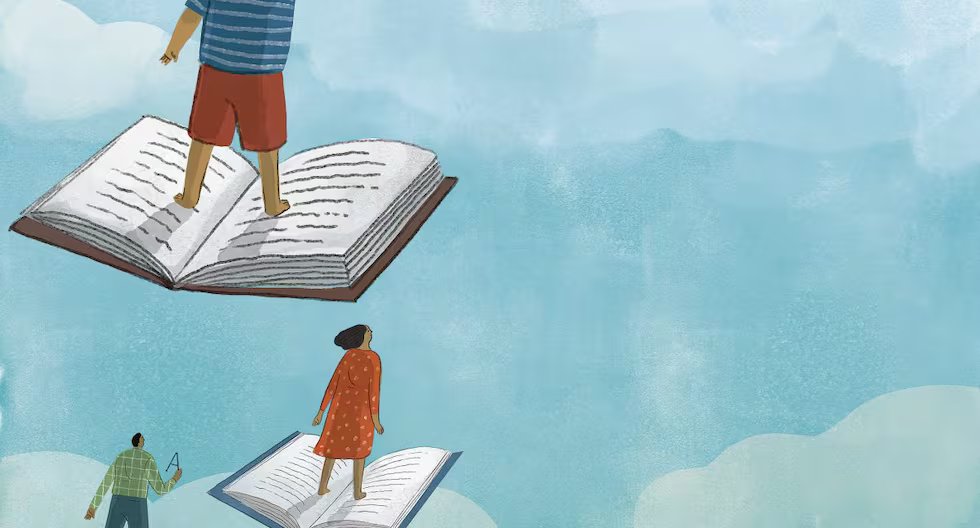

I have learned to read for the second time. Through the eyes of my son, I have relived that amazement at the intact mystery of the letters, the effort of deciphering, the slow and stammering task of milking their meaning from the words. My lips began to syllable again while his tongue unraveled the sounds hidden in the signs. It is not an easy task to snatch the pages from silence. As a child I was not aware, but now I have been fascinated by the strange, synesthetic and mestizo operation that involves teaching the eyes to listen.
A text is the score of language; the words, written air. Right now, with your gaze, you extract quiet music from these paragraphs. The alphabet is a beautiful invention to preserve the trace of thought, also to communicate at a distance. But it is not the only way to make messages travel. Our ancestors found other ways to cross the horizon with their phrases. This is how they devised the language of smoke or the rhythmic language of the drums. In “The Oresteia”, Aeschylus describes how Agamemnon sends news from Troy to Greece through a row of bonfires that the watchers light successively from their guard posts, from tower to tower and from mountain to mountain, like a fiery telegraph. The Incas transmitted stories and orders through knots on their quipus, speaking with the thickness of the fringes, the colors and the ties. We have always been passionate about plots, the warp and the outcome of stories.
Recently the writer Juan Camilo Rincón discovered to me an amazing method of communication created by Colombian slaves. After a rebellion and long struggles, the governor of Cartagena de Indias recognized the freedom of San Basilio de Palenque. Secret routes emerged to escape to that city, where, after a dangerous adventure, the end of servitude awaited. Those black women invented a code to memorize the itinerary: they braided their hair in the shape of a map. In that network of hairstyles that outlined the steps and pathways, their heads carried, without anyone suspecting it, the dream of an escape, the cartography of a new life.
Over the millennia we have been able to write with smoke, strings, hair; even –surprisingly– with the eyes. Using sequences of dots and dashes, Samuel Morse created an electrical system almost two centuries ago to challenge long distances. Because its signals are so simple – short and long – Morse code can also be used with sounds, lights or flashing gestures.
In 1966, an American pilot prisoner of war in Vietnam was forced to record a television interview. As he recited the speech dictated by his captors in front of the camera, he blinked the word “torture” in Morse. In an unexpected communicative pirouette, his face was able to send two messages at the same time and thus managed to narrate all the sides of his story.
We are intertwined beings, we make tapestries of words, we are knotted by the threads of language. From the moment we are born we send signals with our hands, the arch of our eyebrows, our hesitations. Therefore, when someone is transparent, when their gaze and gesture clearly reflect what they feel, we say that they are an open book. Mysterious writings reveal our history: the grooves of wrinkles and the incisions of time, like the rings of trees; the scars; the calligraphy of motherhood; tattoo illustrations; highlighting dark circles; the smudges of the bruises. In the film “The Pillow Book”, by Peter Greenaway, a young writer receives a letter from an editor reproaching her that her verses are not worth the paper on which they are written. From then on, she wrote her poems with exquisite skill in the skin of her lovers, creating carnal books that earned her enormous success. I look at my son engrossed in his reading and try to read his hands clinging to the book, his eyes walking along the lines, his lips drawing syllables in the air. Our bodies are page, atlas and score: they narrate what is not written.