Loading Text-to-Speech…
It was perhaps inevitable that when the Tim Cook announced his retirement after 15 years as its CEO Appleo Donald Trump he would immediately attempt to appropriate his achievements. The US president may have acknowledged that Cook was “an incredible guy” with “an amazing career, almost unparalleled,” but hinted he wouldn’t be as successful if he hadn’t “licked me” (if he hadn’t “kiss(ed) my ass”) at critical moments in Apple’s course. Indeed, reading Trump’s post, one might conclude that “licking” Trump was one of Cook’s most valuable skills.
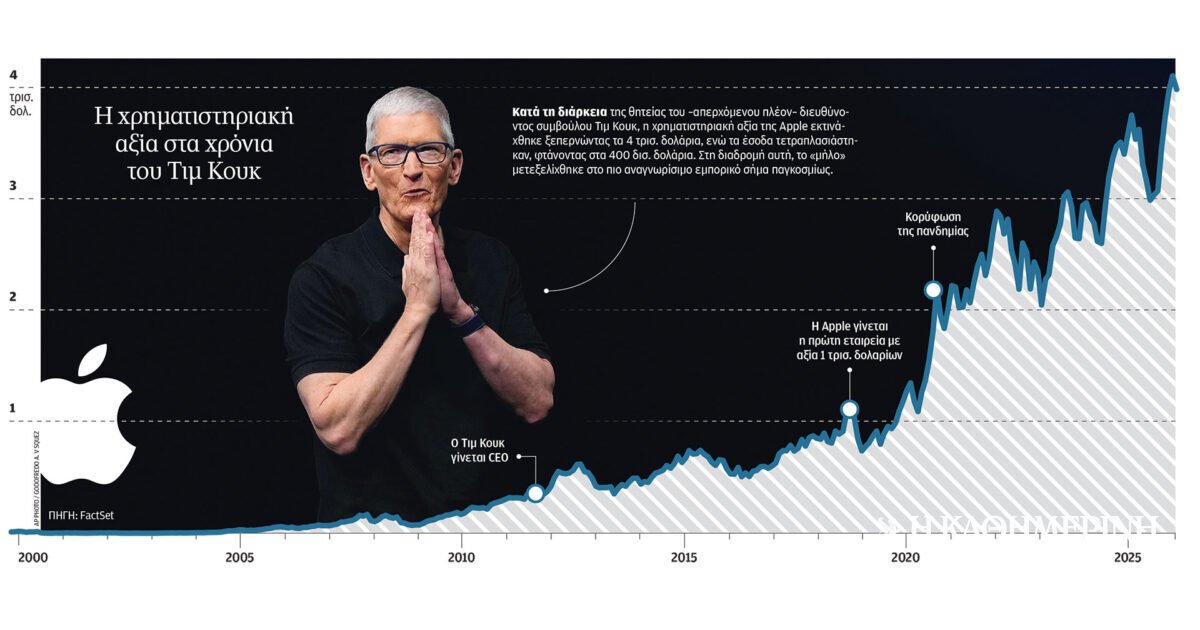
In fact, deft handling of politics – both in the US and in China, where under his leadership Apple moved most of its production – was just one of the traits that made him a great businessman. During his days, Apple’s market value soared from $1 trillion. dollars to 4 trillion dollars and revenues quadrupled to $400 billion, and that’s without the help of some revolutionary new products.

Cook capitalized on his predecessor’s innovations, Steve Jobs –notably the iPhone–, and developed them further, including through the creation of the most sophisticated supply chain in the world, spanning more than 100 countries. In the process, he turned Apple into the world’s most recognizable brand – the quintessential symbol of American technological excellence.

The comparison with Europe
It is precisely this supremacy that should concern Europeans. It’s not just that Europe hasn’t produced any company in the last 50 years—since Jobs started Apple out of his parents’ garage in Palo Alto—that comes close to its achievements or those of other American tech giants. The Euro Stoxx 50 index of top European companies includes just three founded in the last 50 years, of which only ASML – a supplier of semiconductor manufacturing equipment – is a technology company; by contrast, all of the US “Magnificent 10” leading the artificial intelligence revolution are in this category. Europe has no company with a valuation of more than 1 trillion. dollars; the US has ten. ASML, Europe’s most valuable company, has a market value of just over €479 billion.
The greater concern is that, at a time of escalating geopolitical tensions, in which Europe seems to be under increasing pressure from both east and west, technological superiority also translates into brute power. Europe’s dependence on American technology has become a key vulnerability, as recent events have shown.
Last year, the attorney general and other officials at the International Criminal Court found themselves blocked from email services, information systems and bank accounts after the US imposed individual sanctions against them for their role in investigating allegations of Israeli war crimes. US officials are also reported to have threatened delegations to the International Maritime Organization with similar measures ahead of a crucial vote last year.
And it’s not just people who are at risk. European policymakers are increasingly concerned that the US could order companies to deny entire countries access to critical systems. A new report by the Future of Technology Institute, a Brussels-based think tank, warned that most European countries, whose defense services rely on US cloud services, are vulnerable to a “kill switch”. Greece was classified as “medium risk”. Meanwhile, Amazon, Microsoft and Google account for more than 70% of the European enterprise cloud market, while more than 80% of enterprise IT spending in Europe goes to US vendors.
The cost of the “emancipation” is estimated at 35 trillion. dollars and the time horizon in decades – and that’s assuming Europe can develop an Apple of its own, something it has shown no ability to do.
Technological superiority also gives the US more sophisticated sources of power. At last year’s Delphi Economic Forum I moderated a discussion on the role culture can play in defending European values against the threat of “cultural flattening” by illiberal, oligarchic regimes such as those of Vladimir Putin and Trump. There was broad agreement on the unifying power of culture – but also concern that much of the channels through which Europeans today access culture, from social media to streaming services, and the algorithms that shape them, are controlled by US companies, including Apple. And this is also a vulnerability.
“European pyramid”
Some governments are already taking steps to promote technological dominance. France, for example, plans to replace American video conferencing services such as Zoom and Microsoft Teams with domestic solutions by the end of the year. Others argue that Europeans should prioritize the development of a “European pyramid” covering everything from chips to data centers, communications and energy infrastructure. However, this looks more like fantasy, at least in the short to medium term. One estimate puts the cost at 35 trillion. dollars and the time horizon in decades – and that’s assuming Europe can develop an Apple of its own, something it has shown no ability to do.

Nevertheless, Europeans urgently need to identify their technological vulnerabilities and consider how they can mitigate them. The European Council has asked the Commission to draw up a technological sovereignty package ahead of its next meeting in May. However, any action by the Europeans to reduce their dependence on American technology is bound to meet with an American backlash. Indeed, tech regulation has already emerged as one of the key fronts in the emerging “culture” clash between Europe and America – something underscored by the presence of Cook and other tech executives in the front row at Trump’s inauguration last year.
However, this is a “war” that Europeans cannot afford to lose. Cook runs the most admired company in the world, but he still had to please Trump. Europe, without an Apple, will struggle to avoid the same fate.
*Mr Simon Nixon is a freelance commentator and editor of the Wealth of Nations newsletter at Substack.