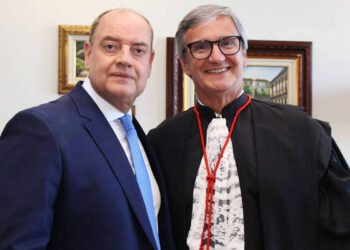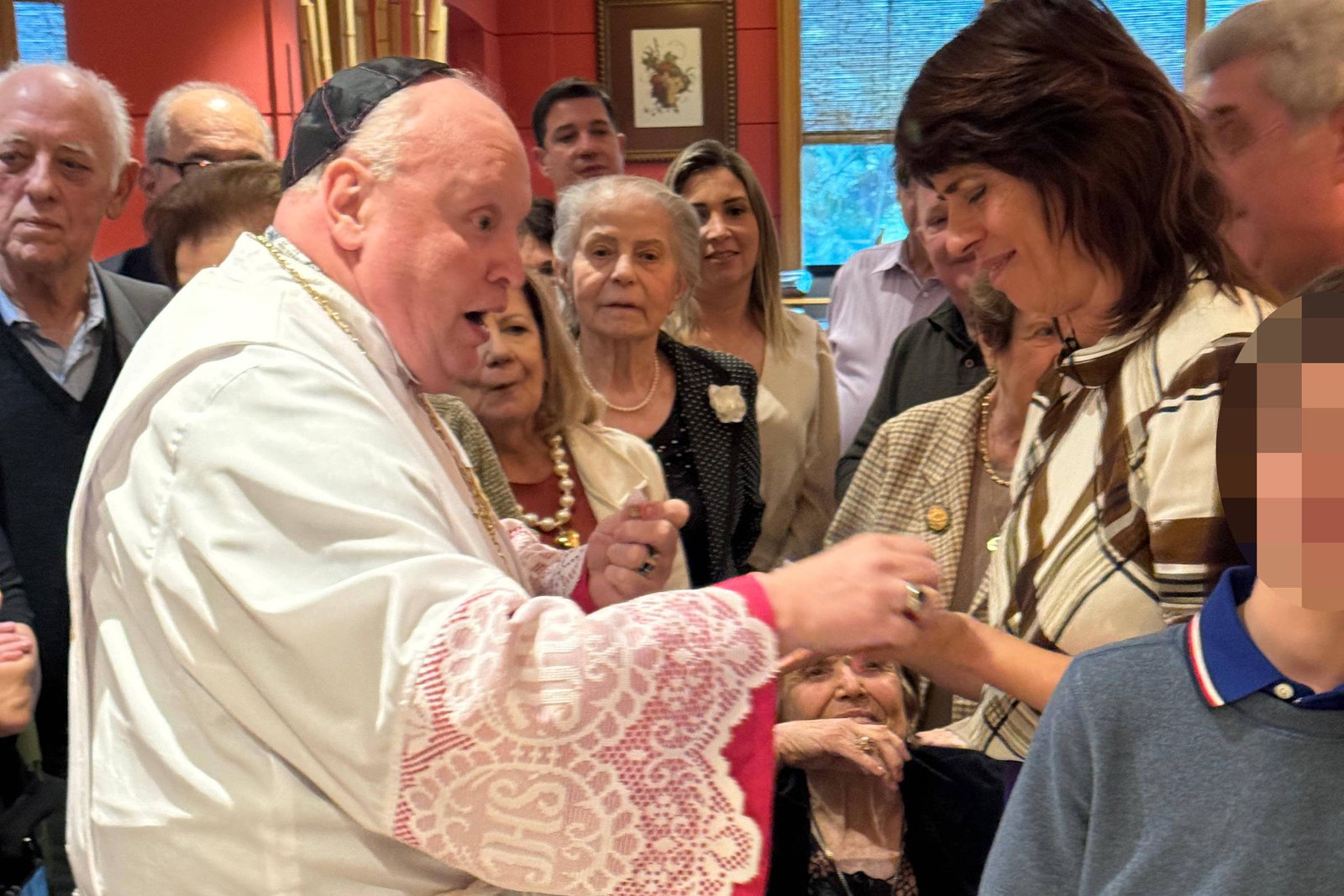
For more than a decade, Monsignor Marcos attended the house, distributed blessings and participated in important rites of the Stecca and other traditional Catholic families in São Paulo.
“He has a wonderful oratory. He ordered my mother’s body with beautiful words”, recalls the artist Elisa Steccaabout the religious’s presence at the matriarch’s wake on July 30, 2024.
The priest deprived everyone of their appreciation and trust and relied on financial support to maintain a children’s home. However, the man who presented himself dressed as a priest Catholic He was an impostor, according to his family.
The discovery came after her mother’s death, when Elisa made a “generous” cash donation to the orphanage that the priest said he ran, in addition to contributing baskets of Christmas and gifts for children.
“He would always ask me for financial help to buy medicine or replace burnt-out fans in the house”, says Elisa, who keeps bank statements, such as a transfer worth R$5,200.
She began to suspect something was wrong when she asked to visit the children’s shelter. “He said the children were protected by the state and could not be visited.”
The denial raised an alarm and made the artist look for her godmother, Benedita de Almeida Bego, who had introduced the monsignor to the family, where he was always treated with the deference due to the title of honor granted by the Pope for special merits.
Faced with the CNPJ requirement and the address of the child care institution, the supposed monsignor informed that he had left the house’s management due to health problems to undergo treatment in Minas Gerais.
Elisa spoke to her godmother again, also suspicious of the fact that the monsignor had chosen a hotel to celebrate 25 years of priesthood.
“I don’t like this at all. Did we just push the guy and he’s going to Minas?”, asked the artist. “I began to fear that there was some kind of child exploitation with the children who appeared in the photos he sent us.”
Internet searches revealed the criminal record of Marcos Rodrigues Fontana, 65. On October 8, 2009, the newspaper “Agora” published the news on its police pages: “Fake priest accused of charging to pray in five cemeteries”.
According to the report, the 48-year-old man charged up to R$500 to celebrate seventh-day masses and was the target of three investigations.
A housewife reported having been approached by Marcos Fontana at her husband’s wake in Araçá Cemeterywhen he saw the priest collect R$240 from his children and offered to celebrate the seventh-day mass for R$450. “He said that R$200 would go to the children (at a daycare center) and another R$250 would go towards renting the chapel.”
The worst thing is for a person to manipulate what is most sacred to us, which is our desire to be good, in addition to using the name of God
When pulling the thread, the widow Benedita confronted the supposed religious man, exchanging messages and audios via WhatsApp. Faced with the evidence, he ended up confessing that the orphanage had never existed and said it belonged to the Old Catholic Church.
It is an independent Catholic movement not recognized by the Vatican, arising from a dissent from the Roman Church, starting in 1870. In protest at the First Vatican Council, the elders reject dogmas such as papal infallibility, seeking to return to the foundations of the “old” church.
“I suffered persecution from some ministers of the Roman Church and then the newspapers increased their number and invented many things”, wrote Marcos to the lady he called a second mother.
He appears in a YouTube video celebrating 20 years of priesthood at the Santo Antônio Parish, headquarters of the Order of Saint Andrew, in Vila Clara, in São Paulo. “Then I’m not a false priest,” he said to Benedita. His ordination would have been on February 26, 2000.
By means of a note, the Archdiocese of São Paulo informs that “the aforementioned gentleman is not a priest of the archdiocese, nor was he ordained a priest in the Roman Catholic Apostolic Churchtherefore not having any link or authorization to act on behalf of the Church”.
And it advises the faithful to always check the origin of people or initiatives that present themselves as linked to the church, especially in cases of requesting donations.
Dom Diego Pereira, primate archbishop of the Old Catholic Church in Brazil, also informs that “after checking the name of the person in question I can say that I have never heard of him”. “Our Church has only one priest in the State of São Paulo and he also does not have this name. I deeply regret the citizen’s attitude.”
Father Jonas, from Vétero Católica in São Paulo, also does not know any Monsignor Marcos. “The gentleman mentioned is not part of our church.”
It was then that Benedita, a fervent Catholic, took it upon herself to formally report him to the police, the Archdiocese of São Paulo and the Public Ministry.
“Monsignor participated in several masses at the Gethsemani cemetery in memory of my husband, family meetings and religious acts of which I doubt the legitimacy and lawfulness”, reported Benedita when registering the police report on March 24.
The case is under investigation at the 36th Police District, in the process of hearing witnesses.
“I lived with him for 14 years, treating him with the greatest respect due to his status as a priest. Unfortunately, I discovered his falsehoods which revealed his lies regarding the exercise of his priestly role and the maintenance of the orphanage that claimed to welcome children sent by the judiciary”, denounced the widow, asking for measures to ensure that there are no new victims.
Marcos’s history reveals a recurrence in the use of religious titles. In 2009, he was convicted in the first instance of embezzlement after holding illegal funeral celebrations in the traditional Araçá Cemetery, wearing priestly vestments without belonging to any official order of the Roman Catholic Church.
In 2013, the final decision was made, in which the initially foreseen three-year prison sentence was replaced by community service and a fine.
Wanted by Sheet at the address where he received donations for the children’s shelter in the center of São Paulo, the supposed monsignor received the report at the entrance of the building and said he would not give an interview. “My lawyer advised me to only speak in court.”
Neighbors are witnesses to the many donations that used to arrive at the building on festive occasions. A nearby businessman says that “that priest” is a problem, reporting that about three years ago he was stabbed in his apartment by a boy.
The new victims of the false priest hope that this time the reports will help other believers not to fall for similar scams. “Due to the disappointment of discovering that our orphanage didn’t exist, I did what I thought was necessary in my conscience”, says Benedita.
The widow placed photos, bank receipts and other evidence in a folder. “I shelved everything. Just like I did in my heart. Forgiving has been very difficult because of the trust I placed in this gentleman. It was a very deep disappointment”, he concludes. “If men do not do justice, God will.”
His goddaughter Elisa states that she decided to speak publicly about the case to prevent this type of manipulation through faith from happening again.
“Every time I made donations in my mother’s name and myself, I did so with a lot of gratitude in my heart for the opportunity to be able to help,” she says. “The worst thing is for a person to manipulate what is most sacred to us, which is our desire to be good, in addition to using the name of God.”