A war in the Middle East probably was not what Canada’s Prime Minister Mark Carney had in mind in Davos earlier in 2026, when he made a pitch for the world’s so-called middle powers to join together in a world defined by increasingly aggressive military juggernauts.
Nevertheless, his theory is being simultaneously proven and tested in the Persian Gulf. For there can be few clearer examples of the need for what Mr Carney proposed – and the obstacles to achieving it – than the predicament of the Gulf states, and Saudi Arabia in particular, as they try to navigate a conflict they did not choose and cannot control.
It is something US President Donald Trump and his aides should think hard about before responding to Iran’s multi-phased ceasefire proposal, which arguably represents the worst of all possible worlds for America’s Gulf allies – other than the alternative.
There was a time when the House of Saud was as enthusiastic as Israel to prod the US into military action against Iran’s nuclear programme – to “cut off the head of the snake”, as the late King Abdullah Abdulaziz put it in 2008. But that was before the kingdom made a huge bet on economic diversification that demands stability to succeed; before the unashamed Israeli expansionism that followed Hamas’ Oct 7 terrorist assault; and before Mr Trump prioritised Israeli security interests over those of his Gulf Arab allies by starting this war.
With the conflict under way, Riyadh now finds itself a victim, with multiple conflicting – and potentially existential – interests to protect and few means to do so.
On one side, Saudi Arabia has a clear interest in preventing the war’s further escalation. Iran has said it will respond to any attacks on its energy and water desalination infrastructure (which Mr Trump has threatened) by destroying those of the Gulf states. The Saudis, even more dependent on freshwater plants than oil, can afford neither.
They are also well aware that Yemen’s Houthi militia, which until now has largely kept out of the war, will likely join in if it sees a US effort to out-and-out crush Iran’s Islamic republic, its primary arms supplier. The Houthis have shown before that they have the ability to close the Bab el-Mandeb Strait, gateway to both the Suez Canal and Saudi Arabia’s Red Sea port of Yanbu.
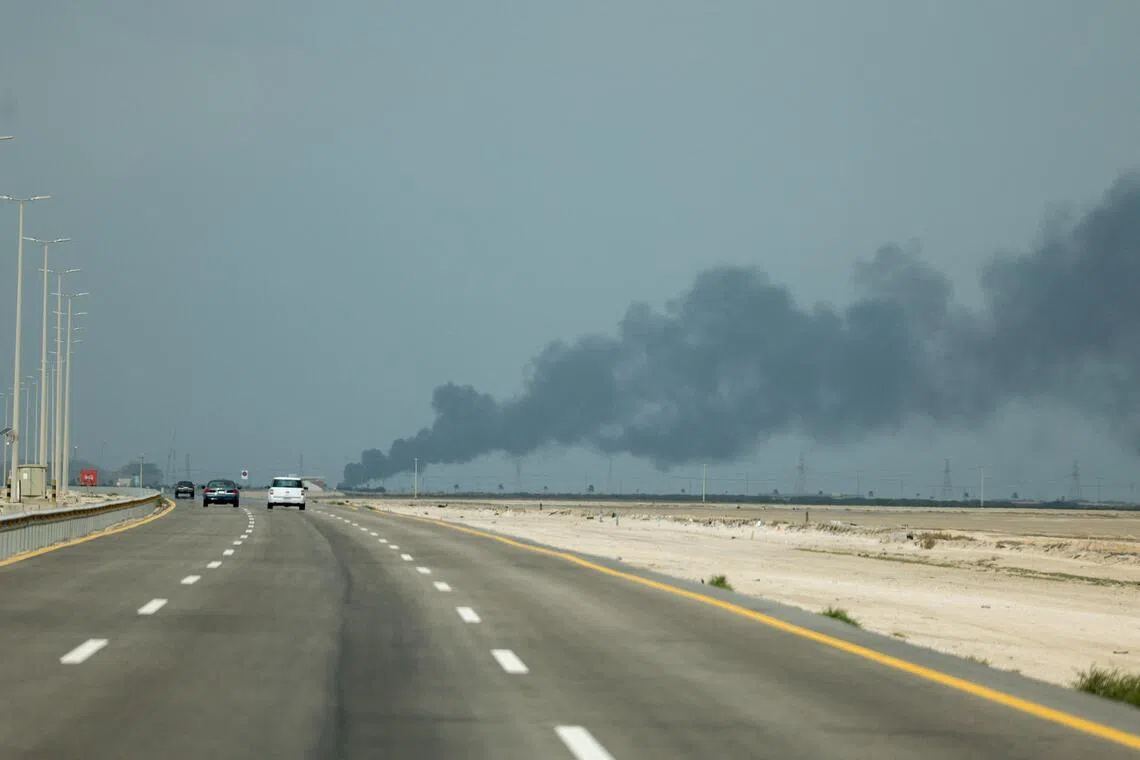
That was not so worrying for Riyadh before the war, but Yanbu is now the transshipment terminal for a 1,200km oil pipeline the Saudis are using to circumvent the blockaded Strait of Hormuz.
Closing Bab el-Mandeb would effectively halt the workaround that has allowed Saudi Arabia to continue exporting up to seven million barrels of oil per day, thus supplying its own budget and the global energy market. It would also end the Houthis’ 2022 ceasefire agreement with Riyadh, which is something both want to avoid.
At the same time, though, Riyadh also cannot afford an unstable ceasefire that leaves a wounded, yet still dangerous, Iranian regime in power and unbound by a strong permanent settlement. The Islamic republic that would create would be more militarised, more consolidated and more motivated to build a nuclear weapon, whatever deal is struck – and with far more leverage over its Gulf state rivals through de facto control over the Strait of Hormuz than was the case before the war.
Still less does Saudi Arabia want a situation in which that unstable ceasefire is disrupted from time to time as Israel decides to “mow the lawn”, triggering a new round of retaliation against the Gulf states, whenever it feels the Iranians have rebuilt too much of their nuclear or ballistic missile capabilities. Investors would flee the kingdom. Crown Prince Mohammed bin Salman’s Vision 2030 economic development plans, already under strain, would become unachievable.
The wider danger here is that Saudi Arabia emerges into a new post-war reality in which it becomes a bit player, tossed around by the actions of others in a new regional security order forged by Israel and Tehran, with the US, China and Russia weighing in from afar. It is a measure of this war’s folly that both of Mr Trump’s possible next steps – to resume the war or negotiate a weak and unstable peace – will significantly damage core US allies, an outcome that is likely to have a long geopolitical tail as they reassess their security interests.
Even before the war, Riyadh had been looking for hedges against its over-dependence on an increasingly unreliable US guarantor. Those included a thaw in relations with Tehran, as well as closer ties to China – though both were limited in what they could realistically achieve.

So, Saudi Arabia looked to the region’s other middle powers. It has been reconciling with Turkey, once a bitter rival, since 2022. It signed a military accord with Pakistan in 2025. Adding Egypt, a longstanding ally, these relationships have developed into a kind of quad partnership that operates outside Washington’s direct orbit.
The four were pursuing common interests in the Horn of Africa before Feb 28, and with Pakistan taking the lead, they have now sought a mediating role in the US-Israeli conflict with Iran.
Whether the group can assert itself sufficiently to give Saudi Arabia the lost geopolitical agency it wants is an open question. The limits of its influence over such powerful military players as the US, Israel and Iran are now on cruel display. It underscores both the need for new options that Mr Carney’s middle-power theory identifies and the reason for which it may not offer effective answers.
Disunity and the relative weakness of the coalition’s constituent parts rank high among those hurdles. The United Arab Emirates (UAE), for example, should be another natural Saudi partner, but it is more tightly allied to Israel and before the war had been pursuing an active rivalry with Saudi Arabia and its “quad”.
The UAE is less keen than the Saudis on seeing a weak, mediated deal with Iran, and more ready to endure escalation in the hope of forcing regime change in Tehran. Europe offers other natural middle-power partners for the Saudis, yet the Europeans are struggling to rearm even themselves.
President Trump went to war ignoring the advice and interests of his Gulf Arab allies. It is not clear why resuming and escalating the conflict would deliver on regime change when it has failed to do so until now. Nor, as Iran’s willingness to snub a second round of talks with the US and submit its own package of demands shows, does Mr Trump, contrary to his claims, hold all the cards.
This war was a gamble that Mr Trump made, with other people’s money and other nations’ security and economies for stakes. With a fragile ceasefire in place and an unattractive deal on offer from Tehran, the smartest thing he can do is start listening to what the Saudis have to say about how best to escape his ill-advised war with the least possible damage. BLOOMBERG
-
Marc Champion is a Bloomberg Opinion columnist covering Europe, Russia and the Middle East.