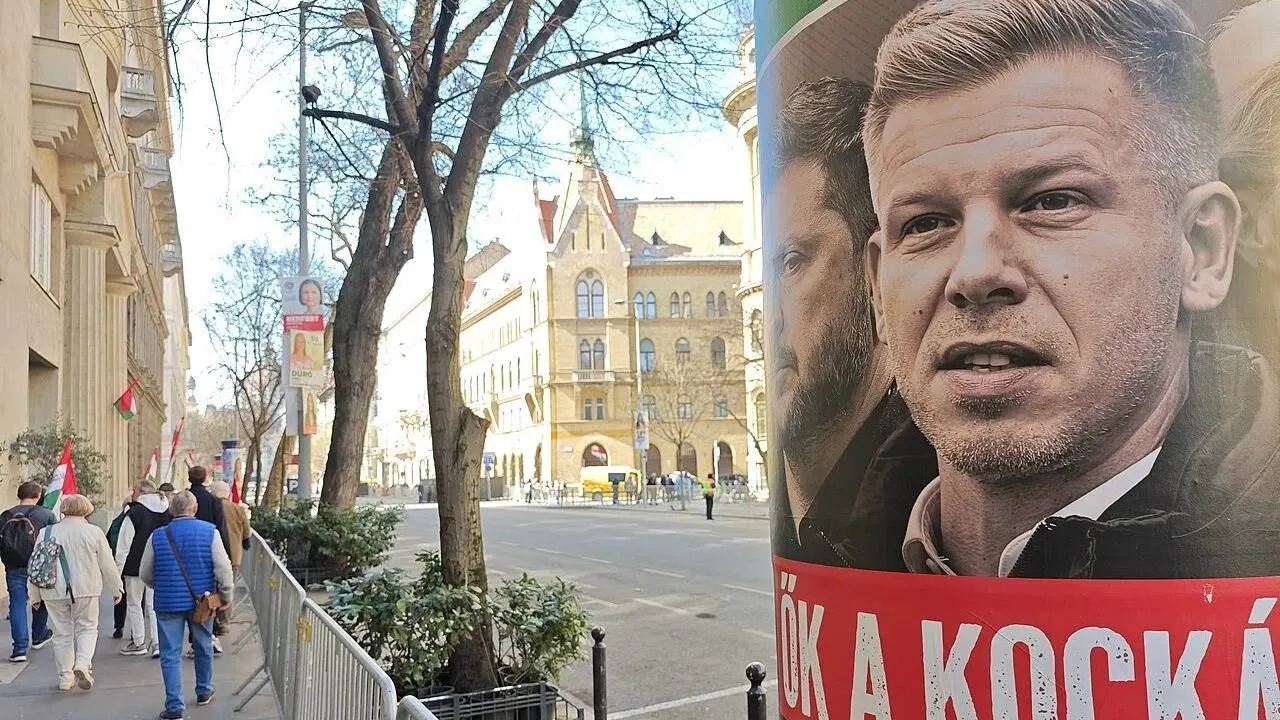
The Hungarian elections, despite the conservative views of the eventual winner, have ultimately become a matter of life and death for the liberal international. However, this is only a prelude to what awaits us next year – in 2027. Elections will take place in key EU countries – Poland, Spain, France, and Italy. And supporters of “ever closer integration” have increasingly more tools at their disposal to ensure victory for the “people of the Union” – writes Gazeta Polska.
“The Hungarian nation has regained its country! A decisive rejection of entrenched corruption and foreign influence”, wrote on April 12 on X Alex Soros, son of George Soros. “The heart of Europe beats stronger”, commented Ursula von der Leyen on the result. Donald Tusk, calling Peter Magyar, admitted he was even happier than the winner himself. Barack Obama, the informal spiritual leader of the Democratic international, left no doubt: the stakes in the Hungarian elections, just as in the 2023 elections in Poland, were the same. “Yesterday’s victory of the opposition in Hungary, like the Polish elections in 2023, is a victory for democracy, not only in Europe but worldwide”, he wrote on April 13. “Moreover, it proves the resilience and determination of Hungarians”, he added.
The choice made by Hungarians was internationalized. And although everyone praised the independence, agency, and resilience of Hungarian voters to “foreign influence”, at the same time the liberal international clearly signaled that only one choice was correct and could be recognized as democratic.
How “democracy” wins
The reasons for Viktor Orbán’s electoral defeat can be debated at length. Certainly, the Hungarian prime minister’s own mistakes, the entrenchment of his allies within the state, the weakness of the Hungarian economy, and the fatigue after an unprecedented 16 years in power played a significant role in boosting support for the opposition. To this one can add a difficult moment for all allies of Donald Trump in Europe, something also recently felt by Giorgia Meloni.
But beyond discussions assessing Orbán or evaluating whether the right wing in Poland gains or loses from such an outcome, it is also important to notice the systemic mechanism through which the liberal international seeks to distribute and take away power in Europe. This mechanism will also have a significant impact on the elections awaiting Poland at the end of next year.
The principle of this mechanism is quite simple. In Washington, the Democratic Party must govern, as it supports the project of deeper integration, accepts the leading role of Paris and Berlin in Europe, and backs “democratic” forces, for example by funding NGOs and liberal media through USAID. In return, Europe provides clear support for one side in U.S. elections. It repeats that when Democrats govern, transatlantic relations are excellent, while a Republican president, especially someone like Trump, destroys them. The tool of “broken relations”, which can later be promised to be repaired, plays a key role here.
The second, even more effective part of the mechanism concerns control over the countries of the “new Union”, meaning our region. Here, “European parties” are meant to govern – they may have different political colors depending on local specifics, but must meet one condition: they cannot question the assumptions of “ever closer integration”. That means accepting the gradual centralization of the EU and agreeing, without major conflict, to the steady transfer of member states’ competences to Brussels.
In the case of Magyar, the EU is willing to tolerate a certain degree of what it sees as folkloric conservatism. Magyar, like Donald Tusk before him, officially opposes, for example, the migration pact. As his first actions show, like Tusk, he has also been given the green light for what Klaus Bachmann described as “restoring democracy by undemocratic means”. One should also expect that the unblocking of European funds, as in Poland, will be a political decision rather than the result of any real assessment of “restoring the rule of law” or actual reforms.
However, the election winner has also made commitments crucial from Brussels’ perspective. These include readiness for Hungary to adopt the euro. The loss of a sovereign currency and even greater dependence of the Hungarian economy on central decisions will be sufficient gain for Brussels and will place another tool of pressure in its hands.
It is no coincidence that immediately after the Hungarian election results were announced, media reports emerged that von der Leyen wants to use the moment to abolish the unanimity rule in EU foreign policy. Under the guise of greater efficiency and responsiveness to threats, Brussels would gain another valuable tool of political influence. In the context of a difficult geopolitical situation and security challenges increasingly dependent on central decisions, it will be harder to convince voters that supporting parties in conflict with the EU is a rational choice. And even if such a party wins, withholding funds and support will send a clear signal that the choice was not “democratic”.
Crisis of the old Europe
Even pro-European Brussels media such as Euractiv write that the EU is shifting power to higher levels, and that “decisions are made at the highest political level”, without consultation even with lower levels of the European Commission and bypassing the fragmented European Parliament.
The haste of the European Commission and von der Leyen herself is not accidental. The goal is to extract as much power for Brussels as possible – something that, as EU history shows, is not easily reversed. And time is short, before elections take place in key EU states. The most likely revolutionary change could occur in France. A simultaneous victory of a National Rally candidate (most likely Jordan Bardella) in France, combined with Giorgia Meloni retaining power in Italy and a victory in Spain by the People’s Party in coalition with the right-wing Vox, together with a right-wing victory in Poland at the end of the year, would be a black scenario for the plan of “ever closer integration”.
It should be noted that “old Union” countries are treated differently than Poland and other states in our region. Toward the latter, politicized financial tools are used, the Commission interferes deeply in internal political processes, and chooses its favorites. Mechanisms such as SAFE are designed to use key security issues to further increase dependence of domestic politics on Brussels’ goodwill. But this strategy is also an attempt to prepare the EU for a crisis that could arise if the liberal international loses power in a key country like France.
If power is secured in the right hands in a key regional country such as Poland, then even in the event of Bardella’s victory, Brussels will be able to negotiate with him from a position of strength and force a path of cohabitation.
This is not an ideological dispute
The second part of the strategy involves pushing through changes as quickly as possible before French voters make their decision, so that the system can survive even in the event of defeat. Brussels aims to conclude negotiations on the seven-year budget framework before the French elections. There is also talk of confirming another term for European Council President António Costa while Emmanuel Macron is still in office.
Macron is also doing his part by appointing political allies to key positions in the French bureaucracy and institutions in advance – positions they will retain even if a right-wing candidate wins. Politico openly calls this strategy “Le Pen-proofing” – the system must be airtight even if voters choose the “wrong” candidate. Although the outlet notes that many of these moves violate constitutional or legal principles, the international liberal camp, in line with Bachmann’s doctrine, has long had few scruples in such matters. Defending democracy requires sacrificing certain principles.
From Poland’s perspective, the French elections in April-May may play a valuable role in breaking and weakening the system. But on the other hand, a potential right-wing victory in France will only raise the stakes of the elections in Poland, and the power-holding group in Europe will double its efforts and increase pressure to prevent a right-wing victory in Warsaw.
This is no longer an ideological dispute, because as seen in Hungary, liberals can accept right-wing rhetoric as long as its proponents do not challenge their power. It is a conflict between an oligarchy that has tools to maintain its influence, even if its views on Russia, migration, or cultural issues have long been defeated. On the other side should stand those who, regardless of their views, believe that nations should not hand over decisions about who governs them into foreign hands.