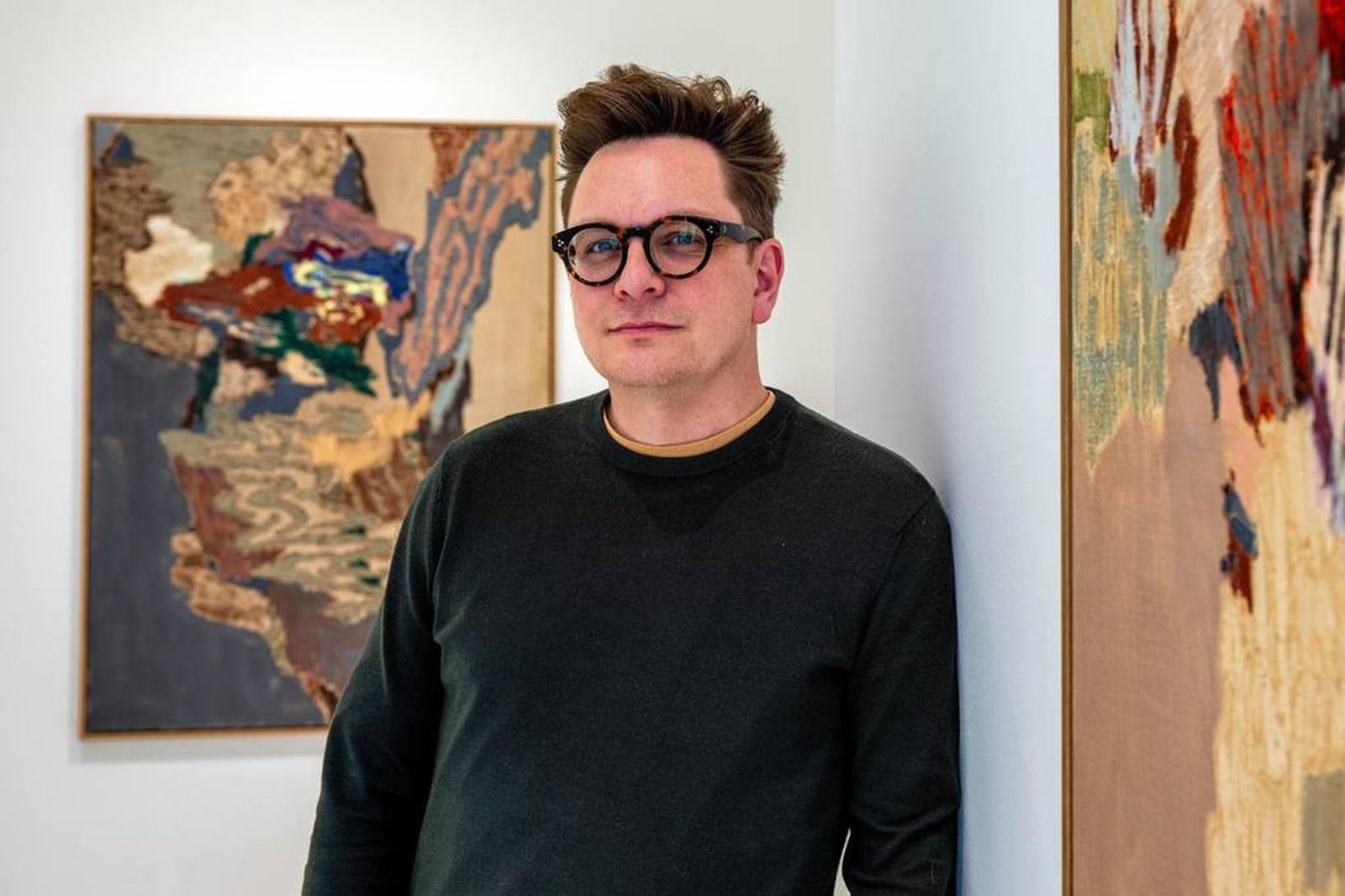
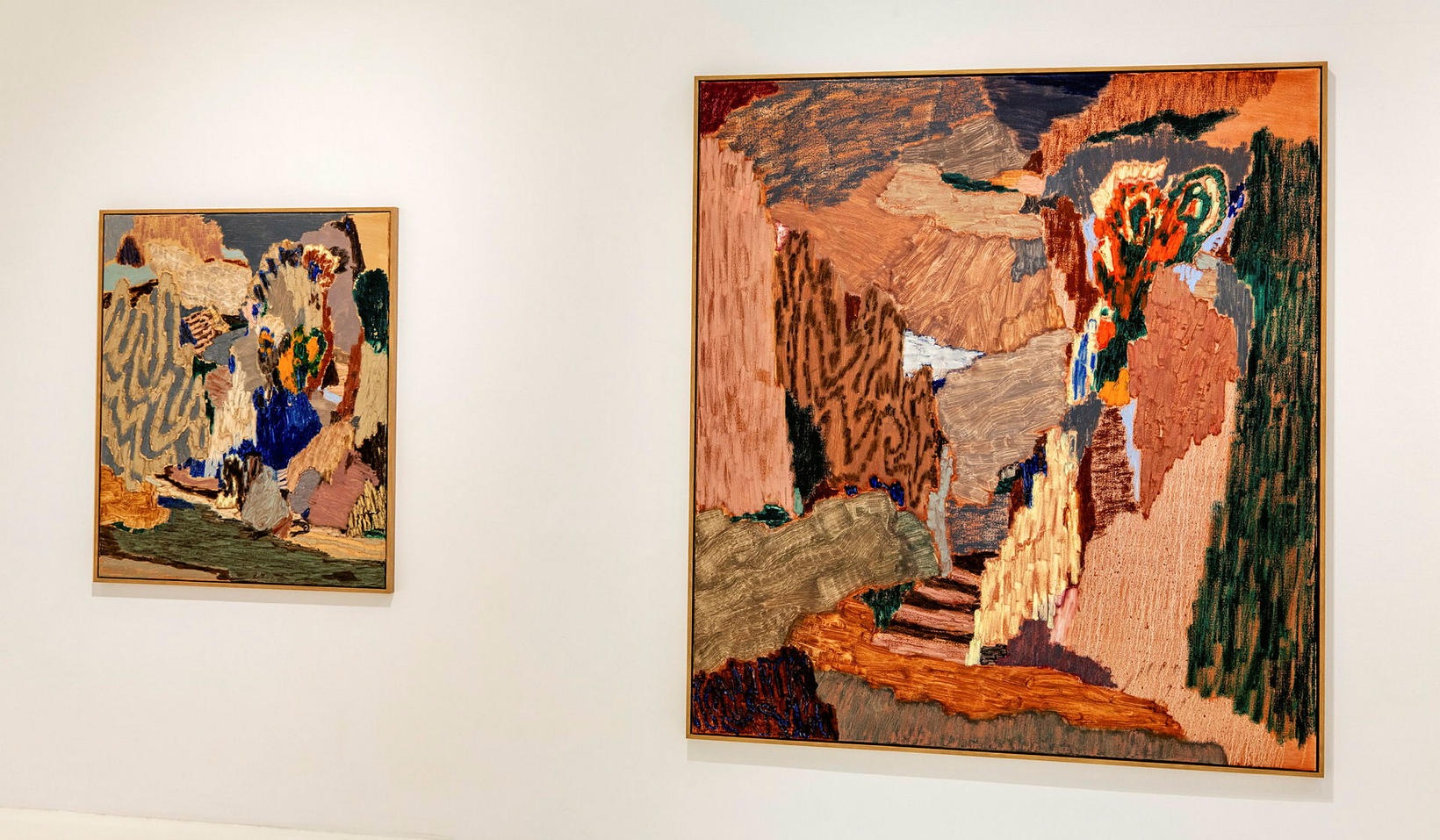
“Usually, the title of the exhibition comes to me at the very end because I don’t come up with a specific idea at the beginning. These are not very concept-oriented works, but they are made based on intuition where I let the colors and shapes lead me forward. The works in this exhibition are based on a similar basis to the works I have been making for the past three to four years, which is a free abstraction on a non-verbal landscape basis. You can see references to the landscape even if I am not directly working with it as such.
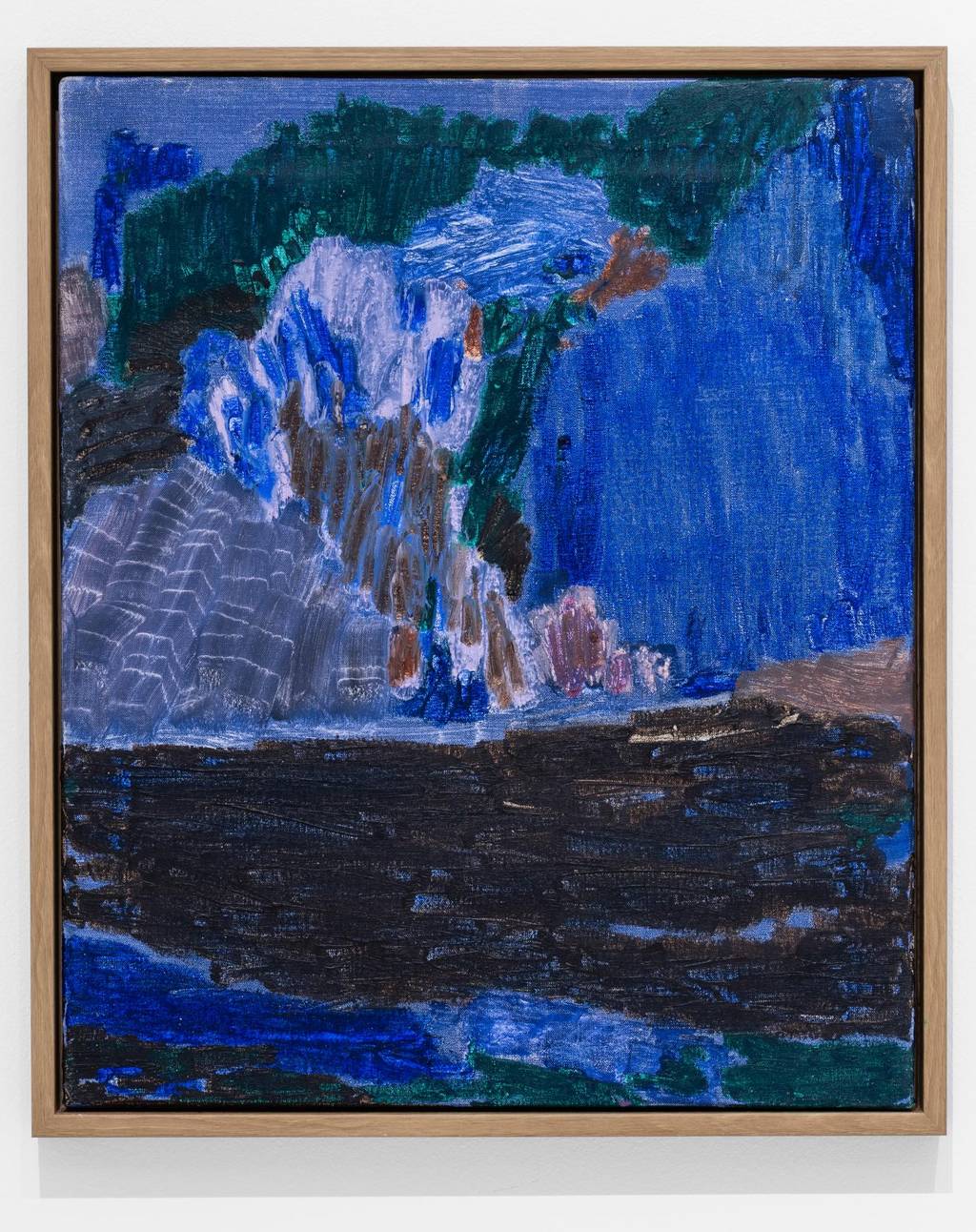
This piece by Guðmund is called Náttstaður. The work is made with oil and oil pencil on linen canvas and is 60×50 cm in size.
Photo/Páll Kjartansson
I have the landscape more behind my ear when I’m making each picture individually, just so I have some frame to aim for,” Guðmundur explains, adding that in this way the pictures are not calculated, but flowing and impulsive, where one thing leads to another until everything finally comes together in perfect balance.
“The title Handouts came about when I looked over the pieces and wondered what they had in common. I felt that the pictures were like portraits or short incidents each one, not that each picture told a full story, but rather it was more like lines from a poem or the first part that was thrown out without responsibility and then it was up to the viewer to find the bottom line. However, I don’t know if this is very noticeable to others, but this is what I saw in these works,” he says.

Often something unexpected happens
When asked more about this flow and what happens when he is faced with a blank canvas at the beginning of each work, there are no answers.
“It’s a bit of a tug-of-war between what I think I want to put down and what comes. A very typical start to a piece is that I do a very thin background, often in musk or salmon pinks, so it’s not just a screaming white canvas behind, and while it’s still wet I just start hammering away at the piece with these oil sticks that I make myself. As I move them back and forth, they push the background color, which I’m I’ve just put it down, and that’s how I have to work very quickly before the background color dries, and then something unexpected happens that I may not have thought about at the beginning.
Makes your own oil paste
What can you tell me about these oil sticks that you make and use instead of traditional brushes? What is the reasoning behind this unconventional use of materials?
“It all started out of necessity. I was at a crossroads with what I was doing and was dabbling in making oil pastels on paper. Oil pastels are very similar to these pencils but a little different, much smaller, more used in drawing and they don’t dry, in fact they are always wet. When I was making these oil pastels, I started thinking about how I could express this in a painting, that is, these dry then I remembered that there was something called oil pencils, but they didn’t really exist in the country, I only found about five colors in one shop, which wasn’t enough for me.
So I started ordering them from the outside, but found that they were available in rather limited sizes, so I just started digging around and looking at how to build something like this. It’s a small matter because you just mix color powder, oil and beeswax and melt it together in a pot. Then this is poured into a shape and then you have a stick that can be shaped as you like, big or small, fat or thin. I immediately felt that I had to do this myself because there was neither the range of colors I needed nor in the form I wanted,” says Guðmundur, and then affirmatively answers that this is characteristic of his art.
“Absolutely, because it really steered the direction of the pieces going there two or three years ago when I started this style. The pencils have a lot to say about how my pieces look.”
“You just know”
Blaðamanni is curious to know when Guðmundi feels the painting has reached its perfect balance and when he considers it ready to hang on the wall.
“It’s always a little difficult to decide. I think that 20 years of experience plays a big part in that. Sometimes you actually have a completely finished painting, then you step away until it’s almost in perfect balance, but then it can happen that it doesn’t root you and doesn’t do anything for you, and then sometimes you have to take something out or change something to put it a little out of balance. I’m still pretty traditional about this and often look for things to be in good order balance,” he says jokingly.
“It’s a really big dance and I sometimes step back and forth. Sometimes I think a picture is ready and I want it a little open, but then I quickly see, when I’ve had a cup of coffee and just look at it, that maybe it’s a little too loose in the ropes. Then I have to do what I call tighten it a little and finish a few loose ends. You could say that it’s hard to know when a work is ready, but I still don’t really feel it, you just know it.”

A man of many interests
Then Guðmundur says that he does not want to steer the viewer in any specific direction.
“I think you might be happy when you hear that the audience thinks along the same lines as you do and get the same impression as me. But it might just be selfish, wanting everyone to have the same opinion as you,” he says and laughs. “I know that many people see landscapes in my pictures and I have nothing against that, but maybe that’s not what I would most like people to take from them. It would be more some kind of dynamic interplay of colors and shapes that gives you a speechless and powerful feeling, now or calm because sometimes the pictures are calm. I guess I don’t want to achieve abstract feelings inside people rather than that they should see something predetermined from the pictures.”
Is there a particular beat or rhythm that characterizes your work?
“Yes, maybe just that there is rhythm and rhythm in them. It borders on being a dance, especially in larger works because sometimes you have to bend up and down and back and forth and then a certain rhythm comes into the work,” he says, adding that he usually takes certain pieces of work.
“I am a man of many interests, and they can grab me as much as art. It happens that I might not work on a painting for a month, so I can definitely say that I don’t feel the constant need to always put something down on canvas. I work on it in scraps, and then nothing else gets in the way.”

mbl.is/Árni Sæberg
Scared of the criticism here
Guðmundur was born in 1980 and completed a BA degree from the Iceland Academy of the Arts in 2003 and an MFA degree from the School of Visual Arts in New York in 2011. Since then, he has held numerous solo exhibitions in Iceland, in New York and across Europe. Finally, when asked what will happen after this exhibition, Guðmundur says that he always has enough to do, but that it is two different things to show abroad and here at home.
“I am much more sensitive to what the people here at home think and am therefore more afraid of the criticism here, because outside you are viewed more from an international context and there the audience is anonymous as you do not know them. Here at home you are more vulnerable. If I had to put on a questionable show, I would prefer to do it outside,” he says, then we both leave. Guðmundur also plans to hold an exhibition in the gallery he works with in New York, Asya Geisberg Gallery, next year, but he usually shows there every other year.