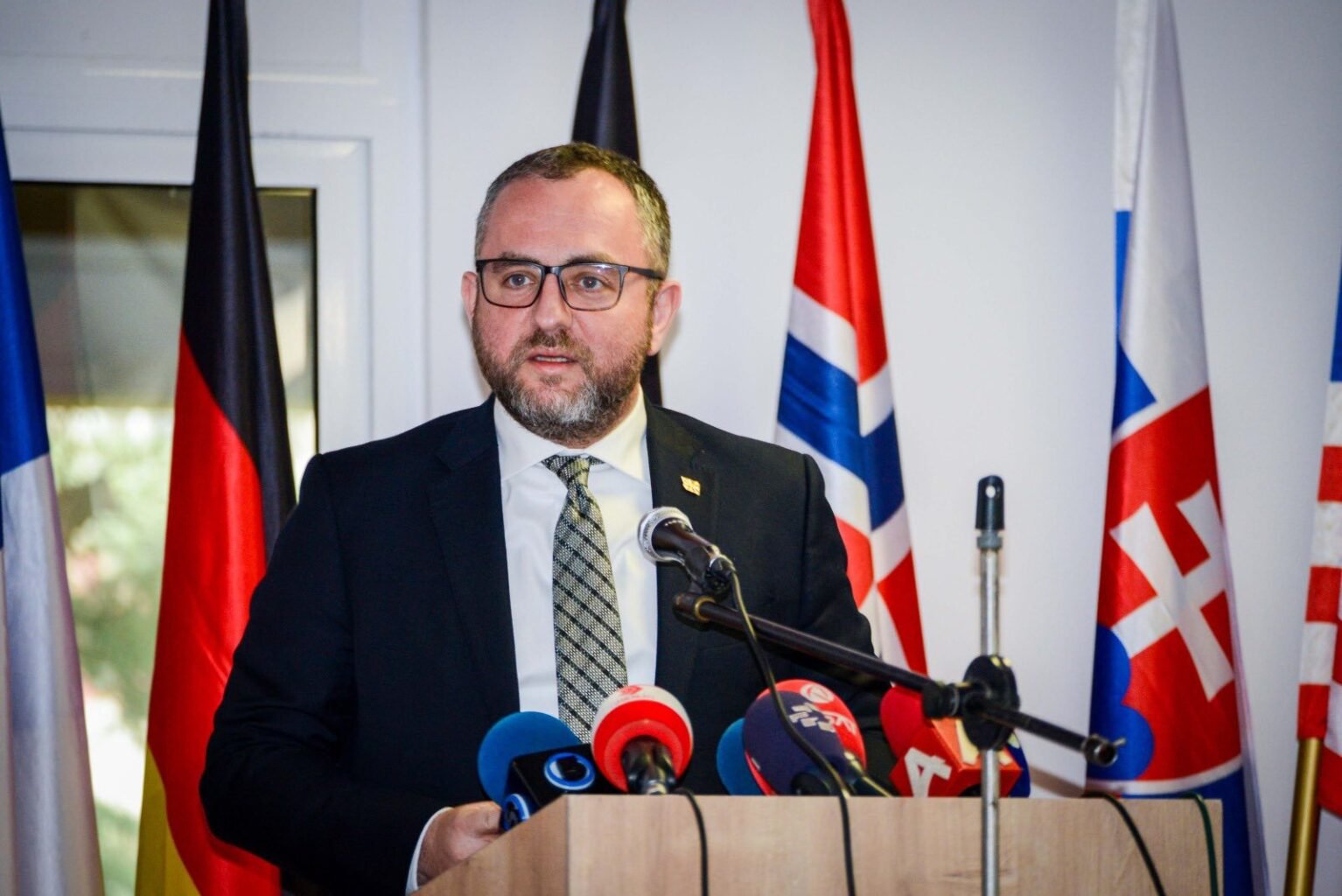
For years, domestic violence has been a clearly visible problem both in institutional practice and in statistics, but for too long it has been treated in a fragmented manner, with a delayed reaction and without substantial coordination between institutions – the Minister of the Interior emphasized Panche Toshkovski.
He addressed the supervisory hearing organized by Parliamentary Commission for Equal Opportunities for Women and Mendedicated to the implementation of laws, policies and institutional measures for prevention and protection from domestic violence, reported MIA.
Toshkovski indicated that from 2018 to 2025, over 44,700 cases with elements of domestic violence were registered, which means an average of about 15 signals per day.
In the same period, over 8,500 crimes, more than 2,900 misdemeanors and over 33,000 complaints were recorded.
According to the minister, this statistic includes 42 murders, 24 attempted murders and 192 serious bodily injuries.
He emphasized that the police is usually the first institution that comes into contact with the victim, performs a risk assessment and makes initial decisions that directly affect security.
However, he pointed out that the police cannot solve the problem on their own without the prompt action of the centers for social work, a quick response from the prosecutor’s office and efficient court decisions.
Toškovski announced changes in the Law on prevention and protection against violence against women and domestic violence, especially in the area of emergency and temporary measures.
The key innovation is the introduction of a police authorization with which the officer, after a risk assessment and determined immediate danger, will be able to immediately issue an emergency measure for the protection of the victim.
This will mean that the perpetrator is removed from the home, that he is prohibited from approaching and contacting the victim.
The measure will be valid for up to 48 hours, and then the court will decide whether to confirm, cancel or extend it for up to 30 days.
In parallel with the legal amendments, the Ministry of the Interior is also working on providing body cameras for police officers, in order to better document the interventions.
The minister emphasized that according to the data from March, the system is starting to function differently and the institutions are finally treating the problem with the seriousness it deserves.