He National Election Jury (JNE) made official the resolution in which it declared the holding of complementary elections unfeasible. Among the arguments, the electoral body pointed out that the delay in the installation of the tables did not have a decisive impact on citizen participation.
Read also | Fujimorism vs. anti-Fujimorism: Keiko Fujimori will contest the second round for the fourth consecutive time
“This gap is small and not enough to explain electoral behavior on its own (…) Absenteeism responds rather to multiple factors, such as socioeconomic conditions, political motivation, transportation difficulties and distance to voting locations,” states the resolution of April 23.
The electoral body ruled after evaluating various technical reports, as well as the requests submitted by the Renovación Popular candidate, Rafael López Aliaga, and the public debate of different sectors, which proposed the holding of complementary elections.
In addition, it highlights that in the face of delays in the installation of several tables due to “deficiencies” of the National Office of Electoral Processes (ONPE), they adopted extraordinary measures, such as extending the installation hours of the polling stations and voting on April 12 and extending them until April 13 in the tables not installed.
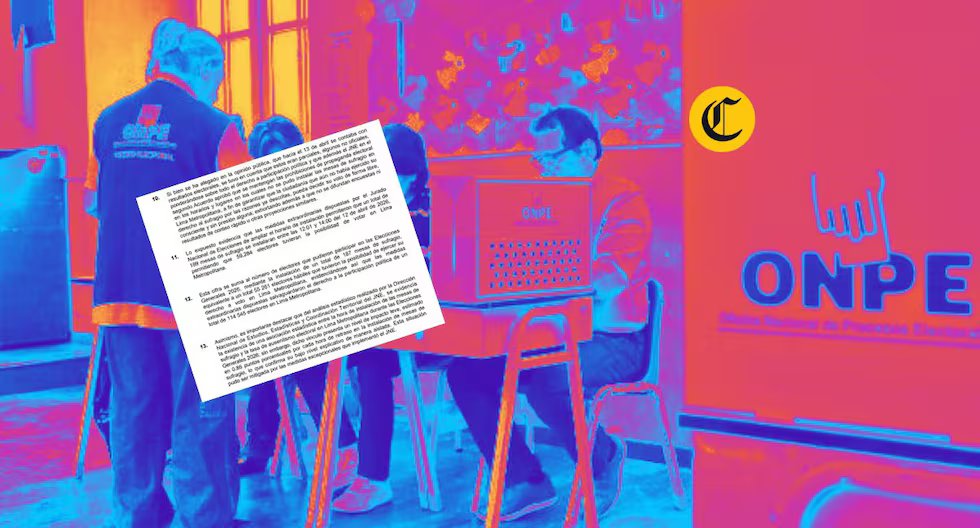
A report from the JNE inspection area detailed that 256 polling stations received electoral material late, in which 3,605 voting tables had to be installed, corresponding to a total of 1,071,111 voters. The districts with the highest number of incidents were concentrated in South Lima.

It emphasizes that the measures they took “made it possible to significantly mitigate the effects of the situation generated” by the ONPE.
“Although it has been alleged in public opinion that electoral results were available by April 13, it was taken into account that these were partial, some unofficial, weighing above all the right to political participation,” he states.
He adds that that day the bans on electoral propaganda were maintained at times and places in which the voting tables could not be installed to guarantee that citizens who had not been able to vote could decide freely and consciously,
The electoral body concludes that electoral absenteeism occurs due to multiple factors and “it is not materially or legally valid” to attribute the delay in the delivery of material to “certain voting locations” as the only sufficient cause or excuse “to ignore the will of the voters at the national level or segmented in a certain constituency, even more so if it is noted that thanks to the measures adopted opportunely, its effects could be mitigated, regardless of the time of the installation of the voting tables.”
“The statistical analysis carried out by the National Directorate of Studies, Statistics and Territorial Coordination of the JNE, shows the existence of a statistical association between the time of installation of the voting tables and the electoral absenteeism rate in Metropolitan Lima during the 2026 General Elections; However, said link presents a level of slight impact, estimated at 0.86 percentage points for each hour of delay in the installation of voting tables, which confirms its low explanatory level of isolated manner,” says the resolution.

Another argument from the JNE is that the figure of complementary elections is not foreseen within the framework of general elections, it only applies to municipal elections. It warns that admitting the opposite “means violating” the principles of legality and reservation of law, as well as affecting the legal security and predictability of the electoral process.
“It is not legally acceptable to maintain the origin of complementary elections within the framework of General Elections through the analogical application of assumptions provided for municipal processes, to the extent that this would imply an undue extension of legal figures to an area not provided for by the legislator,” he points out.
“The nature, scope and regulatory regulation of the General Elections respond to a constitutional logic that is specific to and differentiated from subnational processes, so the extensive or analogical application of such assumptions goes beyond the limits of a constitutionally justifiable legal interpretation,” he adds.
The JNE also indicates that the stages of the electoral process are preclusive and that the eventual implementation of complementary elections “would generate a serious scenario of legal uncertainty” and would alter the rules of competition in the middle of the process.
“The holding of an additional day could influence the formation of electoral will, especially in a context in which the official partial results are highly developed (more than 94%) and are public knowledge, thus affecting the authenticity of the vote,” he highlights.
It also mentions that this situation would impact not only the presidential elections, but also the elections to elect senators, deputies and the Andean Parliament, while the counting of votes in said elections is already about to be concluded.
“It should also be considered that the preliminary scrutiny is in an advanced phase, close to its completion, while the Special Electoral Juries are resolving the minutes observed with a view to the prompt proclamation of results. In this scenario, the holding of a new electoral day could affect the decision of the voters, moving it away from a free and spontaneous expression,” he says.
For the JNE, “it is necessary” to contribute to the preservation of social peace and democratic stability, which “involves ensuring the continuity” of the electoral process within the current constitutional and legal framework.
“Consequently, there is no assumption that justifies the holding of complementary elections beyond the express regulatory framework, which, by their very nature, proceed only in exceptional scenarios in which the electoral process has not been carried out or has been declared null, or in which it could mean a serious impact on fundamental rights, which does not occur in the present case, even more so when said impact was substantively mitigated with the exceptional measures that were ordered by the National Elections Jury,” he argues.
In their analysis they also assessed that the ONPE “is in a position to endure an election day in such a short time, even more so, when this could put the second presidential round at risk.”

Analysis
In dialogue with El Comercio, specialists in electoral issues José Tello, president of Aklla, and Enzo Elguera pointed out that the JNE has minimized the impact of the delay in the installation of the voting tables.
“They are wrong because absenteeism also occurs when people look at the problem at the polling stations and do not go to vote (…) It is minimizing,” Tello said.
The expert indicated that what the electoral body itself has mentioned must be taken into account: 0.86% per hour of delay. “How much is 0.86% for five hours late or seven hours late for tables that were set up at 2 pm? We are talking about between 4.3% and 6%. They themselves cannot deny the impact,” he questioned.
Tello said that the JNE suggests that it “saved the election” and that this “stance is quite criticizable.”
“For them, the problem is ONPE and they do not assume that they did not adequately inspect the day before the election, that they did not corroborate that the voting centers were in accordance with the law and the ONPE operational plan,” he stated.
Under his analysis, this election “has a serious legitimacy problem” due to what happened in Lima and the affected and mistreated electoral candidates. “It’s okay that Mr. López Aliaga has not had the best of reactions, but he is an affected candidate and that is reality. Neither he nor Mr. Jorge Nieto, even Keiko Fujimori, would be going to the second round, because he could have one more senator or deputy,” he said.
These events also have an impact on the level of citizen confidence in electoral bodies, according to the former Minister of Justice.
Finally, he opined that, facing the second round, all that remains is to “organize the electoral process well with regard to coordination between ONPE and the JNE.”
In turn, Elguera asserted that “this decimal damage is prioritized in a group of electoral districts that affect a specific group of candidates, such as Metropolitan Lima.”
“This percentage represents a certain amount of votes. In tight results, it can allow a presidential candidate to go to a second round by a minimal difference. This difference also affects the passage of a deputy, senator and whether he is elected or not. Of course the difference matters,” said the specialist.
Elguera pointed out that, after this decision, the only thing left to do is for the electoral organizations to be more transparent and regain the trust of the population through clear measures and “changing the logistical apparatus, as far as it represents and is necessary.”
“That all the errors, which have been gross, are not repeated in any way because to the extent that the electoral process is questioned, someone can win the Presidency under the character of legality, but they lose legitimacy due to the errors, negligence and clumsiness of the people in charge of ensuring the entire electoral process,” he concluded.