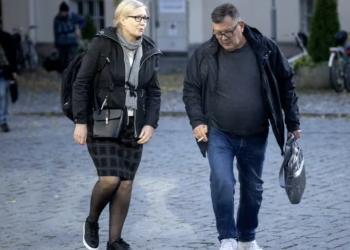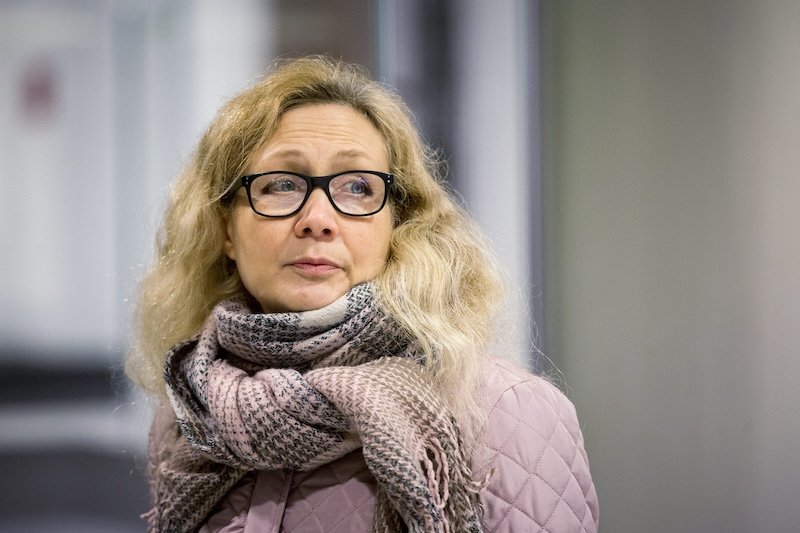
A district court in south-west Finland has cleared Anneli Auer and Jens Ihle of all charges linked to alleged sexual and violent offences against children, ending a case that has spanned close to two decades and led to prison sentences later overturned.
The Varsinais-Suomi District Court ruled on Wednesday that prosecutors failed to prove any of the 18 alleged offences said to have taken place between 2007 and 2009. The court found that the core evidence, based on statements given by Auer’s children in 2011, did not meet the threshold required in criminal cases.
Judges said the accounts contained detail but also contradictions and elements that did not align with other evidence presented in court. The ruling stated that the testimonies could not be treated as reliable without strong supporting material, which the prosecution did not provide.
The decision followed a retrial ordered by Finland’s Supreme Court in December 2024. The higher court had annulled earlier convictions after three of the children, now adults, withdrew their statements and said they had been pressured to make false claims while living in foster care.
The district court said the new testimonies, alongside other evidence, supported the position that the alleged offences did not occur. “The descriptions of the acts remained unproven,” the court said in its judgment.
Prosecutors had sought a prison sentence of seven years and six months for Auer and ten years for Ihle. Both had already served sentences handed down by the Turku Court of Appeal in 2013, which relied heavily on the children’s earlier accounts and expert assessments.
In its ruling, the district court also raised concerns about parts of the original expert evidence. It noted indications of bias and over-interpretation in medical statements, including claims that ultraviolet light revealed injuries not visible to the naked eye. The court said such findings were not supported by current scientific understanding.
A statement from the Finnish Institute for Health and Welfare in August 2025 had concluded that ultraviolet imaging cannot reveal hidden scars on skin. Defence experts challenged earlier claims, and the court said it found no reliable physical evidence linking the defendants to the alleged acts.
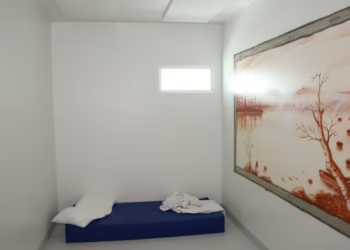
The judgment also referred to the circumstances in which the children’s initial statements were formed. It said the conditions in foster care and limited contact with relatives created a setting in which the children were exposed to external influence. Early interviews and recorded testimonies took place in what the court described as questionable conditions.
Some charges related to assault were dismissed as time-barred. One count was dropped by the prosecution during proceedings.
The state was ordered to cover legal costs exceeding €400,000, including fees for defence lawyers and legal representatives of the complainants.
Following the ruling, Auer said in a statement released through her lawyer that she was satisfied with the outcome. “I am very satisfied that a correct judgment has finally been reached,” she said. She added that the process had taken almost 20 years of her life, referring to events that began after the killing of her husband in 2006.
Her lawyer, Markku Fredman, called for an investigation into what he described as a miscarriage of justice. He urged the government to examine how the case had been handled and why earlier courts reached a different conclusion based on similar evidence.
Fredman also warned against further appeals, stating that prolonging the case would delay compensation for time spent in prison. “It is intolerable if the inevitable outcome is postponed,” he said in a statement.
The ruling is not final. If upheld, it opens the way for compensation claims by Auer and Ihle for wrongful imprisonment. Ihle spent a total of 1,825 days in custody, while Auer also served a multi-year sentence before release.
The case has drawn attention in Finland due to its length, the involvement of child testimony, and the role of expert evidence. The district court’s unanimous decision marks the latest development in a legal process that began with allegations more than 15 years ago.
HT