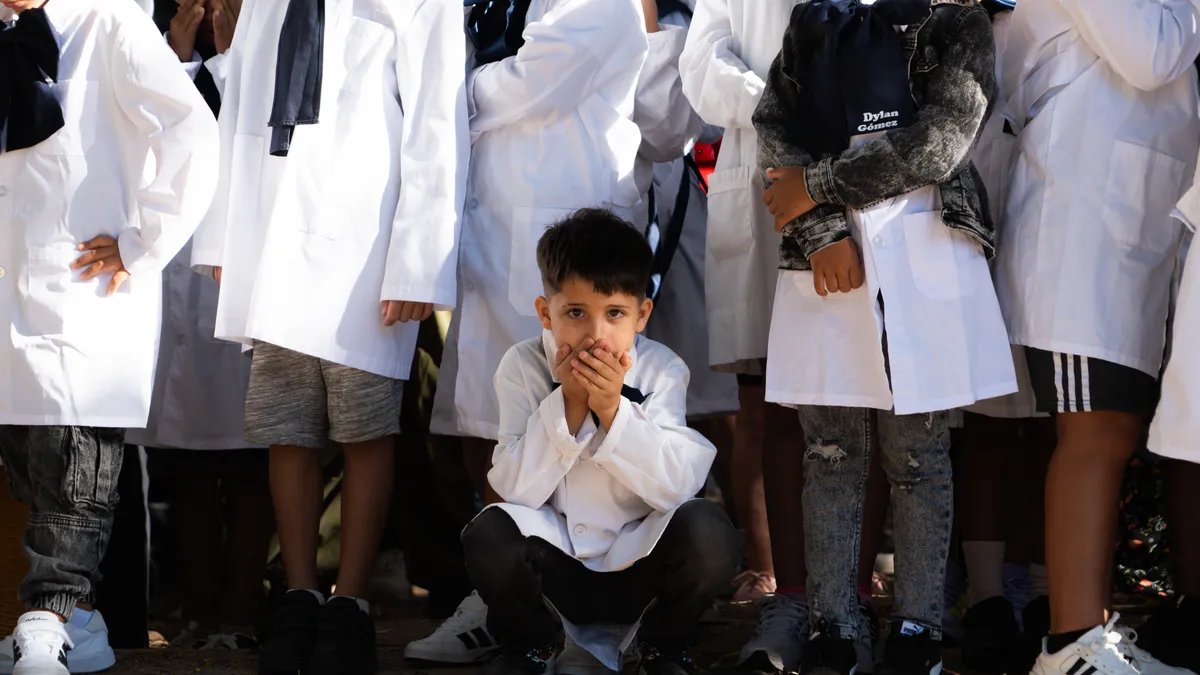
The repetition It stopped being a topic in Uruguayan schools. The technical and political consensus is clear: this tool must be used as little as possible and never for “repeat more of the same”.
But how that decision is reached—which is partly described in a regulation that the previous government modified—does have nuances. That is why the General Directorate of Initial Education and Primary changed that regulation again.
For example: absences from class are one of the Achilles heels of the Uruguayan system. The regulations in force until now did not take this item into account. It is now established that Those who are absent more than two out of every ten days in the school year should not automatically promote and your case must be studied in detail. Why was it missing? Was it a health issue? Parental neglect? Were you a victim of any exploitation? That is to say: it is a general criterion, but flexible depending on the conditions.
Under the idea that the teaching team can follow the students’ careers as best as possible, it is made clear that it is the school’s task to try to promote every student. “This involves the personalization of teaching strategies taking into account the singularities of boys and girls in relation to their ways of learning,” says the document accessed by El Observador, which, in Creole, is equivalent to teachers have freedom in format changesin work with small groups, in pairs and a long series of breaks from the old classic model.
And since the teaching team is the one who knows the progress of each student, they are the ones who must decide whether to promote or not.no matter what grade you are studying. Only that he cannot repeat the same cycle more than once (therefore he cannot be left behind more than twice in the six school grades), as reported by El País.
This represents a change from what was in force until now, in which repetition was only possible in even-numbered grades (second grade, fourth and sixth).
In essence, both policies point to the same thing: “the definition of repeating a school grade must be duly founded, taking into account that it is the best for each boy or girl.”
The sociologist and director of Research at ANEP, Santiago Cardozo had said it to El Observador: “In the academic world there is a consensus, not only in Uruguay, that repetition is a rather useless, unfair instrument and that it is anchored to another educational era in which it was thought that all children learn at the same pace and that those who do not do so must be left a year behind.”
The new regulations continue to leave the qualifications (something that at one point he wanted to get rid of completely in Primary), but he emphasizes that teachers have to make a qualitative evaluation, well explained, so that it is useful to families of the students.
The change in regulations (of grade passage regulations) is the result of the agreements that Primary reached when the review of the so-called “curriculum transformation” began last year and the unions, technical assemblies of teachers, Primary technical teams and political authorities were invited.