
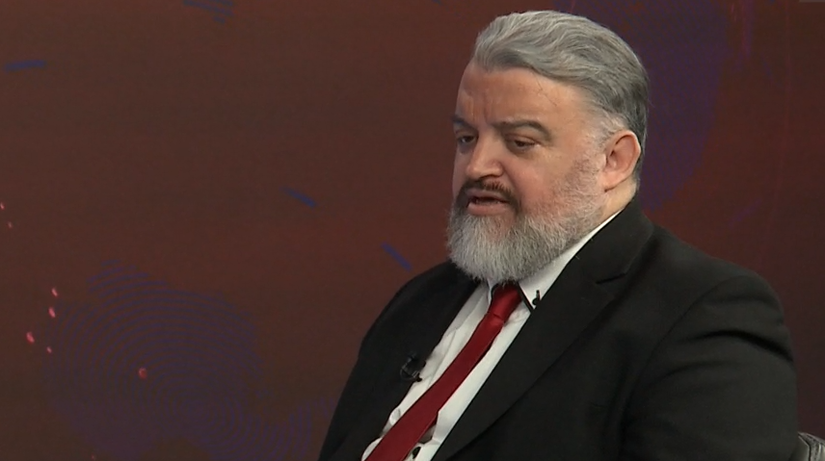
Political commentator Eduard Chmelár criticized the current atmosphere in Slovak politics and the manner in which parliamentary disputes are conducted.
In the discussion session ta3 Topic of the day reacted to the tense meeting of the National Council, during which MP Zuzana Mesterová was expelled from the hall for petition sheets marked as a visual aid.
In the interview with Eduard Chmelár you will learn:
- from 0:04 – how he evaluates arguments in parliament;
- from 2:33 am – both the coalition and the opposition are responsible for the heated atmosphere;
- from 3:44 am – whether the expulsion of MP Mesterová was appropriate;
- from 5:35 – why, according to him, Šimečka politically “ran into Fico’s pitchforks”;
- from 6:17 – statements about Šimeček’s mother crossed the line;
- from 12:29 – what does he say about the case of Ján Ferenčák;
- from 19:48 – warning against growing aggressiveness in society;
- from 23:28 – how he comments on the dispute in the Czech Republic;
- from 28:36 – what is the difference between the positions of the Czech and Slovak presidents;
- from 36:42 – the difference between federalization and centralization of the EU.
Politics is not football
According to Chmelár, the parliamentary conflicts have reached “deeply below the level” and both sides of the political dispute are responsible for the current state. “Politics is not football,” he said, adding that the public, journalists and commentators should not be subject to the trench logic of political camps.
In the case of Mesterová, he described the bringing of petition sheets into the meeting hall as theatrical, but he considers the expulsion of the deputy to be unreasonable. “I very much doubt that this falls under visual aids. Those were sheets that had no business being there in my opinion, but the punishment for that is too strong,” he said. At the same time, however, he added that shouting and making it impossible for colleagues to speak in the parliament creates an atmosphere in which, according to him, “everyone’s nerves can burst”.
Chmelár also commented on the dispute between Prime Minister Robert Fico and representatives of Progressive Slovakia. Michal Šimečka called him politically inexperienced when, according to him, he admitted in a live broadcast that he lent money to his mother’s civic association and the association did not return it. According to Chmelár, the prime minister was able to use this politically.
At the same time, however, he sharply criticized the vocabulary used by the ruling party in this context. According to him, expressions such as “the thefts of Šimeček’s mother” or “greedy family” do not belong in the politics of a democratic state. “I am disgusted by the way in which the other side is not only exaggerating, but dishonouring,” he said. He called it inadmissible in particular attacks on family members politicians.
Chmelár claims that the legal and political level of the dispute must be distinguished. Legally, according to him, “it is impossible to back down” if it is a suspicion of subsidy fraud. On a political level, however, he pointed out that the company must not be drawn into the logic of the fan fight. He sees the biggest problem in the fact that, according to him, part of the electorate forgives their leaders almost everything and rejects any oversight.
The situation around Ján Ferenčák
Chmelár also spoke about the situation surrounding the deputy Ján Ferenčák after his expulsion from Hlas. He emphasized that any violence against politicians must be condemned without reservation and, according to him, Ferenčák could apply for protection as a constitutional figure. At the same time, however, he rejected the way in which the deputy publishes behind-the-scenes information after leaving the party. According to Chmelár, people who keep silent about alleged wrongdoing until they get into a personal conflict or under pressure lose credibility.
According to him, the tension surrounding Ferenčák also shows the wider problem of polarization of society. He recalled the attacks or threats against other politicians and warned that accumulated emotions can turn into physical violence. In this context, he also mentioned the attacks on Donald Trump and refused to justify violence against politicians regardless of their views. “This cannot be legitimized, nor justified, nor belittled,” he declared.
Dispute in the Czech Republic
In the foreign policy part of the discussion, Chmelár addressed the dispute in the Czech Republic over who should represent the country at the NATO summit in July. According to him, Prime Minister Andrej Babiš has a stronger position in this case, since the government determines the defense policy. According to Chmelár, President Petr Pavel is constitutionally “pulling the short end of the stick” and his participation would only make sense if he interpreted the government’s position.
He compared the situation with Slovakia, where, according to him, the president has a potentially stronger position in foreign policy than the Czech head of state. In particular, he recalled the authority to negotiate and ratify international treaties, while the right to ratify is, according to him, non-transferable. According to Chmelár, if the Slovak president were to make full use of his constitutional options, the system could approach a semi-presidential model.
Criticism of Ursula von der Leyen
At the end of the discussion, Chmelár also criticized the leadership of the European Commission under Ursula von der Leyen. He claims that the European Union is being centralized under its leadership and more and more power is being concentrated in the hands of the Commission. He referred to the statements of the former president of the European Council, Charles Michel, who, according to him, warned against the authoritarian features of the commission.
Chmelár distinguished between federalization and centralization of the EU. According to him, the federation does not have to be a problem in itself if it is accompanied by the democratization of European institutions. However, he called it unacceptable to withdraw the right of veto from member states without creating mechanisms that would protect smaller countries from being overruled. According to him, such a development would open a legitimate discussion about the benefits of Slovakia’s membership in the European Union.








![COMMENTARY: Once upon a time – Diplomacy in the image of our times [Shridath Ramphal Centre Trading Thoughts]](https://agentially.org/wp-content/uploads/2026/05/pexels-gabby-k-6289049-e1777829357976-120x86.jpg)
