Monday, May 4, 2026
    The GeoStrategic Consensus
    No Result
    View All Result
    • Login
    • HOME
    • AMERICAS
      • Argentina
      • Brazil
      • Canada
      • Chile
      • Colombia
      • Costa Rica
      • Cuba
      • Dominican Republic
      • Ecuador
      • El Salvador
      • Greenland
      • Guatemala
      • Honduras
      • Mexico
      • Nicaragua
      • Panama
      • Paraguay
      • Peru
      • United States
      • Uruguay
      • Venezuela
    • ASIA-PACIFIC
      • Australia
      • Brunei Darussalam
      • Cambodia
      • China
      • Federated States of Micronesia
      • Fiji
      • Indonesia
      • Japan
      • Kiribati
      • Laos
      • Malaysia
      • Marshall Islands
      • Mongolia
      • Myanmar
      • Nauru
      • New Zealand
      • North Korea
      • Palau
      • Papua New Guinea
      • Philippines
      • Samoa
      • Singapore
      • Solomon Islands
      • South Korea
      • Taiwan
      • Thailand
      • Timor-Leste
      • Tonga
      • Tuvalu
      • Vanuatu
      • Vietnam
    • CARICOM
      • CARICOM – Non-English
        • Haiti
        • Suriname
      • CARICOM Associates
        • Anguilla
        • Bermuda
        • British-Virgin-Islands
        • Cayman-Islands
        • Curacao
        • Turks-and-Caicos
      • CARICOM English
        • Antigua and Barbuda
        • Barbados
        • Belize
        • Dominica
        • Grenada
        • Guyana
        • Jamaica
        • Montserrat
        • Saint Kitts and Nevis
        • Saint Lucia
        • Saint Vincent and the Grenadines
        • The Bahamas
        • Trinidad and Tobago
    • EURASIA
      • Armenia
      • Azerbaijan
      • Balarus
      • Georgia
      • Kazakhstan
      • Kyrgyzstan
      • Moldova
      • Russia
      • Tajikistan
      • Turkmenistan
      • Ukraine
      • Uzbekistan
    • EUROPE
      • Albania
      • Andorra
      • Austria
      • Bosnia and Herzegovina
      • Bulgaria
      • Croatia
      • Cyprus
      • Czech Republic
      • Denmark
      • Estonia
      • Finland
      • France
      • Germany
      • Greece
      • Holy See
      • Hungary
      • Iceland
      • Ireland
      • Italy
      • Kosovo
      • Latvia
      • Liechtenstein
      • Lithuania
      • Luxembourg
      • Malta
      • Monaco
      • Montenegro
      • Netherlands
      • North Macedonia
      • Norway
      • Poland
      • Portugal
      • Romania
      • San Marino
      • Serbia
      • Slovakia
      • Slovenia
      • Spain
      • Sweden
      • Switzerland
      • United Kingdom
    • MIDDLE EAST AND NORTH AFRICA
      • Algeria
      • Bahrain
      • Egypt
      • Iran
      • Iraq
      • Israel
      • Jordan
      • Kuwait
      • Lebanon
      • Lybia
      • Morocco
      • Oman
      • Palestinian Territories
      • Qatar
      • Saudi Arabia
      • Syria
      • Tunisia
      • Turkey
      • United Arab Emirates
      • Western Sahara
      • Yemen
    • SOUTH ASIA
      • Afghanistan
      • Bangladesh
      • Bhutan
      • India
      • Maldives
      • Nepal
      • Pakistan
      • Sri Lanka
    • SUB-SAHARAN AFRICA
      • Angola
      • Benin
      • Botswana
      • Burkina Faso
      • Burundi
      • Cabo Verde
      • Cameroon
      • Central African Republic
      • Chad
      • Comoros
      • Cote d’Ivoire
      • Democratic Republic of the Congo
      • Djibouti
      • Equatorial Guinea
      • Eritrea
      • Eswatini
      • Ethiopia
      • Gabon
      • Gambia
      • Ghana
      • Guinea
      • Guinea Bissau
      • Kenya
      • Lesotho
      • Liberia
      • Madagascar
      • Malawi
      • Mali
      • Mauritania
      • Mauritius
      • Mozambique
      • Namibia
      • Niger
      • Nigeria
      • Republic of the Congo
      • Rwanda
      • Sao Tome and Principe
      • Senegal
      • Seychelles
      • Sierra Leone
      • Somalia
      • South Africa
      • South Sudan
      • Sudan
      • Tanzania
      • Togo
      • Uganda
      • Zambia
      • Zimbabwe
    • HOME
    • AMERICAS
      • Argentina
      • Brazil
      • Canada
      • Chile
      • Colombia
      • Costa Rica
      • Cuba
      • Dominican Republic
      • Ecuador
      • El Salvador
      • Greenland
      • Guatemala
      • Honduras
      • Mexico
      • Nicaragua
      • Panama
      • Paraguay
      • Peru
      • United States
      • Uruguay
      • Venezuela
    • ASIA-PACIFIC
      • Australia
      • Brunei Darussalam
      • Cambodia
      • China
      • Federated States of Micronesia
      • Fiji
      • Indonesia
      • Japan
      • Kiribati
      • Laos
      • Malaysia
      • Marshall Islands
      • Mongolia
      • Myanmar
      • Nauru
      • New Zealand
      • North Korea
      • Palau
      • Papua New Guinea
      • Philippines
      • Samoa
      • Singapore
      • Solomon Islands
      • South Korea
      • Taiwan
      • Thailand
      • Timor-Leste
      • Tonga
      • Tuvalu
      • Vanuatu
      • Vietnam
    • CARICOM
      • CARICOM – Non-English
        • Haiti
        • Suriname
      • CARICOM Associates
        • Anguilla
        • Bermuda
        • British-Virgin-Islands
        • Cayman-Islands
        • Curacao
        • Turks-and-Caicos
      • CARICOM English
        • Antigua and Barbuda
        • Barbados
        • Belize
        • Dominica
        • Grenada
        • Guyana
        • Jamaica
        • Montserrat
        • Saint Kitts and Nevis
        • Saint Lucia
        • Saint Vincent and the Grenadines
        • The Bahamas
        • Trinidad and Tobago
    • EURASIA
      • Armenia
      • Azerbaijan
      • Balarus
      • Georgia
      • Kazakhstan
      • Kyrgyzstan
      • Moldova
      • Russia
      • Tajikistan
      • Turkmenistan
      • Ukraine
      • Uzbekistan
    • EUROPE
      • Albania
      • Andorra
      • Austria
      • Bosnia and Herzegovina
      • Bulgaria
      • Croatia
      • Cyprus
      • Czech Republic
      • Denmark
      • Estonia
      • Finland
      • France
      • Germany
      • Greece
      • Holy See
      • Hungary
      • Iceland
      • Ireland
      • Italy
      • Kosovo
      • Latvia
      • Liechtenstein
      • Lithuania
      • Luxembourg
      • Malta
      • Monaco
      • Montenegro
      • Netherlands
      • North Macedonia
      • Norway
      • Poland
      • Portugal
      • Romania
      • San Marino
      • Serbia
      • Slovakia
      • Slovenia
      • Spain
      • Sweden
      • Switzerland
      • United Kingdom
    • MIDDLE EAST AND NORTH AFRICA
      • Algeria
      • Bahrain
      • Egypt
      • Iran
      • Iraq
      • Israel
      • Jordan
      • Kuwait
      • Lebanon
      • Lybia
      • Morocco
      • Oman
      • Palestinian Territories
      • Qatar
      • Saudi Arabia
      • Syria
      • Tunisia
      • Turkey
      • United Arab Emirates
      • Western Sahara
      • Yemen
    • SOUTH ASIA
      • Afghanistan
      • Bangladesh
      • Bhutan
      • India
      • Maldives
      • Nepal
      • Pakistan
      • Sri Lanka
    • SUB-SAHARAN AFRICA
      • Angola
      • Benin
      • Botswana
      • Burkina Faso
      • Burundi
      • Cabo Verde
      • Cameroon
      • Central African Republic
      • Chad
      • Comoros
      • Cote d’Ivoire
      • Democratic Republic of the Congo
      • Djibouti
      • Equatorial Guinea
      • Eritrea
      • Eswatini
      • Ethiopia
      • Gabon
      • Gambia
      • Ghana
      • Guinea
      • Guinea Bissau
      • Kenya
      • Lesotho
      • Liberia
      • Madagascar
      • Malawi
      • Mali
      • Mauritania
      • Mauritius
      • Mozambique
      • Namibia
      • Niger
      • Nigeria
      • Republic of the Congo
      • Rwanda
      • Sao Tome and Principe
      • Senegal
      • Seychelles
      • Sierra Leone
      • Somalia
      • South Africa
      • South Sudan
      • Sudan
      • Tanzania
      • Togo
      • Uganda
      • Zambia
      • Zimbabwe
    No Result
    View All Result
    Agentially
    No Result
    View All Result
    Home AMERICAS United States

    Smashed pipes, blocked off wells: Taps run dry in the West Bank as Israeli settlers target Palestinians’ water

    The Analyst by The Analyst
    April 29, 2026
    in United States
    Smashed pipes, blocked off wells: Taps run dry in the West Bank as Israeli settlers target Palestinians’ water


    Ein Samia and Bardala, West Bank — 

    When the masked men sliced through the metal fence of the water-pumping station on a dark February evening and ran toward the squat building, the four workers inside panicked. Three fled; the fourth stayed behind. He jumped into a manhole and crouched in the cramped, dank space for 90 minutes. Above him, the attackers shattered monitors, severed electrical wires and smashed pipes.

    This is the threat faced by those who work in the Ein Samia pumping station in the occupied West Bank, said Mohammad Abu Ayyash, water operations director at the Jerusalem Water Undertaking, a regional public water utility, as he recounted the story of the attack to CNN.

    The station, northeast of Ramallah, is a vital water hub, supplying around 100,000 Palestinians across more than 20 communities. It’s also become a target for attacks by extremist Israeli settlers. Since the beginning of the year, Ayyash said they have attacked Ein Samia at least 10 times.

    The day CNN was there in late February, two weeks after the attack, two settlers pulled up in an ATV and started filming on their cell phones. They’d spotted our rental car; it wasn’t safe to stay there too long, Ayyash warned.

    Ein Samia is far from the only target. Attacks by settlers on Palestinian water in the West Bank have soared over recent years, according to United Nations data. The West Bank has seen a surge in settler violence in recent months amid an effort by Israel’s right-wing government to deepen control over the territory.

    “The settlers now are launching a campaign to take as much water from the Palestinians as they can,” said Jad Isaac, the director general of the Applied Research Institute-Jerusalem, known as ARIJ, which promotes sustainable development in the occupied Palestinian territories

    Taps can run dry for hours or days at a time, while farm animals and crops suffer — water was off for 12 hours after the February attack at Ein Samia, Ayyash said. It’s a devastating additional pressure for a region that is already water scarce, prone to droughts and heat waves that are worsening as the climate crisis escalates.

    The Israeli military acknowledged it encountered incidents of violence against Palestinians and their property and said soldiers were required to act to stop any violations.

    Mohammad Abu Ayyash inspects the fence protecting the Ein Samia pumping station, on February 21, 2026. It has been reinforced with barbed wire after recent attacks.

    READ ALSO

    Full moons: What to know about May’s double feature

    The Return for These Investors Isn’t Money, It’s More Affordable Housing

    Damaged monitors from the February 7 attack are propped outside Ein Samia pumping station.
    Israeli settlers arrive at Ein Samia pumping station during CNN's visit on February 21, 2026.

    This arid region has no big rivers or abundant rainfall. Yet Israel has become a water superpower through its mastery of and investment in desalination, the process of converting seawater into freshwater.

    It has plentiful supplies, but the benefits don’t trickle down to Palestinians who have long struggled to access enough water for their needs, said Aviv Tatarsky, a researcher at the Israeli non-profit Ir Amim, which advocates for a more equitable Jerusalem for Israelis and Palestinians.

    The roots of the West Bank’s water struggles go back decades. Israel has had significant control of water since its occupation in 1967. It controls roughly 80% of the West Bank’s water resources under 1995 peace accords, which were intended to last five years but have remained in effect.

    In the intervening decades, the West Bank’s population has surged yet water allocations to Palestinians have not changed. To make up the shortfall, the Palestinian Authority buys water from the Israeli national water company Mekorot at a high cost, according to Israeli human rights non-profit B’Tselem.

    Palestinians also need Israeli permission to build and expand water infrastructure, which is granted sparingly, experts say. They even need approval to repair infrastructure, which can make dealing with damage from settler attacks even more costly and time-consuming.

    Israel’s tight hold over water is a concerted policy of control, Tatarsky said. “It’s not that if Palestinians get more, settlers will get less. Really, the motivation is: ‘we want to push Palestinians out, so we don’t want them to have the needs for survival,’” he said.

    COGAT, the Israeli agency overseeing civilian policy in the occupied West Bank and Gaza, told CNN that Israel transfers approximately 90 million cubic meters of water to the Palestinian Authority each year.

    Responsibility for water supply to Palestinians in the West Bank “lies with the Palestinian Authority,” said a spokesperson, who added that “widespread water theft on the Palestinian side” was responsible for occasional shortages.

    COGAT said claims Israel uses water to control Palestinians in the West Bank were “biased and did not reflect the reality on the ground.”

    Water inequality in the West Bank is stark. The average Israeli consumed 247 liters a day in 2020, while for West Bank Palestinians that figure was just 82.4 liters, according to a 2023 B’Tselem report. Consumption was even lower in communities not hooked up to water supplies, as little as 26 liters a day, well below the 50 to 100 liters recommended as a minimum by the World Health Organization.

    You can tell Palestinian homes by the water tanks on the roofs, because tap water supply is so unreliable, Isaac said. Palestinians are often forced to buy water brought in by tanker – a significant additional expense.

    Water inequality is visible from the air, where lush, green land around settlements often contrasts sharply with arid Palestinian land. Israeli settlers “enjoy an almost unlimited supply of water,” according to B’Tselem.

    The disparity is clearest in the summertime, said Mohammed Sawafta, a Palestinian farmer in Bardala, a village in the Jordan Valley. Settler farms nearby remain carpeted in green during the hotter summer months, he said. In Bardala, however, access to water is restricted and only becoming more so.

    At the end of 2024, an outpost — a tiny settlement on Palestinian land that is illegal under both Israeli and international law — popped up on the hill above the village. It doesn’t look like much, a couple of small buildings, a rotating cast of around five settlers, but its impact has been devastating, Sawafta told CNN.

    At first the settlers said they had no interest in taking the villagers’ land, but that didn’t last long, Sawafta said. They have attacked the village multiple times, he said, including an incident in April 2025 in which settlers set two homes on fire, according to the UN Office for the Coordination of Humanitarian Affairs, and six Palestinians were injured.

    The settlers’ control has spread outward as they’ve fenced off land and blocked roads, turning animal-grazing and cropland into no-go areas for Palestinians and cutting off access to a well and to farming infrastructure into which Sawafta had sunk his savings.

    “We can’t reach the well, we go to it and they come immediately to us,” he said. “Even here it’s not safe,” he added, gesturing to the land on which we stand, a few hundred feet below the outpost.

    Sawafta showed CNN official documents on his phone, in both Hebrew and Arabic, that he said confirm his ownership of the land he now cannot reach. The settlers “don’t have any documents, they don’t have any papers, but I have everything. Why am I leaving and they are staying and grazing on my land?” he asked, unable to hold back tears.

    “My dream and my hard work, 30 years, all of it lost in one moment,” he said. “For farming, for animals, for drinking, water is life. Without water, no life.”

    Mohammed Sawafta is a farmer in Bardala in the West Bank. Israeli settlers have blocked off access to his farmland and a well.
    A couple of low slung buildings seen in the distance make up the settler outpost near Bardala.
    The Palestinian village of Bardala.

    Settlements and outposts have proliferated in the West Bank over the past few years, often established around water sources. The current right-wing Israeli government is pushing to entrench control of the West Bank. In March, it approved the legalization of more than 30 new settler outposts and farms.

    When an outpost appears, violence often follows.

    Attacks by extremist settlers on Palestinians in the West Bank have surged since the brutal Hamas attacks on southern Israel on October 7, 2023, with. Water is increasingly a target. UN data shows 57 water and sanitation structures in the West Bank were destroyed, vandalized or taken over by Israeli settlers in 2021; that figure surged to 387 in 2025.

    Attacks, including those on water sources, are becoming more extreme, Tatarsky said. Settlers are acting in ways they may have avoided in the past because it might have “crossed a line” for Israeli authorities, he said. That line “doesn’t exist anymore,” he added.

    A spokesperson for the Israel Defense Forces said its constant presence in the area means it encounters violations by Israelis, including violence toward Palestinians and their property. “In these cases, the soldiers are required to act to stop the violation,” they said.

    CNN also contacted the Israel Police for comment but did not receive a response.

    For Palestinians, attacks on water resources have a deep impact. Not having enough disrupts lives and livelihoods, including traditional agriculture. “It’s not only about economy and income. It’s a way of living; it’s culture; it’s heritage; it’s identity,” said Nada Majdalani, the Palestine director at EcoPeace Middle East, a non-profit that brings together Jordanian, Palestinian and Israeli environmentalists.

    “Clashes around water sources are part of the bigger fight over control of land,” Tatarsky said.

    He pointed to the Al-Auja spring in the southern Jordan Valley as a stark example. Over the past few years, settlers have gradually blocked off access to the spring, which was vital to the nearby Palestinian shepherding community of Ras Ein al-Auja. In January, after years of violence including attacks on water, the entire community was forced to leave.

    Israeli settlers gather at a water spring in the Israeli-occupied West Bank village of Ras Ein al-Auja on April 22, 2026. The local Bedouin community was displaced by Israeli settlers earlier this year.

    A similar story played out in Ein Samia. A small Palestinian Bedouin community used to live near the water pumping station, grazing animals in the valley, but months of settler attacks, road blockades and threats pushed them from the land in 2023, Ayyash said.

    Now, all that remains of their presence are some rusted steel structures and abandoned furniture. “We don’t have any Palestinians here, just settlers all around,” Ayyash said.

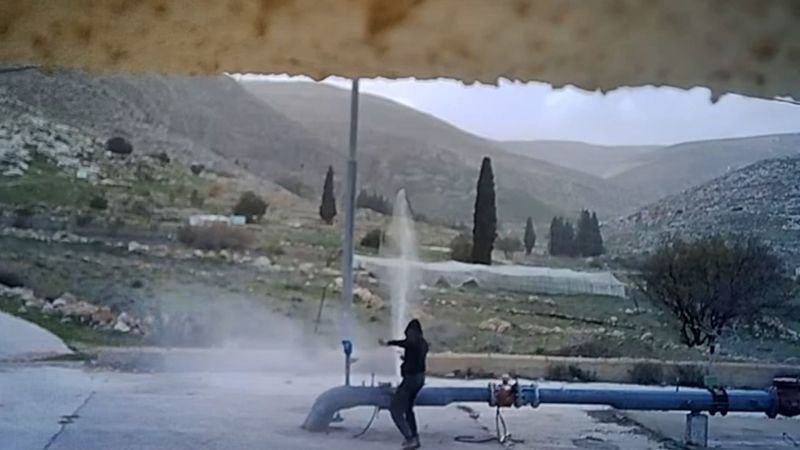
    And the attacks keep coming. Ayyash plays CCTV footage of a settler using what appears to be pepper spray on workers at a well site in Ein Samia. In another incident, a settler with a hammer in his hand kicks a worker. Settlers’ children also appear to be involved. Footage shows boys trying to damage water pipes.

    Settlers have also installed a pipe to divert water into a nearby swimming pool, Ayyash said. A video on social media shows settlers diving into the pool’s green waters.

    The attacks take a toll. “A lot of time we don’t have enough water,” Ayyash said. It’s also very expensive to fix the damage. He fears the settlers will cut off access to the wells that feed the pumping station. That would be “a catastrophe,” he said.

    On the day CNN was at the Ein Samia station, the workers looked on edge as they checked the perimeters of the building — the settlers in the ATV were still hanging around.

    Everyone at the station believes another attack will come. It’s just a question of when, they say.

    Source link

    Related Posts

    Full moons: What to know about May’s double feature
    United States

    Full moons: What to know about May’s double feature

    May 4, 2026
    The Return for These Investors Isn’t Money, It’s More Affordable Housing
    United States

    The Return for These Investors Isn’t Money, It’s More Affordable Housing

    May 4, 2026
    Opinion | Will Massachusetts Sour on Religious Freedom?
    United States

    Opinion | Will Massachusetts Sour on Religious Freedom?

    May 4, 2026
    Iran fires on U.S. ships in Strait of Hormuz, in threat to ceasefire
    United States

    Iran fires on U.S. ships in Strait of Hormuz, in threat to ceasefire

    May 4, 2026
    Supreme Court Temporarily Restores Access to Abortion Pill by Mail
    United States

    Supreme Court Temporarily Restores Access to Abortion Pill by Mail

    May 4, 2026
    Wild parrots copy their friends when deciding whether to try new foods, study finds
    United States

    Wild parrots copy their friends when deciding whether to try new foods, study finds

    May 4, 2026
    Next Post
    Dos vidas extraordinarias – LA NACION

    Dos vidas extraordinarias - LA NACION

    POPULAR NEWS

    Justin Bieber fans flood Coachella festival for headlining show – Entertainment

    Justin Bieber fans flood Coachella festival for headlining show – Entertainment

    April 20, 2026

    Over 600 flee homes as Army, NPA clash in Negros Occidental

    April 21, 2026

    Ex-DPWH exec recalls P800-M ‘delivery’ to Zaldy Co 

    April 20, 2026

    Former PM Paluckas suspends party membership, to waive immunity over criminal probe

    April 24, 2026
    Pres. Ali challenges CARICOM to transform into health research powerhouse

    Pres. Ali challenges CARICOM to transform into health research powerhouse

    April 23, 2026

    EDITOR'S PICK

    USPS Is Running Out of Money. Here’s How It Could Affect Your Mail.

    April 11, 2026
    Yoik, harp and seven or eight different languages ​​for this year’s Arctic Sounds

    Yoik, harp and seven or eight different languages ​​for this year’s Arctic Sounds

    April 12, 2026
    Lawmakers pass Childcare Services Act

    Lawmakers pass Childcare Services Act

    April 15, 2026
    Manila Bulletin – Survey results show PBBM winning battle of hearts and minds–ranking solons

    Manila Bulletin – Survey results show PBBM winning battle of hearts and minds–ranking solons

    April 21, 2026

    Recent Posts

    • ‘I’m hoping people get inspired’: what can we learn from the godfather of community organizing? | Documentary films
    • Ukrainian drone hits upmarket Moscow high-rise ahead of Victory Day celebrations
    • Arrested a tourist with long guns in the Pas who was in the country for Macron’s visit
    • Limassol: Musical instruments worth €63,000 were stolen

      © 2026 Agentially - Navigating shifting sovereignties and global risk .

      Welcome Back!

      Login to your account below

      Forgotten Password?

      Retrieve your password

      Please enter your username or email address to reset your password.

      Log In
      No Result
      View All Result

        © 2026 Agentially - Navigating shifting sovereignties and global risk .

        This website uses cookies. By continuing to use this website you are giving consent to cookies being used. Visit our Privacy and Cookie Policy.