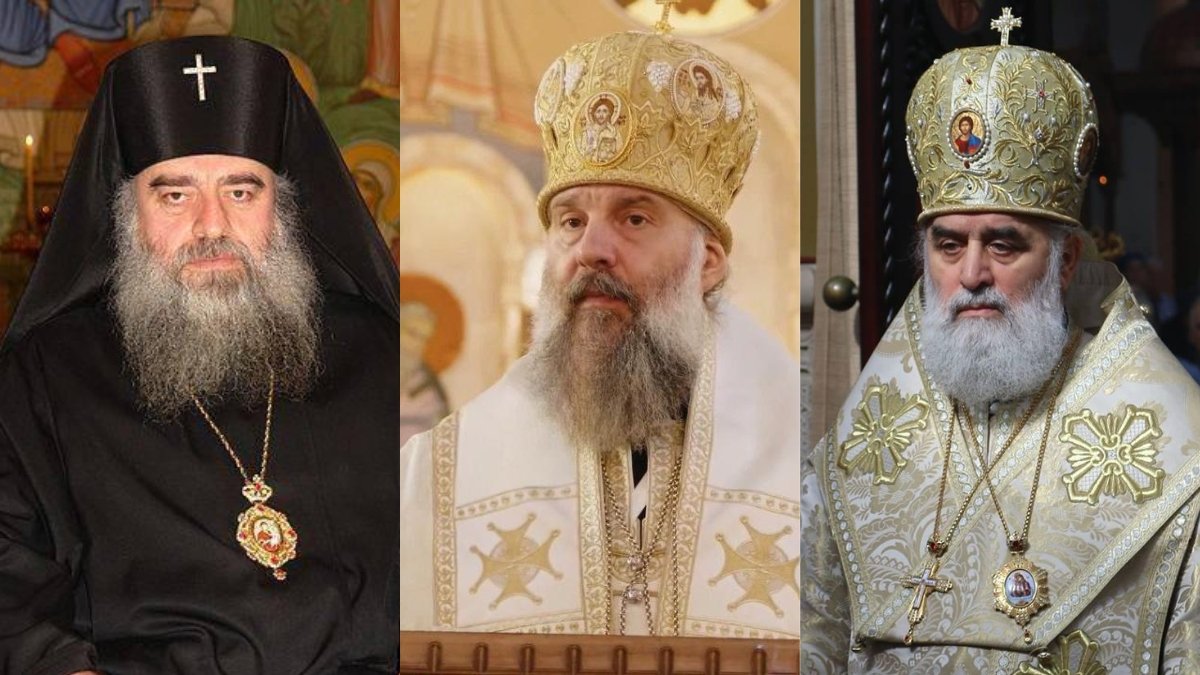
Three Georgian Orthodox Church hierarchs – Metropolitan Shio of Senaki and Chkhorotsku diocese (Patriarchal Locum Tenens), Metropolitan Iobi of Ruisi and Urbnisi diocese, and Metropolitan Grigol of Poti and Khobi Diocese – are the candidates to succeed late Patriarch Ilia II, Andria Jagmaidze, Head of Georgian Patriarchate’s Public Relations Department, announced after the Holy Synod meeting on April 28.
The Synod, which currently consists of 39 voting members, convened with 38 members in attendance to select the three candidates by secret ballot. One member, Metropolitan Zosime of Tsilkani, did not attend the session due to health reasons.
Metropolitan Shio (Mujiri), who has enjoyed growing spotlight since Ilia II named him as his Locum Tenens in 2017, has received 20 votes; Metropolitan Iobi (Akiashvili), an influential and at times controversial leader of Ruisi and Urbnisi diocese, secured 7 votes, and so did Metropolitan Grigol (Berbichashvili), who has been among the most outspoken church hierarchs as the country faced political crisis in recent years. According to Jagmaidze, three more candidates – Bishop Dositheos of Belgium and Holland, Bishop Grigol of Tsalka, and Bishop Melkisedek of Margveti and Ubisi, were considered during the secret ballot.
Patriarch Ilia II passed away on March 17 at the age of 93, after nearly five decades at the helm of the Georgian Orthodox Church, the nation’s most-trusted institution. He was laid to rest in a mass funeral ceremony that attracted tens of thousands. The successor, who will become the 142nd primate of the Church, will have to face the lingering shadow of the late, revered patriarch, as well as new realities, as the Church and its hierarchs are expected to gradually emerge from the same shadow, a shift expected to lead to more pluralistic governance, including the Synod reclaiming greater power.
The succession is governed by the Church’s 1995 statute of administration, which sets out both eligibility requirements and voting procedures.
The new Patriarch must be elected no earlier than 40 days and no later than two months after the death of the previous Patriarch, setting the latest possible deadline at May 17. The election is held during an extended church assembly that includes both clerical and lay participants from across Georgia, though only the 39 members of the Holy Synod are entitled to vote in a secret ballot. A candidate must secure a majority of at least 20 votes to be elected. If no candidate reaches this threshold, a runoff is held.
Candidates must be “Georgian by nationality”, be “no younger than 40 years of age and no older than 70,” be a hierarch of the Georgian Orthodox Church, possess “theological education,” have sufficient experience in church governance, and be ordained as a monk. Patriarchs are elected for life.
No date has yet been set for the extended church assembly, but it is set to be held at the Holy Trinity Cathedral. Speaking to reporters after the April 28 Synod meeting, Metropolitan Nikoloz (Pachuashvili) said that it may be as well scheduled after May 17, citing “many organizational matters” that need to be addressed.
While two other potential candidates, Metropolitan Isaia (Chanturia) and Metropolitan Daniel (Datuashvili), were mentioned in public discussions, neither was considered during the April 28 vote, apparently due to the Synod’s interpretation of the statutory criteria. Isaia, a popular cleric leading a diocese that partly falls within the occupied Tskhinvali region, does not have any publicly recorded theological degree, while Daniel, who heads the Sachkhere and Chiatura diocese in western Georgia, is set to turn 71 on May 29, days after the deadline for the patriarch’s election.
Shortlisted Candidates
Born and raised in downtown Tbilisi, in what would later become a prominent circle that includes Georgia’s fourth president Giorgi Margvelashvili and conservative, Moscow-friendly businessman Levan Vasadze, Mujiri initially pursued music, studying cello at the Tbilisi State Conservatoire before entering monastic life at Shiomghvime Monastery in 1991. He was ordained a monk in 1993, became a deacon in 1995, and a priest in 1996, and later completed theological studies in Georgia and Russia, including at the Moscow Theological Academy and Saint Tikhon’s Orthodox University, where he also earned a Doctor of Divinity degree in 2015. In 2003, he was consecrated bishop and appointed head of the Senaki and Chkhorotsku Diocese.
Metropolitan Shio was designated by Catholicos-Patriarch Ilia II as locum tenens in 2017 amid the late Patriarch’s declining health. Since then, Shio has drawn increasing publicity, with some observers linking the Church’s more hardline and government-aligned positions in recent years to his leadership. While the position of locum tenens – a role reaffirmed by the Holy Synod following Ilia II’s passing – does not formally determine succession, his designation by Ilia II has elevated his public profile, with critics pointing to what they describe as coordinated media support for Shio after Ilia II’s death. Shio’s figure has also been the subject of controversy, including scrutiny over his education in Russia and reported ties to Vasadze.
Born Elguja Akiashvili in the village of Sno, Stepantsminda municipality, from where the late Patriarch Ilia II also hails, Iobi was first trained as an economist, initially serving as deputy head of its financial department and as an archivist in the Patriarchate. He entered the Mtskheta theological seminary in 1985, was ordained a monk and then a priest in 1988. Having held monastic and missionary roles, including as a novice of Martkopi Monastery, he rose through the ranks to archimandrite in 1990. In 1995, he became Bishop of Batumi and Skhalta, and a year later, he was appointed head of the Urbnisi and Ruisi Diocese and named chorepiscopus of Catholicos-Patriarch Ilia II. He was elevated to archbishop in 1996 and to metropolitan in 2000. He is also authorized to perform exorcism prayers, regularly announcing “prayers for the condemned” in his diocese, and has been photographed posing with bear cubs kept there.
Iobi has repeatedly come into the public spotlight, facing allegations of sheltering those wanted for serious crimes in his diocese, as well as over the involvement of the clergy in the area in land disputes with locals. In addition, files allegedly leaked from the State Security Service of Georgia in 2021 suggested that he expressed support for former Metropolitan of Chkondidi Petre Tsaava following his dismissal by the Holy Synod of the Georgian Orthodox Church, after Tsaava publicly accused Catholicos-Patriarch Ilia II of “pederasty.” While he does not clearly express his political views, he is known to have taken positions critical of incumbent governments. Iobi indirectly backed the release of jailed ex-President Mikheil Saakashvili in a 2024 sermon, while in 2025, commenting on Georgian Dream repressions, he told reporters that authorities not serving “justice and truth” could be likened to a “group of bandits,” referencing St. Augustine.
Born Guram Berbichashvili in Tbilisi, Metropolitan Grigol began church service in the late Soviet period and studied at the Tbilisi Theological Seminary and Academy between 1988 and 1994. Ordained deacon in 1989 and priest in 1990, he served in parishes in western Georgia, including in Guria, where he was involved in reviving religious life and publishing church materials. In 1996, he was ordained a monk, elevated to archimandrite, and consecrated bishop of Poti.
Grigol’s name has also appeared in materials allegedly leaked from the State Security Service of Georgia. According to those documents, he was previously convicted multiple times and served a sentence in the Russian Federation alongside Metropolitan Anton Bulukhia. Metropolitan Grigol is known for his outspoken positions on political developments. In 2024, he called on the Georgian Dream government to halt consideration of the “foreign agents” law and take public protests into account, warning against escalating tensions. In a 2025 Christmas sermon, weeks after non-stop protests had erupted against the Georgian Dream’s anti-EU turn, he said, “Today […] a new society is being born in Georgia,” adding that violence against citizens was “unacceptable,” particularly when they act within constitutional rights in pursuit of civil freedoms and a better future.
Also Read: