SINGAPORE – In the near future, drones will be deployed across Singapore to chase criminals, document fires and conduct routine patrols.
Controlled remotely, the drones will fly out from boxes placed across the island, enabling officers to respond quickly to incidents and have more information before arriving on the scene.
These drone box systems were on display at the Milipol TechX Summit (MTX) 2026, which is being held from April 28 to 30 at Sands Expo and Convention Centre.
The event is jointly organised by the Home Team Science and Technology Agency (HTX), Civipol, TechX Ventures and events company Comexposium, and is supported by Singapore’s Ministry of Home Affairs and France’s Ministry of the Interior.
Currently, deploying police drones takes about an hour, as officers must transport the drone to the site, a process influenced by traffic conditions.
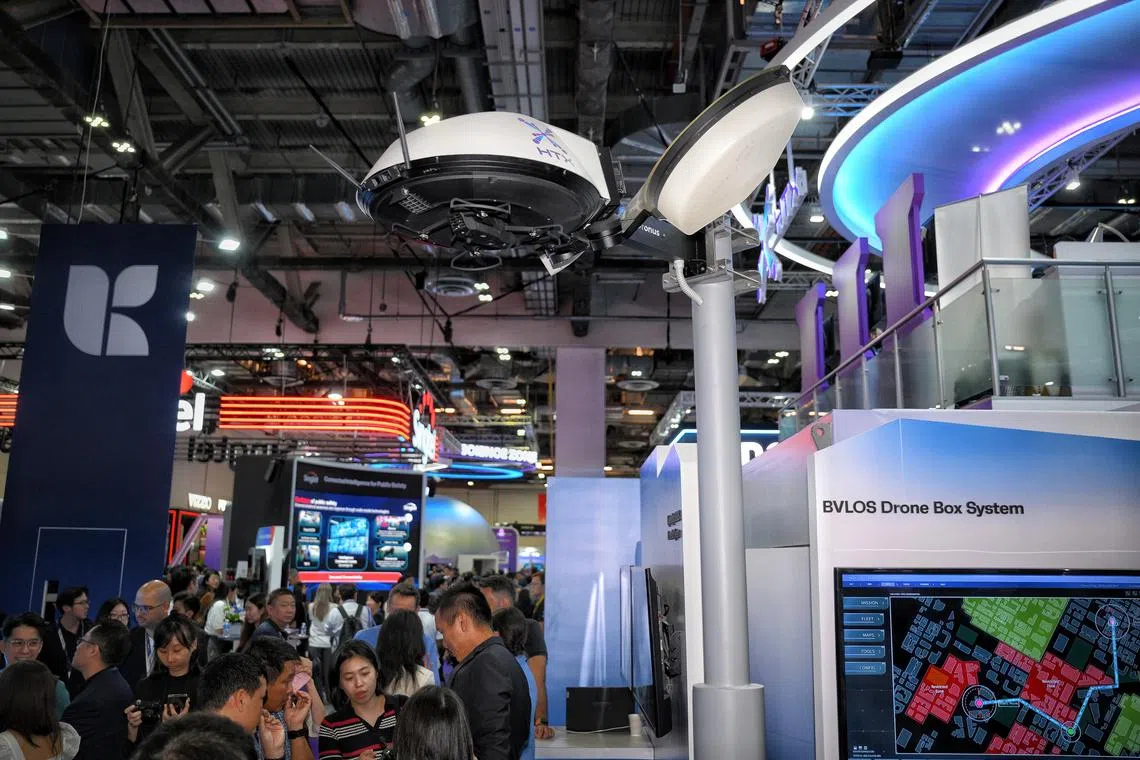
The new drone box system will see 40kg drones being almost immediately deployed to incidents while officers or firefighters are still on their way.
The drones are equipped with three different types of cameras, and can also carry a speaker and a spotlight.
Each drone is housed in a box weighing around 4,000kg, which includes extra batteries and cameras that can be swopped out if needed. This set-up allows the drones to sustain operations for extended periods of time.
Mr Lee Wing Ho, an engineer from HTX’s robotics, automation and unmanned systems (RAUS) team, said the drones come equipped with 5G capabilities.
This approach eliminates the need to station drone operators across various locations. Instead, all of the drones can be controlled from a centralised pool of operators in a single location.
Mr Lee said: “The end goal is to have the drones deployed across Singapore, replacing tasks like routine patrols, and responding quicker to incidents.”
He said, however, that these large drones will not be suitable for all scenarios, as they typically fly higher up in the sky.
As such, HTX is also working on a drone box system with smaller drones.

A drone used in the BVLOS Drone Box System, on display at the Milipol TechX Summit 2026.
ST PHOTO: MARK CHEONG
These smaller drones weigh less than 350g each and are meant to fly at street level, or just over people’s heads.
They are housed in boxes that can be mounted on lamp posts and walls in urban areas.
A video demonstration showed how several such drones could be deployed in a snatch theft incident, tracking the perpetrator’s location and giving pursuit while police rushed to the scene.
Together with the larger drones, they can help the authorities gain important information more quickly and efficiently to solve crime and save lives, said Mr Lee.
Another exhibit at MTX was the Home Team’s first satellite, which it is developing and planning to launch into space in 2029.
Codenamed Xplorer, the 100kg satellite will have sensors and cameras to detect hazardous gases such as ammonia.
Ms Brenda Ong, a principal scientist at HTX’s Disruptive Technologies Office, said the satellite can also be used for other Home Team operations.
She added that the satellite may be used to detect when emergency access routes are blocked.
She said: “There are thousands of such access routes across the island, and it is impossible to physically inspect all of them regularly due to the sheer number.
“The satellite will be able to do this and send the information back.”
Ms Ong said the satellite will be built with an artificial intelligence processor, allowing it to quickly filter all of the information collected and determine what is important to send back to officers on the ground.
She added that the satellite is built for public safety, and is not capable of surveilling individuals.

Visitors looking at a half-size model of the Xplorer, a Home Team hyperspectral satellite, at the Milipol TechX Summit 2026.
ST PHOTO: MARK CHEONG
A third exhibit at the event was the world’s first underwater humanoid robot, developed by Stanford University.
Called OceanOneK, the robot is able to reach depths of up to 1km and is controlled remotely by an operator through haptic controls.
These controls enable operators to sense the relative hardness or softness of objects, allowing for greater control and recovery of fragile items deep underwater.
They are also able to view the location through the robot’s perspective and perceive depth because it uses two cameras, which mimics human vision.

The OceanOneK, the world’s first underwater humanoid robot, by Stanford University, pictured at Milipol TechX Summit 2026.
ST PHOTO: MARK CHEONG
Mr Jerryl Neo, an engineer with the HTX RAUS team, said HTX is hoping to work with Stanford University to develop the technology so it can be used here.
He said that currently, divers still need to be deployed for complex underwater recovery operations, facing potential risks of equipment failure and other underwater hazards.
Mr Neo said HTX hopes for the first deployment here to be in three to five years’ time, which would reduce the need to send divers into such risky operations.