HIGH-END TECH:
The manufacturing overhead of CSIST’s Kuai Chi USVs would be dramatically reduced with the use of Saronic’s software and components, the institute said
-
By Lo Tien-pin and Jake Chung / Staff reporter, with staff writer
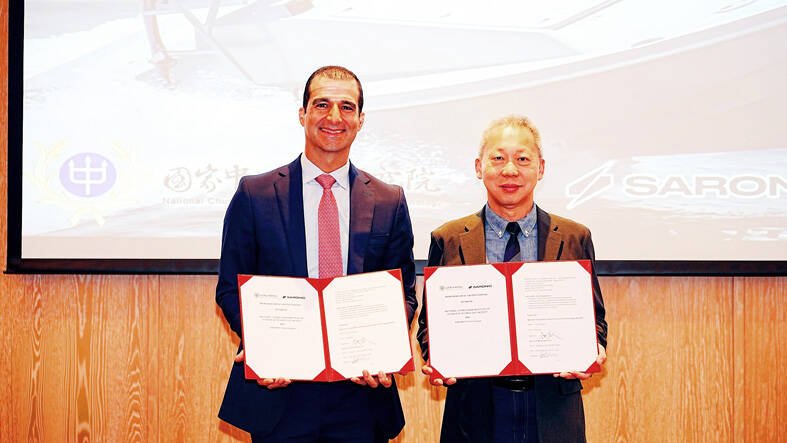
The Chungshan Institute of Science and Technology (CSIST) yesterday inked a memorandum of understanding (MOU) with US-based Saronic Technologies to jointly develop modular uncrewed surface vehicles (USVs) to augment Taiwanese capabilities to produce high-level artificial intelligence (AI) control systems for USVs.
The MOU with Saronic Technologies and Maritime Tactical Systems (MarTac) would reduce development time and diversify high-end technology sources, government officials said on the condition of anonymity.
The government would also diversify its USV manufacturing to ensure that multiple companies could rapidly produce USVs in times of emergency, the source said.
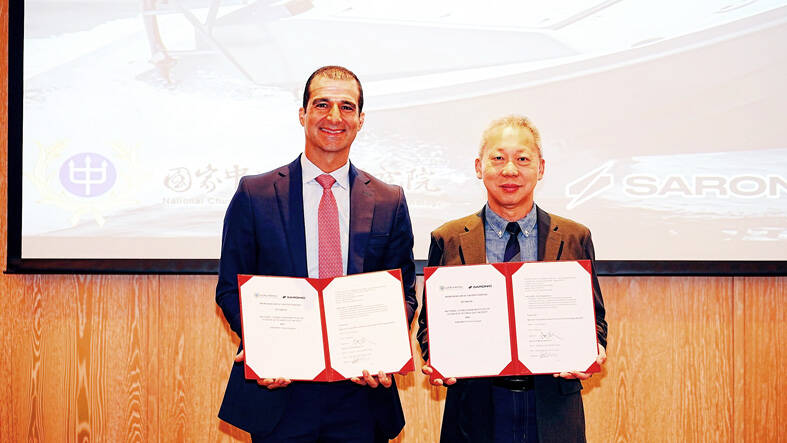
Photo courtesy of the institute via CNA
Citing the Ministry of National Defense’s proposed special budget, the source said the Armaments Bureau’s Materiel Production Center would take point for domestic procurement and integration of all pyrotechnic-related processes to procure 1,320 suicide USVs.
The number of procured vessels would not include vessels required by the Coast Guard Administration (CGA) or other departments, according to the budget.
The USVs must be stealth-capable, with a remote-control range of 40km or above, and an operational range of 250 nautical miles (463km), while being capable of carrying large amounts of explosives or reconnaissance systems, it said.
The source said the institute in September last year inked an MOU with MarTac to develop technologies enabling USVs to perform AI-based target identification and tracking, autonomous interception, protective barrier deployment, synchronized operations among multiple vessels, avoidance of maritime surface obstacles, kinetic interception and autonomous tactical decisionmaking.
The technologies would allow USVs to support CGA operations during peacetime and reduce the personnel allotment, ensuring the CGA can transition to a wartime footing in the event of an invasion, the source said.
The MOU inked with Saronic chief executive officer Kostadino George Mavrookas yesterday would allow both sides to share knowledge on command-and-control systems software, ship design, system integration and the development of autonomous USV supply chains, the source said.
CSIST-developed Kuai Chi USVs, which completed sea trials last year, could see a drastic reduction in manufacturing overhead with the introduction of Saronic software and components, the institute said.
The CSIST-Saronic MOU would foster domestic shipbuilding while ensuring that Taiwan’s electronics and software industries establish a foothold in global national defense supply chains, it added.