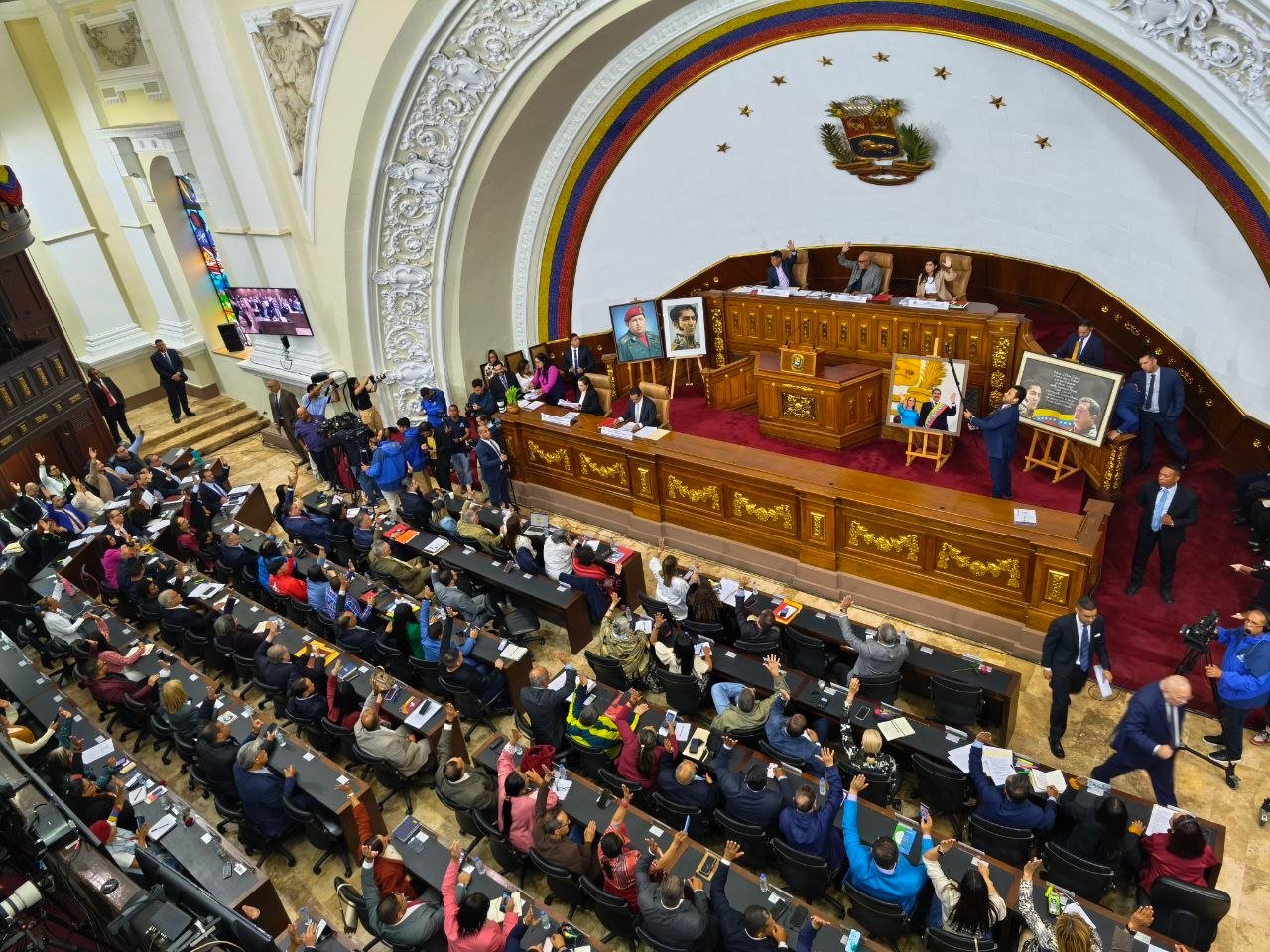
The National Assembly (AN) with a majority of Chavismo sanctioned 60 more articles of the Organic Law of Mines to reach article 115 (of more than 130), before again deferring the second discussion of the regulations that has lasted for almost a month.
The argument presented by the deputy (Psuv), Orlando Camacho, was the same as in the session of March 26: more proposals have arrived for the rest of the articles and require evaluation for their incorporation into the report. The bulk of the articles have been approved so far by a qualified majority of Chavismo with the votes of the Democratic Alliance, while the support of the Libertad group, led by Henrique Capriles and Stalin González, is limited to a few articles in which unanimity was achieved.
The government in charge of Delcy Rodriguez proposed the law to Parliament, chaired by his brother, Jorge Rodríguez, after the visit to the country of the Secretary of the Interior of the United States, Doug Burgum, on March 4, to seal cooperation agreements on mining matters.
Concessions for 30 years
Among the articles sanctioned during the ordinary session of this Tuesday, April 7, is article 65 on the granting of the mining concessions for up to 30 years. The project approved in the first discussion limited the period to 20 years, but Chavismo welcomed the proposal for the extension of sectors opposed to the government such as the Ideas for Democracy Group, made up of former deputy Elías Matta.
“The concession will not exceed thirty (30) years, counted from the date of its publication in the Official Gazette of the Bolivarian Republic of Venezuela, and its duration may be extended for successive periods of no more than ten (10) years each, without exceeding the period initially granted, if the concessionaire so requests from the Ministry with jurisdiction over mines,” was the final wording of the article.
The extension request of the successive periods of the concession will be made by the solvent concessionaire with the Republic before 6 months after its expiration. The Ministry with jurisdiction in the matter will decide the request within a period of six months.
Article 75 establishes the creation of joint ventures mining companies authorized by the President of the Republic in the Council of Ministers. The bench outside of Chavismo, in the voice of deputy Salomón Centeno (Vamos Vamos Venezuela) objected to the power given to the Executive in this and other articles, overriding the powers that states should have in the matter. The observation was rejected by Chavismo.
Royalty payment
Centeno also proposed that royalties for mining activity in article 91 be lowered from 13% to 10% “to attract investment” and that the tax increase be progressive with profits. The article was approved by Chavismo with a royalty payment for the quantities of minerals extracted from any deposit up to 13%.
The tax that the owners must pay to the State for the exercise of mining activities was established in article 95 at 6%. The competent ministry may modify the rate during the execution of the mining project.
The Libertad parliamentary group, in the voice of deputy Antonio Ecarri, proposed a new article that was accepted by Chavismo and sanctioned with number 98. It refers to a special regime for mineral refining industriesaccording to which it is exempt from paying taxes for 10 years. They will only pay the export tax, which should not exceed 5%. The benefit will be subject to compliance with investment commitments.
Prosecutor and defender on hold
In the account, prior to the discussion of the agenda, the secretary of the AN reported on the consignment of the report and account for 2025, corresponding to the Public Ministry and the Ombudsman’s Office.
Nothing was said, neither before nor after the discussion of the Mining Law, about how the process of choosing the new heads of both institutions is going, which seems frozen since March 27, when 21 new applications for the positions were announced, after a 48-hour extension proposed by Jorge Rodriguez.
The lawyer remains as prosecutor in charge Larry Devoe and as acting ombudsman the former attorney general, Tarek William Saab. Devoe ran for ratification in office, which is rejected by human rights defenders for denying crimes against humanity in Venezuela before international organizations.
Saab will not repeat. Delcy Rodriguez appointed him on March 19, as head of the Great Mission Viva Venezuela, Mi Patria Querida, assigned to the office of the presidency to “promote, preserve and disseminate the music, dance, rhythms and traditional cultural values of the country.”
As for the ombudsman, attention falls on the possible appointment of journalist Vladimir Villegas, after the resignation of his brother and former Minister of Culture, Ernesto Villegas, from his candidacy before the AN. NGOs and academics demand that both positions be appointed people with political independence, probity and sufficient credentials.