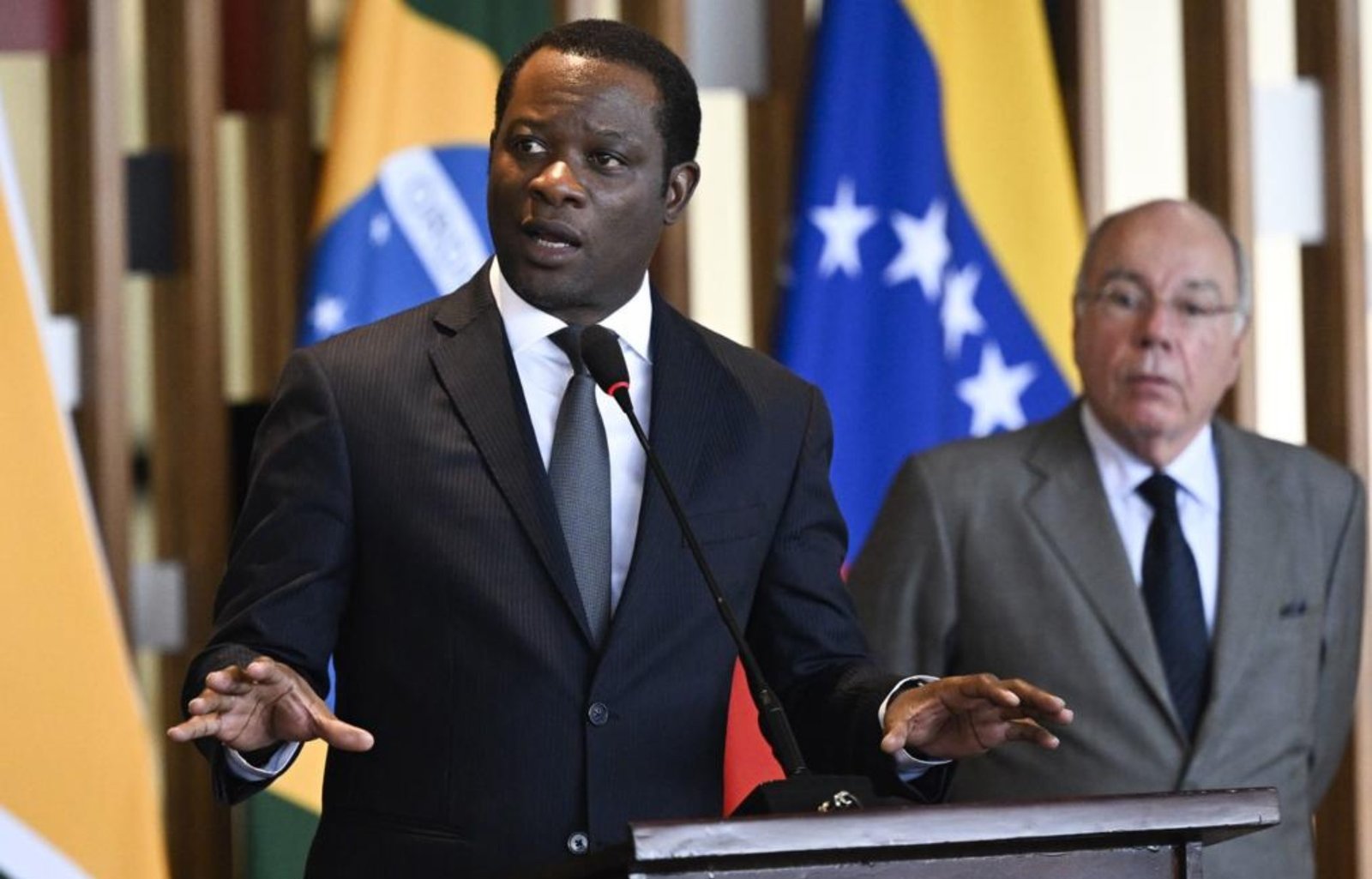
The government of Guyana rejected any bilateral dialogue with Venezuela this Saturday over the disputed Essequibo region, insisting that the border dispute must be resolved before the International Court of Justice (ICJ).
“Guyana has been very clear and firm: we will not hold bilateral talks with Venezuela on the controversy relating to the 1899 Arbitration Award,” which established the border between both countries, declared the Guyanese Minister of Foreign Affairs, Hugh Todd.
The head of Guyanese diplomacy stated in a statement that Guyana remains committed to the judicial process before the ICJ and that it will abide by the court’s ruling, urging Venezuela to do the same. This was published by the EFE news agency.
The ICJ ruling could be issued as early as the first quarter of 2027, according to Todd, who added that Guyana firmly maintains that the 1899 award is “perfect, final and complete.”
Todd’s statements come after the president in charge of Venezuela, Delcy Rodríguez, said on Friday that her country rejects “the fraudulent arbitration award of 1899” and reaffirmed its position of non-recognition of the ICJ to settle the territorial dispute.
Dispute between Venezuela and Guyana
For its part, the United States government assured on Thursday that it continues to respect the 1899 award, following the publication of information that indicated that a US official raised with Georgetown the possibility of ceding part of the Essequibo to Caracas, which occupies two-thirds of Guyana and is rich in hydrocarbons.
“This award must be respected, unless – or until – a competent legal body or the consent of both parties establishes a new border delimitation,” the State Department indicated in a statement sent to EFE.
Coinciding with this information, the Ministry of Foreign Affairs of Guyana assured that it had received guarantees from Washington that its position regarding the border controversy has not changed.
In this regard, Todd explained that the US position proposed two possible ways to modify the border: through a determination by a competent authority or through bilateral conversations between Guyana and Venezuela.
In this sense, the minister stressed that Guyana considers the ICJ as the competent authority, in accordance with the provisions of the 1966 Geneva Agreement, which is why he ruled out the option of bilateral talks.
Differences over the border limits around Essequibo, a territory of about 160,000 square kilometers, began with the Paris Arbitration Award of 1899, which gave sovereignty of the territory to the then British Guiana.
Decades later, Venezuela declared this ruling null and void and signed the aforementioned Geneva Agreement with the United Kingdom.
Guyana brought the case to the ICJ in 2018, seeking confirmation of the legal validity of the 1899 award. The court held hearings on the merits of the matter in May 2026 and is currently deliberating on a ruling.