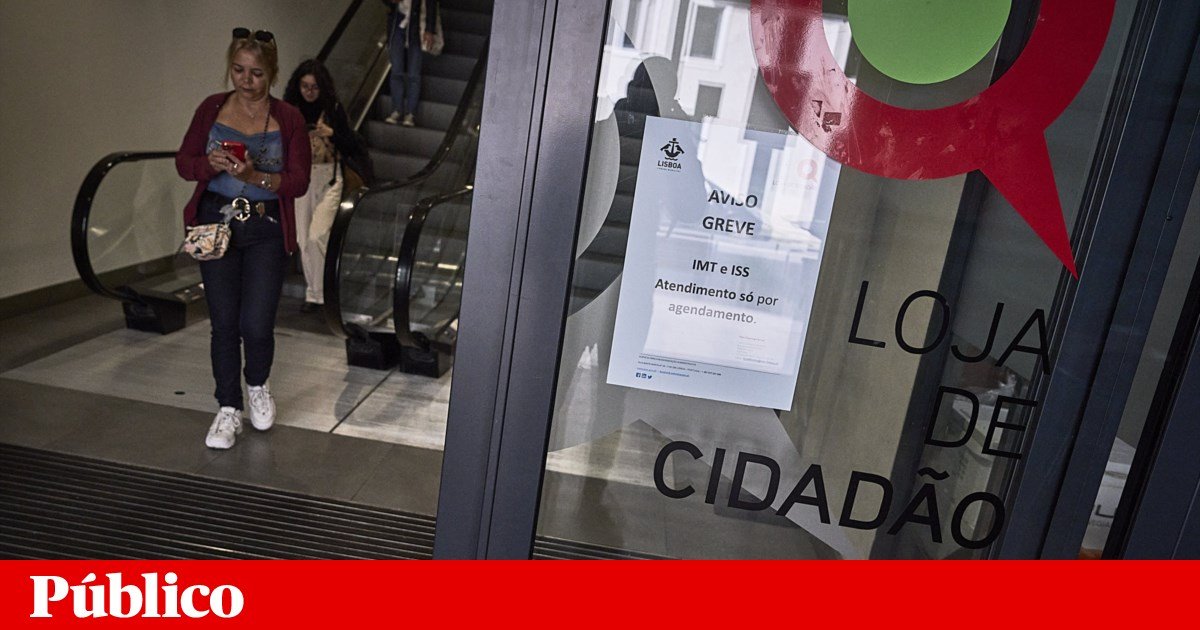
The national strike of Public Administration this Friday, November 20th, should affect schools, hospitals, health centers, courts, citizen stores, local authorities, services linked to cleaning and waste collection, as well as public service counters of Social Security, the Tax Authority and other bodies. This will be the first in a series of four strikes, called by different unions, which will take place over the next few weeks and which will have a particular impact on schools.
Sebastião Santana, the coordinator of the Common Front, a structure that brings together more than three dozen unions and is responsible for scheduling this Friday’s strike, expects there to be “a strong support”.
“In the mobilization work we carried out, we realized that workers are available to join”, highlights the leader, adding that the advance notice covers all areas of the public service, such as teachers, doctors, nurses, judicial employees, general careers and local authority workers.
“There will be no Public Administration worker who cannot go on strike”, emphasizes Sebastião Santana.
In the sectors covered, namely hospitals and courts, minimum services are foreseen.
The leader criticizes the Government’s stance in the negotiations — for not accepting to go beyond the salary increase of 60.52 euros (or a minimum of 2.3%) and for setting the State’s remuneration base below a thousand euros — and hopes that this Friday’s strike will provide an adequate response to the “provocation” of increase meal allowance by 30 cents of public sector workers.
The union leader hoped that, at the meeting that took place at the Ministry of Finance this Thursday, the executive “would bring something that could lead (the union) to consider rethinking this decision” on the strike.
“That’s not what happened”, he stated, regretting that the increase in the meal allowance from 6.15 to 6.45 euros per day is what “the Government has to offer to those who put public services to work every day, schools, hospitals, garbage collection, Social Security, Finance, the Security forces”.
The strike will last 24 hours, but its impact will begin to be felt this Thursday and Saturday morning, especially in organizations that work at night or in shifts.
Also this Friday, diagnostic and therapeutic technicians are promoting the second day of strike, with an impact on analysis and imaging services, among others.
On Saturday, November 21st, CGTP takes workers to the streets in a national demonstration for salary increases, better pensions and in defense of health, education, housing and Social Security. In Lisbon, the parade starts at Saldanha and ends at Restauradores.
Labor conflict will rise again next week, with more strikes and concentrations.
You CP machinists They have a strike called between the 23rd and 27th of November, with a total strike on the 24th and 25th.
For November 24th, the day of the final vote on the State Budget for 2027, CGTP scheduled a rally in front of the Assembly of the Republic from 10:30 am, arguing that the budget proposal does not guarantee real income gains for workers nor does it respond to health, education and housing problems.
Education in the eye of the hurricane
On the same day, several independent unions in the health and education sectors, as well as large supermarket and banking workers, went on strike.
The strike brings together the Union of All Education Professionals (Stop), the Independent Union of All United Nurses, the Union of Workers of Large Superficies, Warehouses and Services of Portugal and the banking union movement Change, which called for participation in the protest in front of the Assembly of the Republic.
On the 24th, disruptions are therefore expected in some schools, a scenario that is likely to be repeated on the 30th of November, given that the National Union of State Workers, Local Authorities and Entities with Public and Social Purposes issued a notice that exclusively covers non-teaching staff at schools and that of the National Federation of Teachers (Fenprof) covers teachers.
On December 2nd, a new strike is planned that will have an impact on schools, on the initiative of the National Federation of Independent Public Administration Unions (Fesinap) which called on workers from the central, regional and local public administration, including special and subsistent careers, regardless of the nature of the contract.