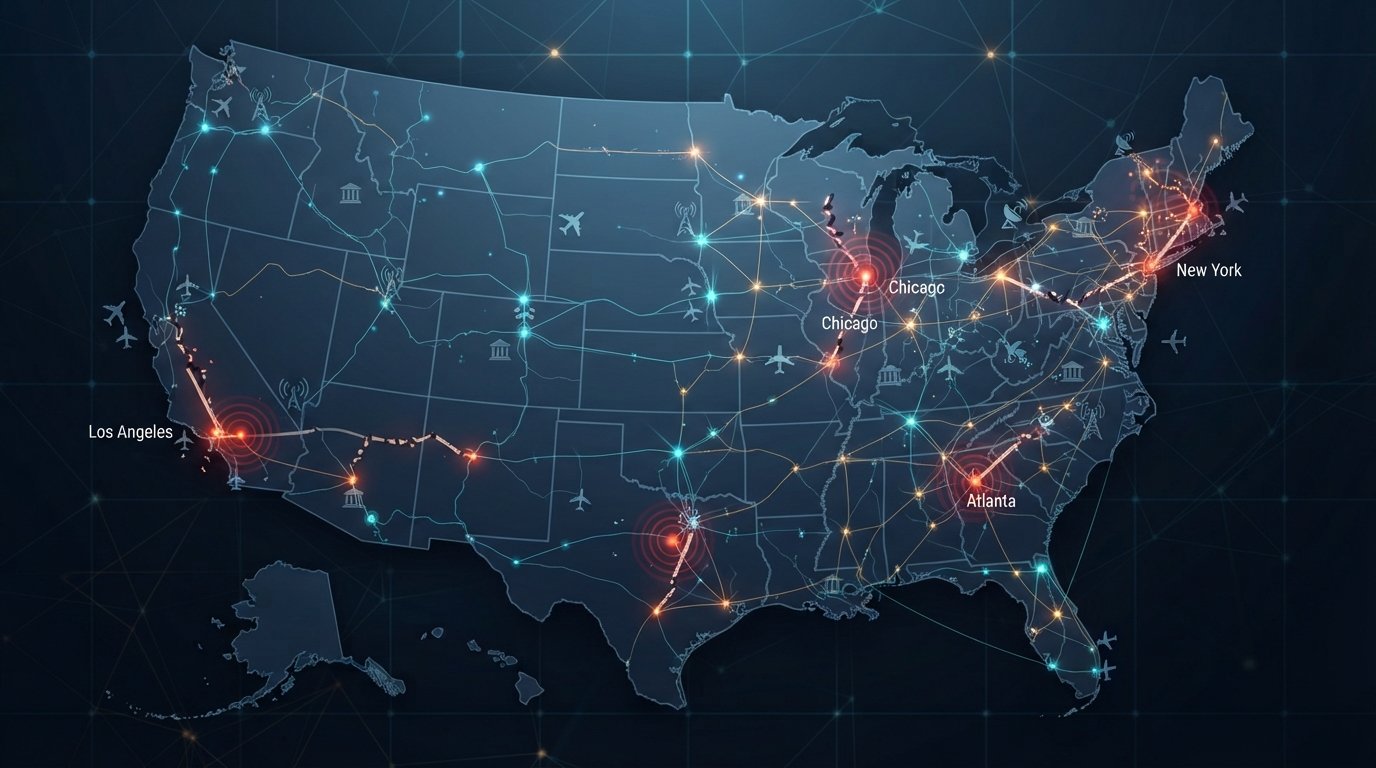

A rapid succession of high-profile technology and communications outages over the past week has disrupted air travel, financial networks, corporate software, and national security operations across the United States, prompting federal officials to reassure the public that the incidents appear to be unrelated technical failures rather than a coordinated cyberattack.
Between Nov. 12 and Nov. 17, failures struck systems operated by the National Security Agency (NSA), the Federal Aviation Administration (FAA), Microsoft, major banks, and commercial airlines. While the timing has fueled public concern and calls from lawmakers for greater transparency, government agencies and affected companies maintain that software bugs, aging infrastructure, and routine maintenance errors are to blame.
The latest disruption occurred Tuesday, Nov. 17, when the classified internal communications network used by the National Security Agency—known as NSANet—experienced an outage.
According to reporting from CNN and The Washington Post, the disruption was significant enough that the agency temporarily restricted campus access to essential personnel and staggered employee arrival times at facilities including Fort Meade, Maryland, and Fort Gordon, Georgia, to reduce strain on the system.
In a public statement, the NSA described the incident as “temporary degradation during scheduled routine maintenance,” emphasizing that built-in redundancies kept mission-critical intelligence and national defense capabilities fully operational.
Director of National Intelligence Jay Clayton told reporters that the problem stemmed from a software patch applied to fix vulnerabilities discovered the previous month, adding there was no indication of a cyberattack.
The intelligence network issue followed major disruptions to U.S. aviation communications just days earlier:
FAA Nationwide Ground Stop (Nov. 13): The Federal Aviation Administration halted all departing flights across the United States for more than four hours after a telecommunications failure impacted regional Air Route Traffic Control Centers. According to NPR and CNN, Transportation Secretary Sean Duffy attributed the stoppage—the first nationwide ground stop since January 2023—to an overload on aging analog air traffic systems, compounded by copper-to-fiber-optic cable upgrades and a faulty router in Arkansas.
United Airlines Outage (Nov. 16): On Monday, United Airlines suffered a separate internal software issue affecting crew-facing applications and flight-planning tools, delaying more than 400 departing flights before service was restored later that day.
Corporate, Banking, and Consumer Tech FailuresSeveral private-sector platforms also experienced widespread service interruptions during the same six-day span:
Microsoft 365 (Nov. 12–14): A multi-day outage disrupted access to Outlook, Teams, and Copilot. Microsoft traced the failure to a latent software defect in its networking gateway servers triggered during capacity and traffic changes.
Banking and Financial Services (Nov. 16): Customers at major institutions—including JPMorgan Chase, Bank of America, and U.S. Bank—reported transaction and Zelle processing delays on Monday. JPMorgan Chase confirmed the issue was caused by an internal software bug affecting on-premises hardware and was resolved by Monday evening. On Tuesday, Charles Schwab also resolved a brief webpage loading issue.
Consumer Services and Other Agencies: Throughout the week, temporary technical glitches also affected Apple services (including iCloud and Apple Pay), Marriott’s reservation platform, Workday HR systems, and routine maintenance lines at the National Weather Service. Separately, cybersecurity researchers noted that malicious code had been injected into an online tool used by nearly 200 organizations via third-party platform Optimizely, though the company stated the vulnerability was patched.
Official Response and Lawmaker ScrutinyAdministration officials have sought to calm public anxiety, particularly ahead of the busy Thanksgiving travel period and amid viral social media rumors falsely conflating a scheduled Nov. 17 Federal Emergency Management Agency (FEMA) alert test with a nationwide blackout.
Speaking to reporters on Tuesday, President Donald Trump downplayed the string of outages, stating, “Things like that happen. It’s fine,” and noting that banking and travel systems were under control. Secretary of State Marco Rubio and Department of Homeland Security officials similarly stated that the incidents appeared to be separate events driven by distinct technical issues and aging infrastructure rather than foreign interference.
On Capitol Hill, however, lawmakers from both parties called for formal briefings and oversight. As reported by The Guardian and CNN, House Minority Leader Hakeem Jeffries urged the administration to brief Congress on the failures, stating the public deserves greater transparency. Republican Sen. James Lankford of Oklahoma also said the sheer number of consecutive disruptions warranted a thorough investigation.
Cybersecurity and infrastructure analysts interviewed by CBS News noted that while no evidence links the incidents to a coordinated attack, the cluster of failures highlights the fragility of deeply interconnected digital systems—where routine software updates or single hardware faults can trigger cascading disruptions across critical daily services.
While federal officials have ruled out a coordinated cyberattack, technology and security analysts view the recent wave of disruptions as a warning sign of systemic fragility across America’s digital backbone.
A primary driver identified by experts is “patching overload”: as artificial intelligence tools uncover software vulnerabilities at an unprecedented pace, tech companies and federal agencies are forced to push frequent, simultaneous updates. This accelerated maintenance cycle significantly increases the risk of human configuration errors, where a single routine update or disaster-recovery test can inadvertently trigger cascading system failures.
Compounding this strain is a heavy reliance on aging hardware and centralized cloud monopolies. Analysts point out that critical national systems—such as air-traffic communications—still depend on legacy telecom infrastructure that struggles to handle modern data loads during routine transitions. Because banking, travel, and government operations are heavily concentrated among a small handful of cloud and network providers, isolated technical glitches can rapidly escalate into nationwide bottlenecks, highlighting an urgent need for better system redundancy and modernized infrastructure.