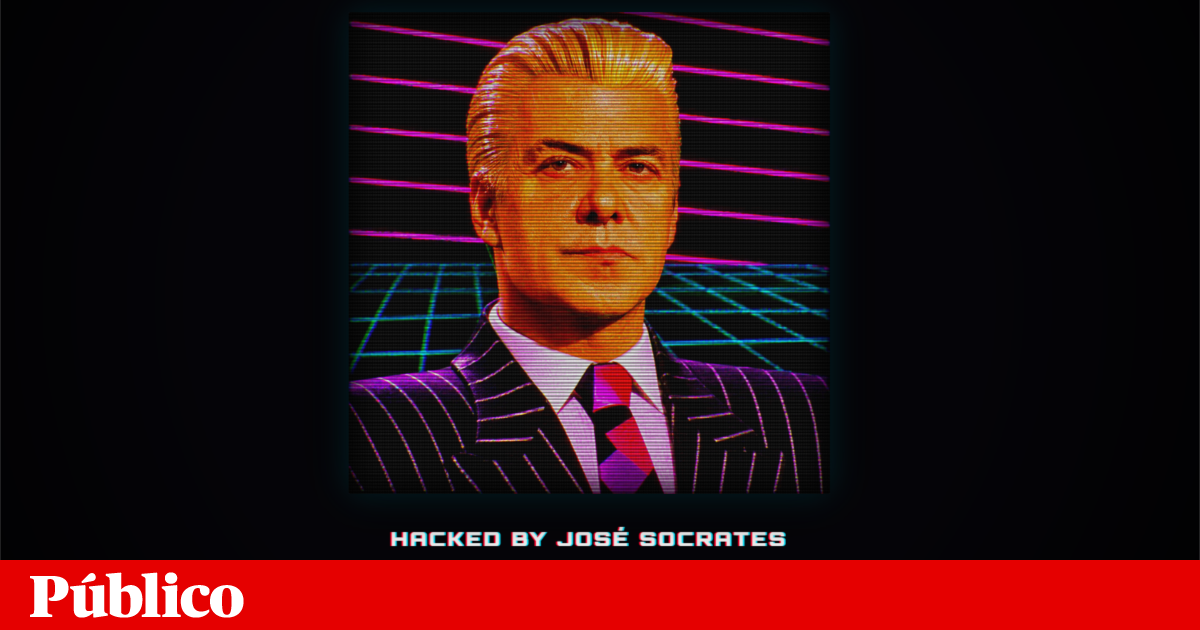
Who tried to open the website of ASAE this Sunday morning did not find the usual services. The Food and Economic Security Authority portal, where consumers and companies consult alerts, legislation and inspection results, had been replaced by an image of a figure who resembled José Sócrates.
In the montage used, the face of the former prime minister can be seen, with blond hair pulled back and a pinstripe suit, silhouetted against a futuristic neon background with the digital aesthetic of the 80s. Below, the signature “Hacked by José Sócrates” (“hacked by José Socrates”) and a sentence: “Too many laws for those who have nothing, too much freedom for those who steal millions”.
The image, created with artificial intelligence, showed a representation of the former prime minister reminiscent of Max Headroomcharacter from a television series from the 80s who was also used as the face of two television signal hijackings in Chicago in 1987.
The computer attack carried out was a defacingexplains to PÚBLICO Rui Martins, IT technician at the head of the Citizens for Cybersecurity (CpC) initiative. This type of action, which has fallen into disuse in recent years, consists of changing the appearance or content of a website after someone enters the system that supports it. The expert states that this is, above all, a display gesture and, as a rule, not very destructive, but it implies that the authors of the attack have write access to the server.
In this specific case, Rui Martins considers that the failure is “serious” because the website of ASAE has a reserved area, where the authority’s employees can authenticate themselves, and is also an entry point for complaints — whoever submits a complaint on the portal has to write in the form present on the website full name and address. Although it is not known, for now, whether this data was exposed, it is a possibility to consider, at a time when the real depth of access is yet to be determined. Rui Martins also adds that the authority’s email was not compromised, as it is hosted in Microsoft’s Outlook service.
The image used in the attack was not hosted on an ASAE server. An inspection of the archived version of the page, when the defacement was still accessible, shows that the caricatured figure of José Sócrates was uploaded from a subdomain of another state body. Technical records consulted by PÚBLICO indicate that this address corresponds to a commercial server from an external company, and not the organization’s own network.
For Rui Martins, the detail suggests that the authors of the attack also have write access to that server, a sign that a second public system has been compromised. The image remains available, and PÚBLICO chose not to identify the service until the error has been corrected.
The problem goes beyond ASAE, says the person responsible for CpC. This is because a large part of the State’s IT systems are “obsolete” and is being maintained without fundamental renewal, a defect that he considers to be transversal to public administration. Added to this is the way in which many services are set up: it is common for there to be few machines exposed to the Internet running several processes at the same time.
In Rui Martins’ opinion, what is most worrying and difficult to explain is the fact that the intrusion was not detected at the time, rather than the existence of the attack.
In a publication this Sunday about the attackthe Citizens for Cybersecurity initiative recommended to ASAE an “urgent forensic analysis and reconstruction of the system on a more secure platform, with multifactor authentication”, which, according to the initiative, was not visible when accessing the reserved area. It also suggested notification to the National Cybersecurity Center (CNCS) and the National Data Protection Commission (CNPD). The CpC advises working with the worst-case scenario, given the possibility of exposing data from whistleblowers, denounced people, witnesses and complainants and reusing credentials in other services, and does not exclude that this month’s attacks, including the second system it identified, are related.
The attack comes in a month when other websites public were the target of computer attacks. At the beginning of November, the service online PSP’s Private Security Department received an offensive message, and the police contacted the CNCS without finding signs of intrusion into its systems. Later this month, a attack on website from the Institute of Housing and Urban Rehabilitation (IHRU) replaced the original photographs with an image of a panda in a tent alluding to the camps in the house.
News updated at 11:03 pm with the CpC recommendations.