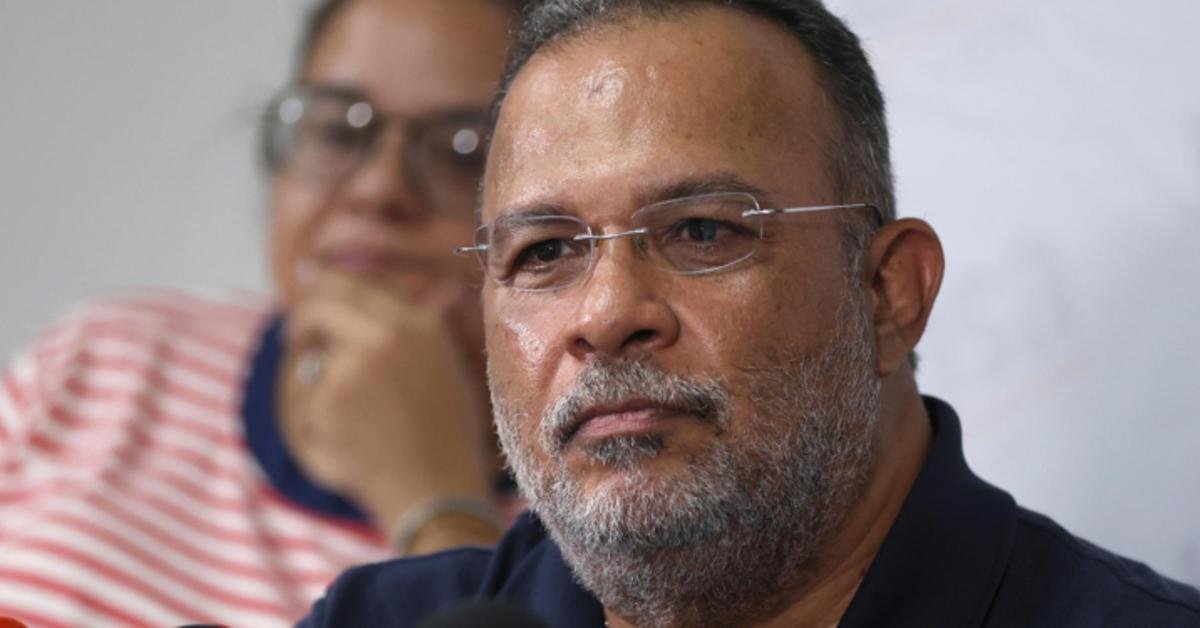
Panama City/The Panama Police arrested this Sunday in a neighborhood of the capital the “first suspect” of the attack on the home of Panamanian journalist Rolando Rodríguez, director of the renowned newspaper The Press. The capture of Luis Valiente Ortega occurred after “a search and search procedure carried out in sector 3 of Samaria, San Miguelito district”, hours after the authorities offered a reward in exchange for information about his whereabouts.
Valiente Ortega became “one of the most wanted” after his alleged connection with the attack on the newspaper director’s home. Several media outlets have identified the suspect as the driver of the taxi involved, but authorities have not provided further details.
After his arrest, the Police reported, the detainee was transferred “for the corresponding procedures in order to be placed at the disposal” of the Panamanian Prosecutor’s Office “while operational and investigative actions continue to find other alleged perpetrators.”
According to a publication by The Pressan individual threw an object at the communicator’s residence, causing an explosion, after getting out of a taxi. The house was “partially” destroyed with the garage and two vehicles set on fire. The Panamanian journalist was not present in the house, but his wife was, and she managed to escape unharmed.
Rolando Rodríguez was investigating some “facts” that implicate businessman Roberto Carretero, sentenced for embezzlement of public funds in 2021
Rolando Rodríguez was investigating some “facts” that implicate businessman Roberto Carretero, sentenced for embezzlement of public funds in 2021; the former director of the Social Security Fund (CSS), Enrique Lau, investigated for unjustified enrichment under his administration, the former director of Legal Advisory of Etesa (electricity company), Ewaldo Pittí, and the lawyer Lictor Reyna, who had already been contacted by the journalist to request their reaction, as reported The Press.
The Prosecutor’s Office began an ex officio investigation last Saturday to clarify the attack against the home of the Panamanian journalist, who assured that the individual threw a “motolov with steroids” bomb that set fire to the two vehicles without the fire reaching the interior of the house.
Panamanian journalist Rolando Rodríguez described this Saturday as “terrorism” the attack perpetrated this morning against his home, in the midst of his investigations into alleged cases of corruption.
“I appreciate once again the solidarity that I have received from everyone, even from unknown people. I invite you to close ranks against this type of terrorism that endangers our democracy and the harmony that must be lived in a democratic society,” said Rodríguez, associate deputy director of the newspaper The Press.
At around 2:30 local time, Rodríguez’s home, located in Panama City, suffered an “attack” – as the newspaper described it – after an individual threw an object at the residence, causing an explosion, after getting out of a taxi, according to a newspaper article.
Rodríguez was investigating some “facts” that implicate businessman Roberto Carretero, sentenced for embezzlement of public funds in 2021
The journalist clarified that although he did not receive threats prior to the attack on his home, he was warned of a possible criminal lawsuit if he published a package of reports by one of those identified in the journalistic investigations after sending, due to media policies, a questionnaire to express his version.
“This is the material author, but I highly doubt that he is the intellectual author,” added Rodríguez, who was a journalist for Agencia EFE in Panama during the US military invasion of the Central American country in 1989.
The attack on the journalist’s home has caused widespread condemnation in Panama, a country not accustomed to this type of violence against the press. The president of Panama, José Raúl Mulino, was one of the first to react, claiming that the country “does not accept these types of acts under any circumstances.”
International and Panamanian journalistic associations, political, social and economic actors have shown their absolute condemnation of this act by describing it as an attack on press freedom.
“The press does not believe in violence. Our weapons are ink and paper. This is what we are going to continue doing. Communicating what is not disclosed, investigating what is opaque and facing the consequences of our actions,” said Jorge Molina, president of the Corporation, visibly affected. The Pressto which the distinguished newspaper founded in 1980 belongs.