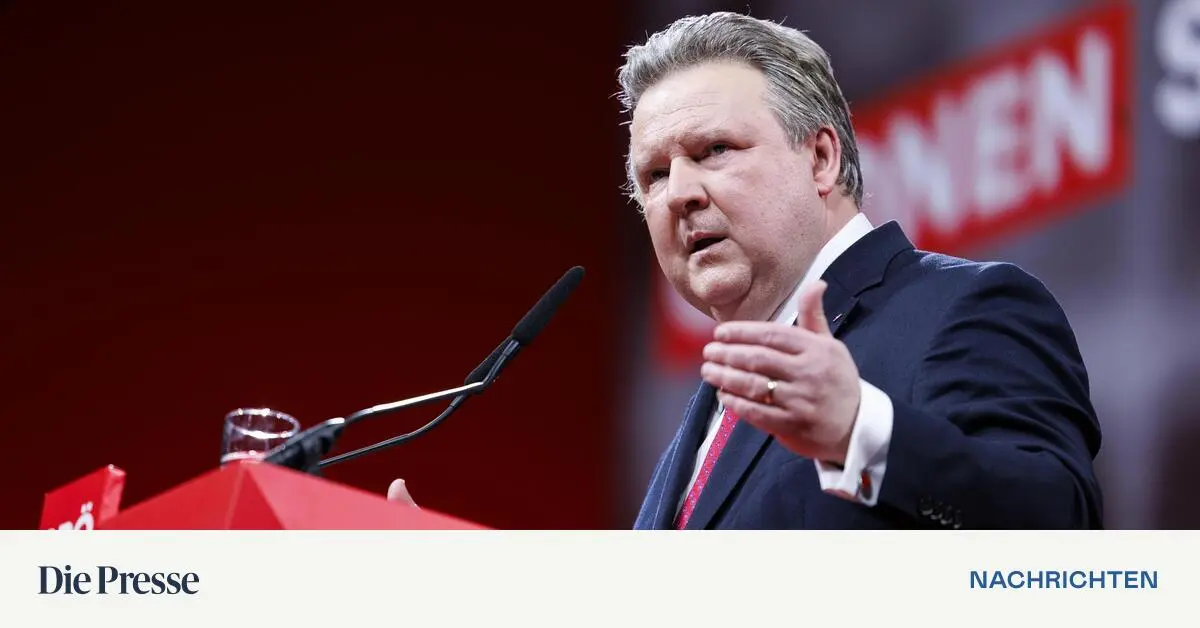
It is the high mass of the Viennese social democracy: On Saturday, the party conference of the Vienna SPÖ, the highest body of the mayor’s party, will take place in the Vienna Trade Fair. The re-election of Mayor Michael Ludwig as Vienna’s SPÖ leader is on the agenda – but that’s not all. In addition to numerous applications, there are also personnel changes at the Vienna SPÖ that deserve special attention: It’s about who could succeed Ludwig if the mayor decides at some point to withdraw from politics. And here Ludwig made a statement.
The withdrawal of housing and women’s councilor Kathrin Gaál from politics (she was succeeded by Elke Hanel-Torsch) has triggered a personnel shake-up not only in the Vienna city government: Gaál, as deputy party leader of the Vienna SPÖ, was also Ludwig’s deputy there. And this job needs to be filled. Whoever gets this job is particularly popular with the mayor. This decision could be read as a signal as to who could one day succeed Ludwig as mayor of Vienna – even if Ludwig is currently not showing any fatigue in office and could run for mayor one last time in 2030. However, with his predecessor Michael Häupl, Ludwig experienced first-hand what can happen if you don’t decide on your successor clearly and in a timely manner.

Vice Mayor and City Councilor for Finance Barbara Novak will be promoted to deputy to Michael Ludwig at the SPÖ party conference on Saturday. Clemens Fabry
At that time, a bitter wing battle broke out in the Vienna SPÖ, in the course of which Häupl, who was considered untouchable within the party, was forced to resign as mayor – after the Realo wing around Ludwig had won the power struggle against the left wing and its candidate, Andreas Schieder.

Climate City Councilor Jürgen Czernohorszky, like Novak, will be elected on Saturday as deputy to Michael Ludwig, who now has six deputies in the Vienna SPÖ – which should satisfy all party wings. Clemens Fabry
There are currently two candidates who have the best chance of one day succeeding Ludwig politically: City Councilor for Finance Barbara Novak, who appointed Ludwig as deputy mayor (after Gaál left office), and City Councilor for Climate Jürgen Czernohorszky. He is a representative of the left wing of the party and also represents the mayor on the SPÖ federal party executive committee. So he is Ludwig’s bridge to federal party leader Andreas Babler. It was therefore eagerly awaited whether Novak or Czernohorszky would join the ranks of Ludwig’s deputies.
The mayor of Vienna was naturally aware of the signal effect of this decision. In order not to create a precedent for a successor, Ludwig made a Solomonic decision: the ranks of deputies will be expanded from the previous five to six, and both Novak and Czernohorszky will be promoted to deputy party leaders. This also maintains peace in the party. Because now all wings of the mayor’s party are represented in the ranks of deputies.
After Gaàl’s departure, Ludwig currently has four deputies: The third National Council President Doris Bures is one of Ludwig’s closest confidants and is said to still have ambitions to run in the 2028 Federal Presidential election. The union is represented in the circle of Ludwig deputies by state parliament president Christian Meidlinger – he was chairman of the municipal employees’ union. The red women’s chairwoman is represented by Marina Hanke and the local council club by Josef Taucher.
Back to the party conference: In addition to Ludwig, SPÖ federal party leader and Vice Chancellor Andreas Babler will also speak to the Viennese comrades. And you could say: He also comes to say thank you. If Ludwig had not opposed ex-party leader Christian Kern’s candidacy at the SPÖ federal party conference a few weeks ago, then Kern would have run against Babler and would have had a very good chance of replacing him as SPÖ leader and vice chancellor.
By the way: The party conference, which takes place every two years, is dedicated to economic and location issues this year – which is not surprising, Ludwig explained when presenting the coalition program with the Neos: the economy and jobs would be the focus of this legislative period after Austria has had a few years of recession behind it. And the economic prospects (worldwide) have not improved as a result of the war in Iran.
Despite this gloomy outlook, the mood in the Vienna SPÖ is surprisingly good. On the one hand, people are pleased that “the shift to the right in Europe has been stopped by the voting out of Viktor Orban in Hungary,” as one comrade put it. On the other hand, the Vienna SPÖ is not doing badly in surveys. At least according to a survey by the TV station W24, which is owned by the city.
The Vienna SPÖ currently holds 37 percent. This would only be slightly below the result of the Vienna election last April – despite the massive, unpopular austerity measures that the red-pink city government has to implement. In addition, there is the government penalty for the three-party coalition at the federal level. According to surveys, the federal SPÖ under Andreas Babler is now only at 18 percent. This means that the turquoise-red-pink federal government has lost its majority (also because of the federal ÖVP’s losses in the most recent surveys). A situation that also occurred in Vienna with the red-pink town hall coalition (according to the W24 survey).