The search for agricultural land has brought conservative Mennonites from Europe to new areas in Latin America. Their agricultural colonies grew into major producers of soy, corn and other crops. But in Bolivia, Peru and Colombia, these developments were accompanied by large-scale deforestation, controversial land transactions and conflicts with indigenous communities. The experiences in these countries shed special light on the plans to settle hundreds of Mennonite families in Suriname.
Text Ivan Cairo
Image Edwin Caballero & playaquebec.com
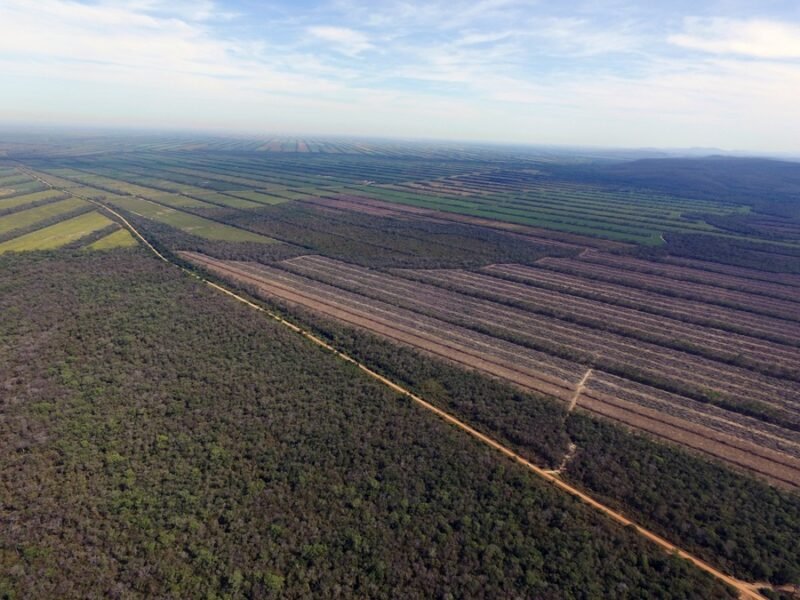
In eastern Bolivia there are vast agricultural areas where tropical forests existed a few decades ago. Among the agricultural areas are settlements of conservative Mennonites, who settled in Bolivia from other countries at different periods. The colonies have acquired an important place in commercial agriculture, especially in soy production.
“The history of the Mennonite colonies in Latin America shows that their religious beliefs and reputation as peaceful agriculturalists are inconclusive about the ecological consequences of their activities.”
Their expansion has been closely monitored in recent years by researchers using satellite images to document changes in the Amazon. The Monitoring of the Andean Amazon Project (Maap) calculated that between 2001 and 2021, approximately 210,980 hectares of forest were lost due to the expansion of soy cultivation by Mennonite colonies.
That was 23 percent of the deforestation for soy in the Bolivian Amazon region studied. In the last five years of that period, from 2017 to 2021, their share rose to 33 percent. The percentages refer only to the soy deforestation examined and not to the total forest loss in Bolivia.
The figures make clear how far-reaching the agricultural expansion of these communities can be. The settlers usually come from families in which agriculture is passed down from generation to generation. When new families need land, existing colonies are expanded or new ones are founded. In Bolivia this has led to large, highly mechanized agricultural companies.
Forest loss and water problems
However, the expansion is not without consequences for neighboring areas. In the Bolivian regions of Lomerío and Zapocó, indigenous communities and civil society groups have objected to agricultural activities that they say are damaging their habitats.
Researching news site Mongabay and the Bolivian organization Fundación Tierra describe how forest areas were converted into fields and how agricultural activities put pressure on water resources. At Laguna Concepción, a protected nature reserve in the Santa Cruz department, concerns arose about canals and other interventions that affect water management. The lake dried up in 2022.
The decline is associated with several factors, including prolonged drought and changes in the surrounding landscape. However, without separate hydrological studies, the lake’s disappearance cannot be attributed solely to Mennonite agriculture.
The discussion about agricultural colonies therefore goes beyond the area that is actually deforested. The construction of roads, canals and agricultural infrastructure can also have consequences for nature reserves outside the plots on which production takes place.
For settlers, new fields represent the opportunity to support their families and continue their communities. For residents who rely on existing forests and water sources, the same expansion could mean the loss of their traditional habitat. That can also happen in Suriname.
Peru: dubious land papers
In Peru, where Mennonite agricultural colonies settled in the Amazon region from 2017 onwards, the discussion took on a legal dimension. There, research began into the origins of agricultural plots and the way in which forested areas ended up in private hands. According to Maap, five Mennonite colonies had collectively lost approximately 8,660 hectares of forest by 2024. This concerned Chipiar, Vanderland, Österreich, Providencia and Masisea.
An investigation of Mongabay into land transactions in Tierra Blanca revealed that of 267 plots surveyed, at least 216 were still forested when Mennonite families acquired them. Deforestation took place afterwards. This finding is important because the settlers involved and their representatives have regularly pointed out when criticizing their agricultural activities that they purchased land that was already intended for agriculture.
Even more serious were the findings in Masisea, in the Ucayali region. Mongabay examined 47 suspicious land files there. 29 of these overlapped with areas claimed by the indigenous Shipibo-Konibo communities of Buenos Aires and Caimito. According to the investigation, forested plots had been registered as agricultural land through irregular administrative procedures. The land was then transferred and eventually passed into the hands of Mennonite farmers.
The involvement of government officials in irregular registrations does not automatically mean that the ultimate buyers themselves have forged documents or bribed officials. However, the course of events does raise questions about the checks that buyers and their intermediaries carry out before acquiring large areas of land. In Suriname there is also discussion about the rights in areas where entrepreneurs want to carry out agricultural projects with the help of Mennonites.
The Peruvian judiciary also took action against deforestation itself. In October 2022, a judge ordered measures to stop further forest clearing at the Chipiar colony. In July 2023, a higher court upheld the order to suspend operations. This meant that further exploitation became the subject of direct judicial intervention.
Colombia: clash with indigenous people
Similar problems arose in Colombia after Mennonite colonies settled in the Meta department from 2014. The communities of Australia, Liviney and Las Piedras jointly acquired almost 38,000 hectares of land, according to research by Mongabay and Rutas del Conflicto. Some of those areas are claimed by the indigenous Sikuani communities of Barrulia, Iwitsulibu and Tsabilonia. They regard the land in question as part of their ancestral habitat.
The Colombian land authority ANT found irregularities in land transactions. Investigations were also launched into possible environmental crimes. The conflict led to legal proceedings over access to disputed areas. In January 2026, legal measures were taken to protect the rights of indigenous residents, including an interim settlement around 63 hectares of land.
The disputes illustrate the problems that arise when private property documents collide with historical territorial claims. For Mennonite farmers, the plots are the basis of their businesses. For the Sikuani, these plots are part of a habitat to which their history and culture are linked.
Victims of land fraud
The available information shows that Mennonites have not become exclusively involved in controversial land acquisition as buyers or users. In Paraguay, colonists themselves became victims of suspected fraud.
According to the Paraguayan Public Prosecution Service, Mennonite families paid approximately US$1.6 million to purchase approximately eight thousand hectares of land in the Chaco. Intermediaries are said to have induced them to pay with incorrect information about ownership documents and political contacts.
In December 2024, three suspects were arrested, including two lawyers. The case highlights how dependent foreign agricultural colonies can be on local middlemen. They do not always know the language, land administration and political relations sufficiently to independently handle extensive transactions.
In Bolivia, accusations have also been made about the involvement of representatives of certain Mennonite colonies in illegal land trade. Eulogio Núñez, who worked for the organization Cipca and later the land authority Inra, among others, has raised the issue of such practices.
Surinamese warning
The experiences in these countries take on significance against the background of Surinamese agricultural plans. Entrepreneurs want to use Mennonite families for large-scale production, while the government must assess where agriculture is possible and under what conditions land can be made available.
The foreign investigations provide no evidence that Mennonites in Suriname will commit the same violations. They do show the problems that can arise when agricultural development anticipates a careful assessment of land rights, existing forest cover and environmental consequences.
“In Suriname there is also discussion about the rights in areas where entrepreneurs want to carry out agricultural projects with the help of Mennonites”
Suriname still has large areas of contiguous tropical forest. An area once developed can become economically productive, but this does not make the consequences of the loss of original nature disappear.
In particular, the history of Mennonite colonies in Latin America shows that their religious beliefs and reputation as peaceful agriculturalists do not provide a definitive answer to the ecological consequences of their activities. These should be judged by the way they acquire the land, use it, and the changes their agriculture causes.