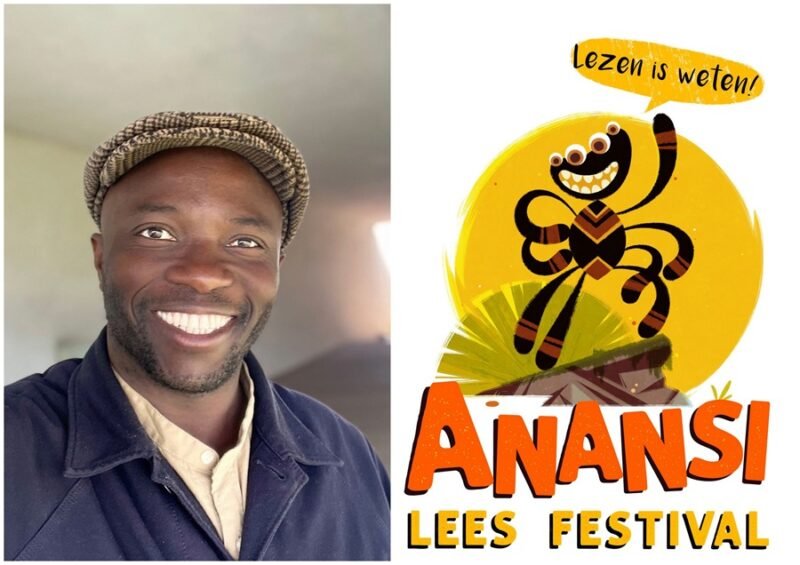
Anansi, the clever spider who always manages to get out of difficult situations with his ingenuity, is more than a character from children’s stories. The stories are part of an age-old storytelling tradition in which life lessons, cultural values and identity are passed on from generation to generation. To keep this tradition alive and to encourage reading pleasure among children, the Anansi Reading Festival will be organized from November 16 to 21 at Villa Zapakara and the School for Young Talent in Ons Erf. During the six-day event, the stories come to life with theatre, song, dance and creative activities.
Text Audry Wajwakana
Image private collection
The festival is an initiative of children’s book writer Iven Cudogham of the Toekomstweb foundation. The direct reason is the teaching material ‘Anansi in the classroom’ that Cudogham developed to introduce young children to the Anansi stories in an attractive way. “This teaching material was introduced in Surinamese primary education a few years ago and was positively received by schools and educational organizations, because it brought a cultural phenomenon like Anansi back into the classroom,” Cudogham explains in conversation with the True Time.
“By using voices, humor and theater elements, I hope that the Anansi stories come to life and make children curious about reading“
After that positive reception, the idea arose to revive the former Anansi Festival. Cudogham, who was not familiar with the festival itself because he has lived in the Netherlands for years, became interested by the stories about it. Together with Villa Zapakara and School for Young Talent, he then investigated the possibilities of reorganizing the event, with the promotion of reading and the experience of cultural heritage as the most important principles.
Stories come to life
The Anansi stories have been part of Cudogham’s life from an early age. He was born in Suriname, but moved to the Netherlands as a three-year-old, where his mother read him the Anansi stories by authors Johan Ferrier and Noni Lichtveld, among others.
Years later he passed on that storytelling tradition to his own children. When his seven-year-old daughter asked while reading why there are no Anansi cartoons, the idea arose to make the stories in picture books more accessible to young children. “I sometimes found the stories and illustrations I grew up with too frightening for this age group,” says the writer.
He therefore rewrote the stories and gave them a new form, tailored to the experiences of young children. He wants to make them curious about books. The author hopes that “by using voices, humor and theater elements, the Anansi stories come to life and make children curious about reading.”
During the festival, children have the opportunity to experience the stories themselves. The program includes games, creative assignments, dance, singing and crafts. An Anansi theater performance from the Netherlands is also coming to Suriname.
(read more below the photo)

Program
From November 16 to 20, the festival is intended for invited primary schools. The organization wants to use the opening day to introduce a National Anansi reading day. Dirk Currie, Minister of Education, Science and Culture (OWC), has promised to attend. President Jennifer Geerlings-Simons has also been invited.
Cudogham hopes that the reading day will become an annual tradition. After the official opening, the students will see the theater performance ‘Anansi the spider and the greedy tiger’. They are then divided into groups to participate in different activities.
The program ends with a reading competition for teachers. They have been challenged in advance to read an Anansi story as expressively and theatrically as possible. Prizes are available for the winning teacher and school.
Cudogham expects 250 to three hundred students from different schools every day. They participate in the program on the festival grounds under the supervision of teachers.
On the final day, November 21, everyone can visit the festival. Parents and children can also participate in the activities. Children up to the age of twelve pay SRD 50 and other visitors pay SRD 100.
Commitment
Villa Zapakara is involved in the programming and production of the activities and the School for Young Talent makes its location and cooperation available. OWC and educational organizations Fibos and RKBO support, among other things, with the participation of schools and the transportation of students. The organization also receives financial support from the Netherlands, including from Bollebozen, part of the online store bol.com.
Cudogham: “We are very proud to be organizing this first Anansi Lees Festival with numerous involved partners with one goal: the future of our children and the preservation of cultural heritage.” To be able to organize the festival annually, he hopes to attract more private partners.
Cudogham also places the importance of promoting reading in a broader historical context. He refers to the past of slavery, when enslaved people were denied education and access to books. He believes that this historical exclusion makes it more important that children learn to read and enjoy books at an early age. “Not only to gain knowledge, but also to learn their history, understand the world around them and shape their own future.”