Forereef habitat at Bikar atoll. (Manu San Félix via SWNS)
By Talker
Some of the “very last wild and healthy ecosystems” unblemished by humans have been discovered.
The remote atolls in the Pacific Ocean teem with life across habitats — and may serve as reference to what has been lost elsewhere, say scientists.
Humans have left their mark on virtually every place on the planet, from the deep sea to the peaks of the highest mountains.
But a new study suggests that a few very remote atolls in the Pacific Ocean may be exceptions.
Researchers found two coral atolls, Bikar and Bokak, located on the territory of the Marshall Islands, to be some of the most intact ecosystems remaining in the region and perhaps the world.
Study first author Alan Friedlander said: “This study provides the first comprehensive ecological baseline of the newly created National Marine Sanctuaries of Bikar and Bokak atolls from the sky and land to the deep sea, and highlights some of the most intact ecosystems remaining in the region.
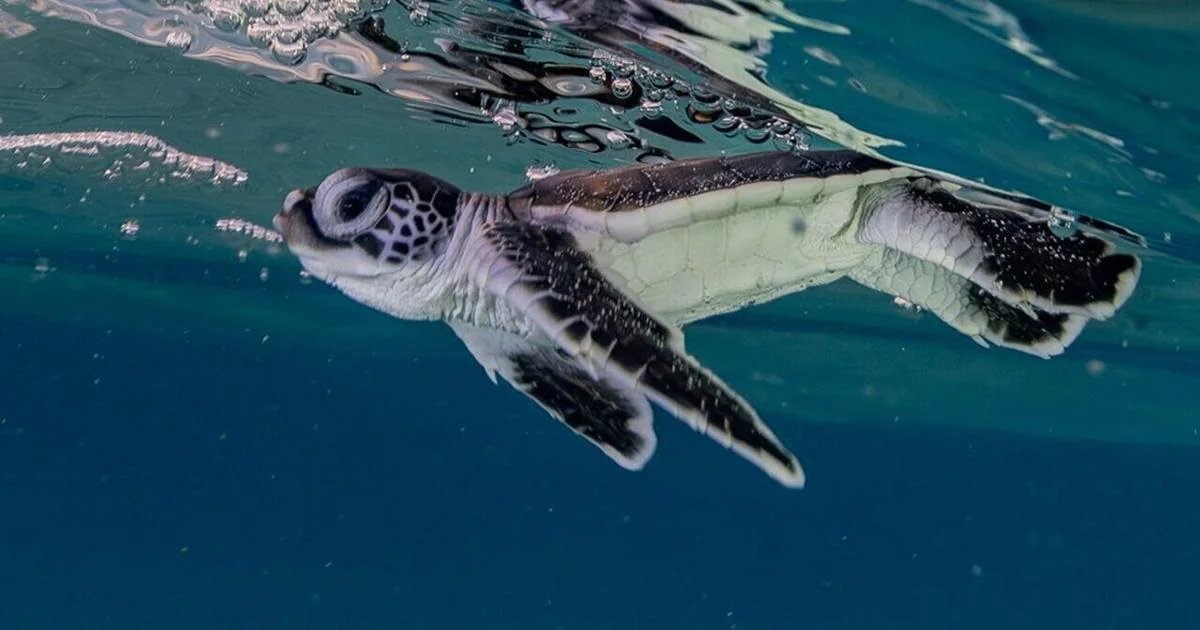
Green sea turtle hatching at Bikar atoll. (Manu San Félix via SWNS)
By Talker
“Bikar and Bokak are not just treasures for the Marshall Islands but for the entire planet, a gift from the community of Utirik Atoll, which has traditionally and vigilantly safeguarded these fragile ecosystems for decades.”
Bikar and Bokak are the northernmost atolls in the Marshall Islands, lying around 72 and 239 miles from the nearest inhabited atoll, respectively.
In 2023, the research team conducted extensive monitoring of local land, sea, and sky ecosystems.
They assessed sea- and shorebird populations, characterized vegetation, and conducted surveys of turtle nesting, coral reefs and fish assemblages using scuba, underwater video, deep-sea camera deployments and a submarine.
Friedlander, a marine ecologist at the University of Hawaii, said: “We set out to inform the creation of a highly protected area within the scope of the Marshall Islands’ Reimaanlok vision, which means ‘looking toward the future.’
“It is a national, community-led conservation framework designed to protect marine and terrestrial resources while ensuring island life thrives for generations to come.”
Bumphead parrotfish at Bokak atoll. (Manu San Félix via SWNS)
By Talker
Friedlander said: “These atolls have extensive seabird colonies, mature native vegetation, active turtle nesting, high reef-fish biomass and large predators, coral-dominated reefs at Bokak, structurally complex mesophotic habitats, and surprisingly diverse and poorly known deep-sea communities.”
Across both atolls, the researchers found 15 seabird colonies that were confirmed or likely to be breeding.
They also found at least 266 groups of reef fish, 138 groups of fish living at greater depths and 79 groups of deep-sea fishes.
Fifteen groups of open-water predators — including sharks, jacks and wahoo — were recorded.
Fourteen of the observed groups haven’t previously been recorded in the Marshall Islands, and two might be species new to science.
Despite sharing many characteristics and housing many of the same species, Friedlander says the atolls also differ from each other.
Brown bobbies at Bikar atoll. (Chris Thompson via SWNS)
For example, sea turtle nesting was almost exclusively concentrated at Bikar, with 132 green sea turtle nest pits recorded.
The total biomass of reef fish was higher at Bokak which is characterized by coral-dominated reef communities.
Bikar, on the other hand, supported more taxa of algae.
The study, published in the journal Frontiers in Marine Science, surveyed the atolls at one point in time, and didn’t determine the environmental mechanisms causing differing ecological patterns.
Friedlander said they could be attributed to difference in lagoon size, water exchange, sediment transport, habitat configuration, nutrient dynamics or ecological history, among other things.
He added: “There is also a bit of a lottery involved as to which species show up and persist at remote locations.”
Friedlander says the extensive surveying of the ecosystems offers an “unparalleled glimpse” into how they function with only minimal human influence.
Giant clams at Bokak atoll. (Alan Friedlander via SWNS)
By Talker
He said: “They are among the best ecological reference systems we have to better understand what we have lost elsewhere and to provide fundamental insights needed for effective conservation and restoration efforts.”
The research team says the important lesson is that monitoring should not focus exclusively on shallow reefs but assess ecosystems in their full complexity, which provides a more complete foundation for conserving ecosystem integrity and tracking future climate-driven change.
They said future studies should also focus on examining nutrient transfer and ecological connectivity between habitats, which was not done here.
Friedlander added: “The Marshall Island government should be applauded for their foresight in protecting these global biodiversity hotspots, where human activity is distant and habitats teem with life.
“As human activities increasingly threaten biodiversity, areas devoid of intense human impacts serve as vital refugia.
“Large marine protected areas serve as globally important ecological reference systems for understanding the structure and future trajectories of tropical oceanic ecosystems in the Anthropocene.”