On Sunday, CBS’ 60 Minutes published an interview with Trump. During the conversation, journalist Ross Douthat asked him: “Do you think immigration hurt you in the midterm elections? Do you think the offensive against immigrants hurt you?”.
Trump responded: “I think it helped and hurt at the same time.. I think I got an A+ for closing the border. I get very good marks for taking out the bad guys. But it hurts me that we have also detained people who had good jobs and whose only infraction, or violation of the law, was having entered the country illegally..
“There is a large part of the country that thinks they should be kicked out. And there is another large part that thinks they should be able to stay if they are good people who work at a landscaping company, in a hotel or somewhere else, and who in some cases pay taxes.”continued the president.

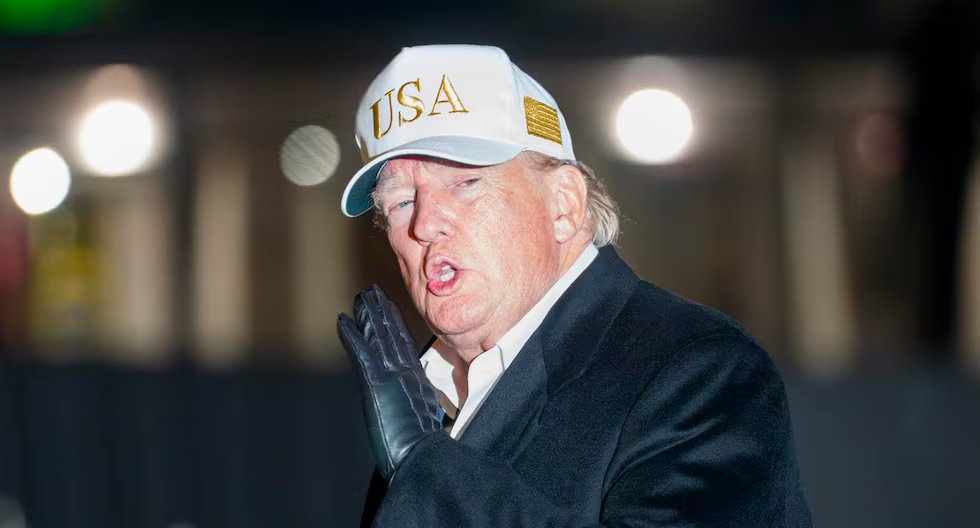
United States President Donald Trump answers a question from the press during the signing ceremony of an executive order in the Oval Office of the White House, on November 5, 2026. (EFE/EPA/JIM LO SCALZO).
/ JIM LO SCALZO / POOL
Then the journalist insisted: “So you think your deportation policy went too far?”.
“Too hard”Trump responded. “I mean, I think she might have been too harsh, yeah.”he continued.
At another point, Douthat asked him what deal he would be willing to negotiate with Democrats.
Trump responded: “I would love to do something about immigration.”
He explained that he would be willing to negotiate so that people who have been in the United States for between 10 and 15 years could regularize their situation, especially if they work and have no record of serious crimes.
CBS recalled that one of its surveys revealed that 58% of voters considered that the Trump Administration’s actions on immigration had gone too far.

White House Deputy Chief of Staff and National Security Advisor Stephen Miller (left) looks on as US President Donald Trump speaks on August 6, 2026. (Photo by ALEX WONG / GETTY IMAGES NORTH AMERICA / AFP).
/ ALEX WONG
On Friday, Trump had appointed Stephen Miller, one of his closest collaborators, as chief of staff replacing Susie Wiles.
Miller, 41, is considered the architect of Trump’s immigration policy and until now was the deputy chief of staff. He was also a National Security Advisor.
Miller’s influence began during the 2016 presidential campaign, when he joined Trump’s team as an advisor and speechwriter. Already in the White House, during the magnate’s first term (2017-2021), he was one of the promoters of the immigration ban on citizens of several Muslim-majority countries and a firm defender of the “zero tolerance” policy on the border with Mexico, which led to the separation of thousands of children from their immigrant parents. He also promoted restrictions on the admission of refugees and different avenues of legal immigration.
After Trump’s defeat in 2020, Miller founded America First Legal, a conservative organization from which he continued to promote his political agenda.
With the Republican’s return to the White House in January 2025, Miller became a central figure in the mass deportation offensive.
Among their initiatives was putting pressure on Immigration and Customs Enforcement (ICE) to reach a goal of 3,000 daily arrests and expand operations against undocumented immigrants, even those without criminal records. Also defended the use of the Alien Enemies Act of 1798 to accelerate the expulsion of alleged members of Venezuelan criminal gangs.
Trump will not reduce immigration actions

Stephen Miller (left) walks on the South Lawn as he leaves the White House in Washington, DC, on November 6, 2026. (EFE/EPA/AARON SCHWARTZ).
For the journalist Jesus Garciaeditor of politics, immigration and national affairs at La Opinión, the appointment of Miller responds to two reasons. The first is to prepare Trump’s political movement and the Republican Party for the 2028 presidential elections, as well as ensure that the president’s group maintains control of the organization.
In this context, he explains that Susie Wiles would focus more on electoral strategy, while Miller will assume a more influential role in the overall leadership of the Administration.
“He was already deputy chief of staff, and now he will have much more influence over it, which could toughen some of the policies that Trump has promoted and that Miller has helped design, including the immigration strategy,” manifests.
García does not consider that there is a reduction in migratory actions, but rather a reorientation of the way they are carried out to continue the detention of undocumented immigrants.
“The massive and very striking operations such as those carried out in Chicago, Los Angeles and Minneapolis could be reduced to give way to more specific and less media interventions, such as those seen in New York, which are in the shadows. This type of operations allows maintaining the number of arrests of undocumented immigrants without generating the same level of public exposure.”explains to The Commerce.
Added to this is the tightening of legal immigration procedures, with greater controls for those applying for work visas, permanent residence and even US citizenship.
“People who even apply for citizenship have an additional review of what they had before. Those policies will be maintained,” he remarks.
“So, rather than there being a reduction, there is a reorientation in the way Trump applies immigration policy”he insists.
The journalist maintains that Trump also has to respond to his most loyal electoral base, that supports the hardening of immigration policies and that was decisive in maintaining Republican positions in states such as Florida.
He specifies that although the offensive against immigrants may have taken away votes from the party, the president cannot ignore one of his main campaign promises or the movement. MAGA (Make America Great Again), which constitutes the core of his political support.
Trump’s contradiction

Immigration and Customs Enforcement (ICE) and other federal agents remove a woman from her vehicle in Minneapolis, Minnesota. (Photo by Octavio JONES / AFP).
/ OCTAVIO JONES
The international analyst Francisco Belaunde Matossian consider that trump has begun to recognize the electoral cost of its offensive against immigrants. He indicates that it is evident that the deportation policy could have alienated an important part of the electorate. “They realize that they have lost a large part of the votes. I think that is a logical conclusion,” holds.
However, for Belaunde Miller’s appointment raises doubts about the possibility that the president is really willing to moderate his strategy. “The problem is that, at the same time, they have named the architect of those policies,” warns.
The analyst describes Miller as an ideologue with radical positions on immigration matters and a vision focused on the defense of Western civilization. “He appears as a fanatical ideologue, with a kind of ideological obsession. For him, that obsession comes first and other types of considerations come later”he states. He also points out that various sectors have accused him of promoting positions linked to white supremacy, a characterization he attributes to his critics.
In this context, Belaunde considers it difficult to anticipate what the course of US immigration policy will be, due to Trump’s frequent changes in speech.
“With Donald Trump you never know: one day he may say one thing and the next day another. We will have to see if they actually moderate those policies and, if that happens, what Stephen Miller is going to do”he points out.
The analyst does not rule out that the president uses a possible relaxation of measures against certain immigrants as a negotiating instrument with the Democrats. Trump would not have to completely abandon his deportation policy, but could offer limited concessions in exchange for obtaining support for other initiatives, he notes.