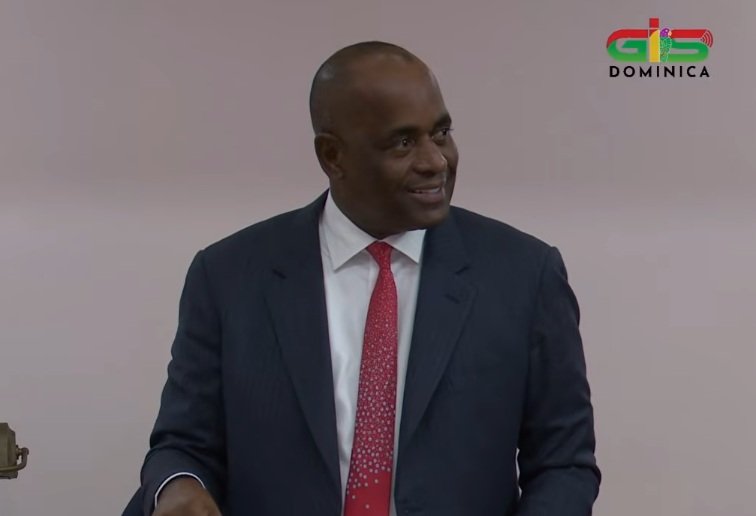

Prime Minister Roosevelt Skerrit has strongly defended his government’s development record, pointing to major investments in infrastructure, education, housing, renewable energy, tourism, and small business development as he expressed full support for supplementary estimates totaling approximately EC$248.5 million.
During an extensive address at the third meeting of the fourth session of the eleventh parliament on Monday, Skerrit argued that the additional expenditure represents a direct investment in the economic and social advancement of Dominica, with benefits extending to communities, businesses, and households across the island. The Prime Minister maintained that his administration has pursued a development strategy designed to create employment, stimulate economic activity, reduce poverty, and place more disposable income in the hands of citizens. He also challenged critics of government spending, insisting that many of the ongoing programs are creating opportunities previously unavailable to ordinary Dominicans.
According to figures presented during the parliamentary debate, the supplementary appropriations amount to EC$248,517,384.02. “Out of that, Mr. Speaker, we have a grant component of [approximately EC$26.7 million],” he revealed.
He expressed appreciation to bilateral partners, international financial institutions, and friendly governments for their continued assistance to Dominica, particularly at a time when nations are increasingly prioritizing their own domestic interests. The Prime Minister said these relationships have been instrumental in allowing Dominica to undertake major development projects despite its limited financial resources and vulnerability to external economic shocks and natural disasters.
“I think we are very fortunate in Dominica that we do have friends out there who are continuing to provide us with the support that we need to move our country forward, and to create the economic environment for the creation of more jobs and addressing the challenges in our country,” Skerrit emphasized. He also defended the government’s borrowing relationships, suggesting that Dominica’s standing with international lenders reflects deep confidence in its development agenda.
A significant portion of the Prime Minister’s presentation focused on the international airport project, which he described as a longstanding national aspiration that successive governments had been unable to realize. Skerrit argued that the development of an international airport is essential to unlocking Dominica’s economic potential, particularly in tourism, agriculture, manufacturing, and international trade.
He recalled the difficulties Dominican travelers previously experienced due to the absence of night-landing facilities, including having to disembark in neighboring countries when flights could not reach Dominica before nightfall. According to the Prime Minister, his administration addressed that challenge by introducing night-landing capabilities at Douglas-Charles Airport and subsequently facilitating direct air connections with North America.
However, he maintained that the international airport represents a much larger economic opportunity. He noted that improved international connectivity would allow farmers to export fresh produce more efficiently, help fishermen reach overseas markets, and create opportunities for businesses involved in perishable agricultural products, including flowers.
The Prime Minister also emphasized that the airport would support the continued expansion of Dominica’s hotel industry by making the destination more accessible to international visitors. He argued that the country’s investment in the airport should therefore be understood as a strategic intervention intended to generate economic returns across multiple sectors.
“What Douglas-Charles [Airport] has been doing for us—imagine what an international airport will do for us,” he stated.