Madrid/The Cuban Minister of Foreign Affairs, Bruno Rodríguez, will be making an official trip to China from this Tuesday until next Friday as a “special envoy of the Party and the Government.” In a brief official statementthe authorities recognize that Beijing “constitutes a strategic partner of great relevance for Cuba and one of the main collaborators in key sectors for the economic and social development of the country.”
Likewise, they say that “bilateral ties have experienced sustained consolidation in recent years, supported by intense political exchange and mutually beneficial cooperation,” and that the visit “is part of the excellent state” of those relations.
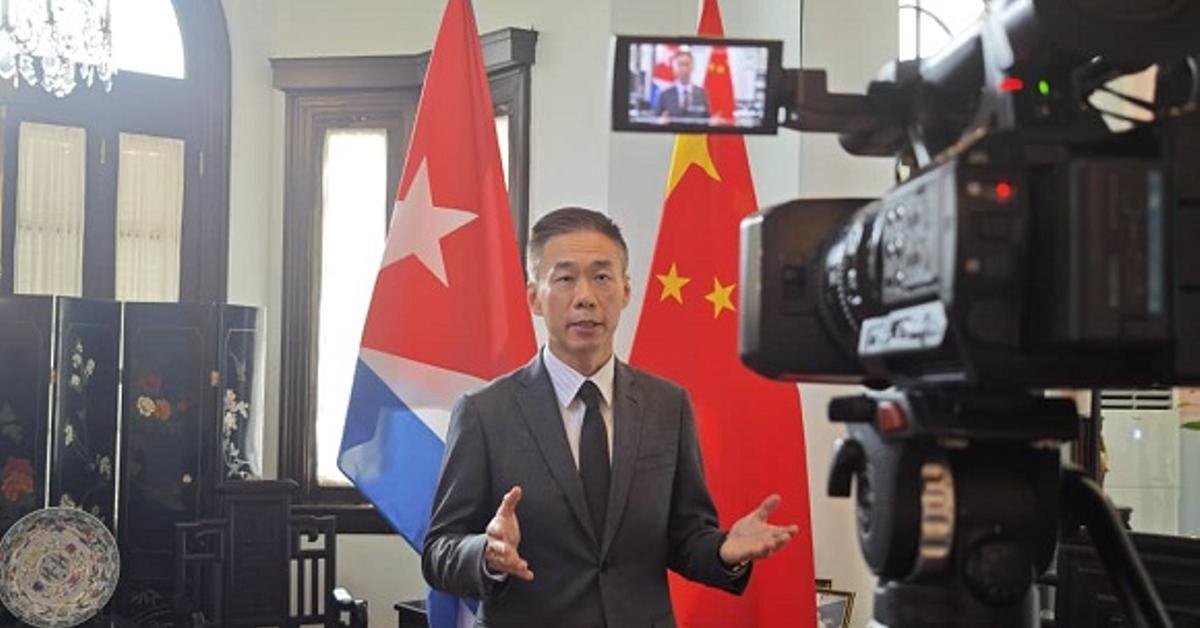
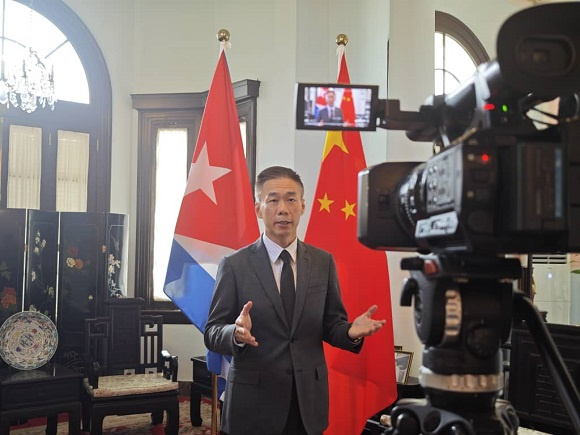
The publication of the news coincides in the state media with an interview with the Chinese ambassador in Havana, Hua Xinin which the Asian giant is described as “a hopeful alternative to global capitalism.” At the meeting, originally broadcast on Randy Alonso’s podcast It’s the ideathe diplomat expressed, as a condemnation of the US sanctions on the Island, the “deep concern about the escalation of the unilateral blockade against Cuba” and “the need to put an end to the coercive, economic, commercial and financial measures against Cuba, in accordance with the resolutions of the United Nations General Assembly.”
The ambassador affirmed that Beijing and Havana constitute “a community with a shared future”
Praising the role of the BRICS – an acronym for Brazil, Russia, India, China and South Africa, the group of emerging economies formed in 2006, of which Cuba is a partner without being a member – on the international scene, Hua affirms that it has become “the most influential platform in the world for cooperation between emerging markets and developing countries and today it is a pioneering force in promoting global governance reform.”
Likewise, he stated that Beijing and Havana constitute “a community with a shared future” and are “in the front row” of the implementation of four initiatives proposed by Chinese President Xi Jinping for the BRICS: “for global development, for global security, for global civilization and for global governance.”
The conversation is a long praise of Beijing and its exponential development, and it mentioned, precisely, the “reforms promoted in recent years by China and that have really caused an impressive economic and social takeoff for the rest of the world.” Although the interviewers do not refer at any time to the most recent measures of the Havana regime, aimed at making the economy somewhat more flexible, the consideration of the Chinese “transformations” was eloquent.
The ambassador asserted, yes, that “China’s development is largely due to reform and opening,” but the official press highlighted – even in the headline – the nuance he introduced next: “persisting in the leadership of the Communist Party.” Hua also pointed out that another key to success is having opened “the door to all countries in the world, we let resources, technologies, science, thinking from around the world enter and we take good advantage of the global market.”
Hua highlighted China’s “many changes and progress” also in industrial development and specifically referred to “three viral products”, solar panels, lithium batteries and electric vehicles, “which are very well received in Cuba”, and three “emerging products”: “robotics, artificial intelligence (AI) and innovative medicines”, which “are growing rapidly”.
Hua specifically referred to “three viral products”, solar panels, lithium batteries and electric vehicles, “which are very well received in Cuba”
Just on Saturday, the Cuban official press was invited to a World Media Summit in Beijing, in which – just at the time when a new wave of repression was being carried out on the island against independent journalism and dissident voices – defended “digital sovereignty” and “equal access” to AI, arguing that technological gaps can deepen inequalities between countries.
Beijing’s cooperation with Havana in the technological aspect is, precisely, one of the elements that most worry the United States for a few months now. Last Thursday, two Chinese companies, China National Electronics Import and Export Corporation (Ceiec) and Beijing H&C Technologies, were sanctioned for supplying military components and equipment to the Island through the Cuban company Duna SA, previously sanctioned in August for its links with military imports from China and Russia.
In this regard, the spokesperson for the Ministry of Foreign Affairs of China protested, Guo Jiakunwho stated in a press conference that the cooperation between his country and Cuba is “completely legitimate and transparent” and rejected the US attempts to “disturb and sabotage” that cooperation.
On the other hand, this same Tuesday official data were published showing that the value in yuan of Chinese exports to the rest of the world increased by 28.7% year-on-year in October, up to about 2.79 trillion yuan (418,248 million dollars).
This represents a slight slowdown compared to the 29.6% growth recorded the previous month, although in any case it remains well above the 18.6% or 17.8% of the two previous readings, thus strengthening foreign sales as a key driver for the world’s second largest economy in the face of its internal demand problems.
In October, total trade exchanges between China and other countries amounted to some 729,664 million dollars, an increase of 31.2% compared to the same month of the last year.
The figures, released by the General Administration of Customs, in turn point to an increase of 34.7% compared to the same month in 2025 for imports, which reached about 2.08 trillion yuan (311,416 million dollars). In the tenth month of the year, the Chinese trade surplus stood at around 712,780 million yuan (106,831 million dollars), which represents an increase of 11.29% in year-on-year terms, according to calculations made by the Spanish agency EFE.
In October, total trade exchanges between China and other countries amounted to some 4.87 trillion yuan (729,664 million dollars), an increase of 31.2% compared to the same month of the last year. The data released this Tuesday also reflect that this indicator grew by 20% accumulated between January and October, with imports rising more (+23.6%) than exports (+17.6%).
Customs also presented today foreign trade data denominated in dollars, used as a reference by international analysts and which usually present divergences from those disclosed in the Chinese currency due to exchange rate fluctuations.
In US currency, foreign sales increased by 35.2% year-on-year to around $412.33 billion, while imports did so at an even faster pace (+41.6%) to stand at $307.05 billion.
Both rates exceed the expectations of analysts, who anticipated an increase of 33.5% for sales abroad and 32% for purchases of foreign goods.