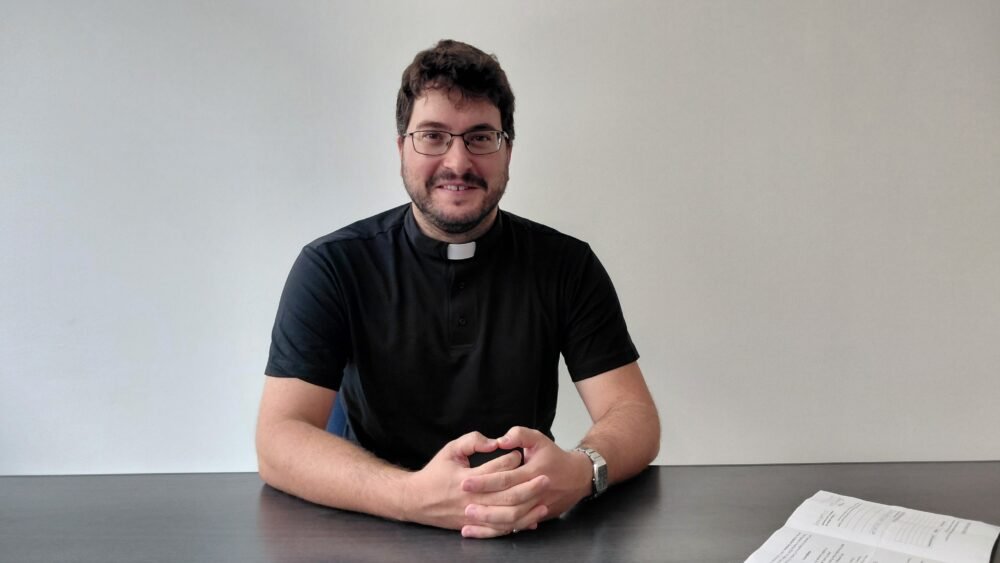
From the information of San Marino (by Don Luca Bernardi*) – We have now entered the month of November, a month which has a long tradition of inviting us to remember our deceased, but this memory is very often accompanied by that of the family: above all we remember the loved ones who preceded us and these are usually our deceased family members. So this month not only brings back the sadness of memories, but the strong bond with the loved ones who are there now: we become more aware that those we have at our side are a gift, not an obvious presence.
For this reason I would not like to dwell on the memory of the deceased, but rather on the importance of the family. Not only for what this month calls to us, but I would like to add two more reasons. On the one hand, it is precisely this period, where the darkest days make us stay at home with the people we love, the arrival of Christmas which in our culture recalls the family (at Christmas with your family, at Easter with whoever you want), but also for the emergency of the family.
What has happened and is happening in recent months, with the riots in European cities, the attacks on teachers in schools, the youth discomfort, the generational clash and above all the lack of meaning require an enormous reflection on the family, because not only is it taken for granted by those who live it (I say this in a good sense), but actually outside in the cultural and social context it has been and is attacked in every way, so we need to remember how beautiful it is, good as such as an ideal to look up to, even with all the difficulties that they live within it.
Aristotle, one of the greatest philosophers in history, in his work “Politics”, talks about the family right from the start, in the first chapter, as the foundation of civil society, indeed there can be neither villages nor cities without families, so it is something fundamental: one cannot in any way expect someone to occupy the space of the family, except in extreme cases, such as when the family is injured or in some way unable to do so. But extreme cases cannot deny this truth: “Since the Creator of all things established marriage as the principle and foundation of human society, the family has become the first and vital cell of society”, writes John Paul II in his encyclical “Familiaris consortio”. But let’s also think about our life: where do we flee when fear, anguish, the difficulties of existence test us, if not from our loved ones. Unfortunately, I am well aware that families are not always these cradles, these places of comfort, indeed, could it be that the discomfort of many is due precisely to this absence of a real family? This is why we need the responsibility to remind ourselves what it is. And let’s remember that family can and mainly must be understood as that of family ties, but it often happens that the closest friends are a sort of family. But even when the bonds of friendship are the ones that hold, it is no coincidence that they are compared to a family, which demonstrates the importance of this cell of society.
Aristotle is echoed by another great rhetorician and philosopher of antiquity, Cicero, who in his “De officiis” calls the family in an extraordinary way: “principium urbis et quasi seminarium rei publicae”, that is, the beginning of the city and, as it were, the seminary of the republic. The family is the principle that should also guide the regency of states, the model. But in no way should we think that the State can take the place of the family. “By virtue of this principle, the State cannot and must not take away from families those tasks that they can equally perform well alone or freely associated, but positively favor them and encourage the responsible initiative of families as much as possible.” this is what Saint John Paul II recalls in the same encyclical cited above.
The beauty of being able to form a nucleus that generates life must never be underestimated in any way.
I imagine that many reading a priest who writes about the family might think: “but what does this guy know about a family that lives alone?” Of course, but let’s remember that if on the one hand a priest also comes from a family of origin and remains tied to it for life, on the other hand the priest sees many families, meets many people: the fact that not experiencing something directly does not mean that he does not see its profound meaning. Indeed, the distance somehow helps us to see things in a different way, from angles that others might not see.
Let us not take for granted the spouse we have at our side, the child we perhaps wanted more than ever, the house we worked so hard to find. Every day the sense of oneself must be rediscovered within one’s family. We must never tire, even in the face of all today’s hardships, of recalling what a family should be, in the hope that we can always aim for the best!
Don Luca Bernardi, parish priest of Faetano
Do you have questions, reflections or observations on the topics addressed by Don Luca?
You can send them to informationsanmarino@gmail.com
Don Luca will respond to readers in the space dedicated to his interventions