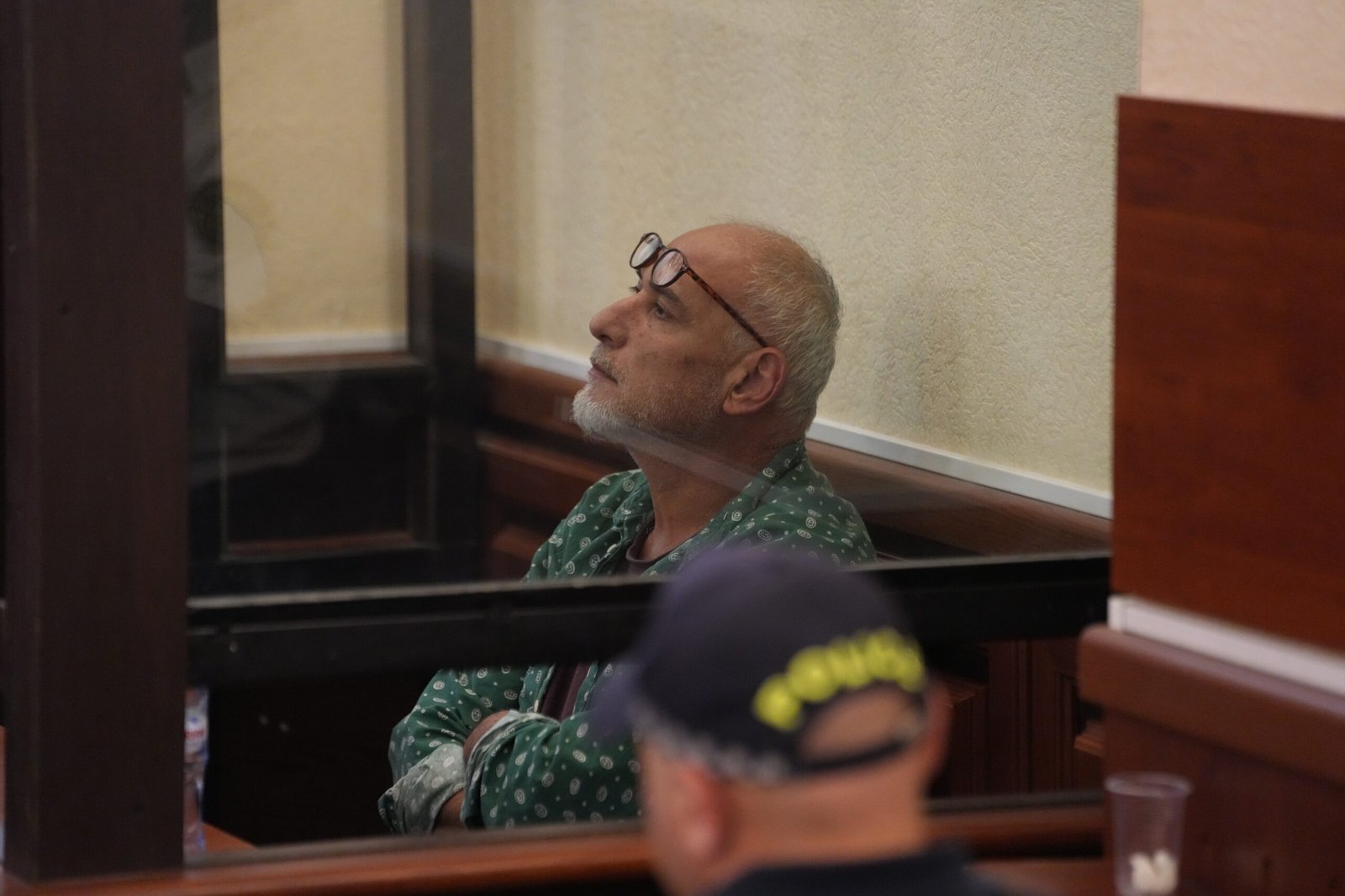
Poet Zviad Ratiani, who is serving a two-year sentence for slapping a police officer, was placed under a stricter prison regime in a decision his lawyer described as “unsubstantiated,” as the Special Penitentiary Service cited “information regarding his safety” that it said led to his classification as a “higher-risk” inmate.
In a letter from Tbilisi’s Gldani prison dated April 20, Ratiani wrote that he was notified on April 6 by the penitentiary department that his “semi-open prison regime” had been changed to a “closed regime” as he was classified as a “higher-risk inmate.” He explained that the change places him strictly “within four walls” and, more importantly for him, “reduces to the minimum” the number of monthly short visits and annual long visits by family or other visitors.
Ratiani, who said he has been in solitary confinement at his own request from the outset of his jail term, without contact with other inmates, added, “I have never had even a minor misunderstanding, let alone a conflict” with prison staff, questioning on what grounds he had been classified as a “higher-risk inmate.”
The Special Penitentiary Service of Georgia stated on April 24 that Zviad Ratiani was classified as a “higher-risk” inmate after his “safety was taken into consideration,” saying, “When making the decision, the commission took into account the inmate’s request to serve the remaining period of his sentence in solitary confinement, which further confirms that his communication with other inmates could pose a certain risk.”
Ratiani’s lawyer, Keti Chutlashvili, who had earlier described the move as “unsubstantiated,” maintained that position even after the agency’s statement. “This explanation is not substantiated – it is unclear what safety risks are being referred to,” she told RFE/RL’s Georgian Service, adding that classifying the poet as a “higher-risk” inmate imposes further restrictions beyond limiting contact with other prisoners, including “significantly restricting the proper use of visits, as well as telephone communication.”
PEN Georgia, a non-governmental organization uniting dozens of Georgian writers, reacted to the move with a statement saying that “the government treats a prisoner of conscience, poet Zviad Ratiani, with particular cruelty.”
“The Georgian authorities are treating one of the best contemporary Georgian poets, Zviad Ratiani, with particular cruelty. His unlawful imprisonment will inevitably remain in the country’s history as a deeply shameful episode,” the organization said.
Ratiani was sentenced in October 2025 to two years in prison over a June incident near the Georgian parliament, where he slapped a police officer in the face. Ratiani admitted from the outset that he had slapped the officer but pleaded not guilty.
“The act of slapping was given a political context by Mzia Amaghlobeli and Nino Datashvili,” Ratiani said in his remarks before the court when the verdict was announced, referring to the imprisoned journalist, who is also serving a two-year sentence for slapping the Batumi police chief, and another woman, a teacher, who was at the time arrested on charges of “assaulting” a court bailiff.
This post is also available in: