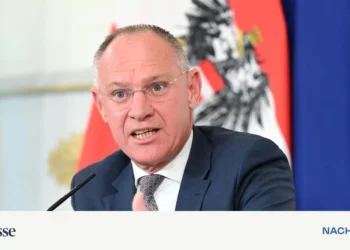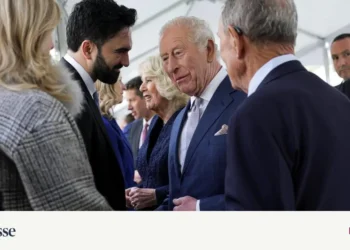
“Everything is fine,” Andreas Babler assures his employees immediately before a campaign appearance, “what could go wrong?” The documentary “Election Campaign” by Harald Friedl about the SPÖ’s 2024 National Council election campaign – which, as is well known, ended with the party’s historically worst result – only partially provides the answer to this. Friedl accompanied the SPÖ leader for a total of two years for his “long-term documentary observation”. Today, Friday, the film opens in cinemas across Austria.
“Election Campaign” caused a stir in advance because money from the Austrian Film Institute, the Vienna Film Fund and the state of Lower Austria was used for the production. The FPÖ spoke of “propaganda at the expense of the Austrian taxpayers” and a “social blockbuster”.
The SPÖ justified itself: The public funding was approved under the black-green government, and today’s media minister Babler was not involved. He also had no say in the design or editing of the film. Director Friedl also confirmed this: “Nobody ever said that you weren’t allowed to use what you filmed earlier.” The independence of the film team was respected. “I won’t like every scene,” feared Federal Managing Director Klaus Seltenheim.
Seltenheim will probably enjoy most of the film, as Babler is seen primarily in keeping with his image, grounded and “close to the people”. When an employee points out to him that he cannot go to the Danube Island Festival without security, he responds in surprise with “Because?” In his election campaign appearances across the country, the SPÖ leader poses for cell phone selfies and insists on “justice” in the form of a contribution from the “super-rich”.
Babler and his team repeatedly discuss how they can bring up its central topics in TV discussions, for example. When preparing for a “ZiB2” interview, they don’t quite agree: Should the top candidate demand more state participation there? In response to the objection that there is no need to “unnecessarily open a nationalization debate, which all the experts advise us against,” Babler replies: “It would be opportunistic to keep the topic flat so that there is no contradiction from the bourgeois press, but that is not our target group anyway.”
Director Friedl leaves the scenes uncommented; not even the names or functions of the people involved are shown. Other politicians, from the SPÖ or other parties, do not have a say, so criticism of Babler can only be seen indirectly in the film: for example through an ORF interview with Gerhard Zeiler, who criticizes the SPÖ leader’s left-wing course, or when Babler describes Doris Bures’ criticism of the election program as “legitimate” in the ORF “Summer Talk”.
Things don’t go as smoothly as the film might otherwise suggest when, in the middle of the election campaign, the Brucknerhaus affair involving the then mayor of Linz, Klaus Luger, comes to a boil: one of the few scenes in which the young campaign team is noticeably relaxed. The topic “extremely concerns the comrades,” it was said in a meeting. “So, finally the emergence of the new SPÖ,” says Babler cynically after calling on Luger to resign via video. He doesn’t get more annoyed in the film than he does here. It was probably not to be expected that a politician would show negative emotions when he had a camera in front of his nose.
The 90-minute film is too long for alleged “propaganda”; even die-hard Babler fans are likely to sit back and forth in their cinema seats during the umpteenth election campaign scene or team meeting. The real highlight, the election evening on September 29th, only takes a few minutes: shocked faces in the party headquarters; Karin Blum, who puts her arm comfortingly around the shoulder of her husband as he sits at his desk; Babler, who speaks to his supporters about a disappointing result.
The time of the coalition negotiations is not shown in “Election Campaign,” but the day of the inauguration is. The film begins and ends on March 3, 2025. Babler’s wife, who shouts “Andi, your pants have a tear” on the drive to the Hofburg, is part of the opening scene; The end goes to the campaign team, which can still cheer after their boss has been sworn in – and is asked with a “friendship” to get back to work.