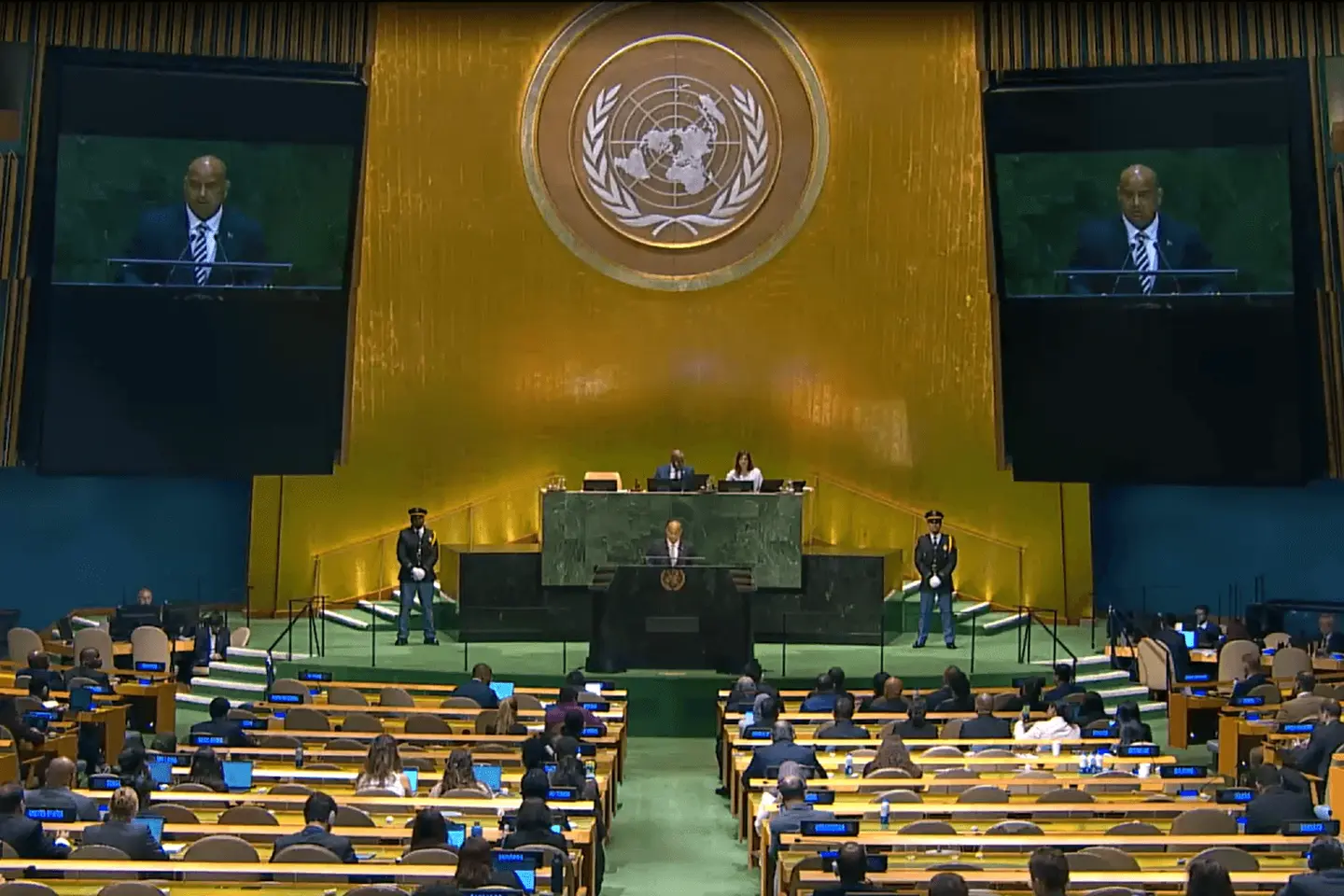
Nine Pacific Island countries used their 2026 UN General Assembly speeches to reject geopolitical competition in the region, up from four in 2025, analyst Oliver Hasenkamp wrote on the Devpolicy Blog.
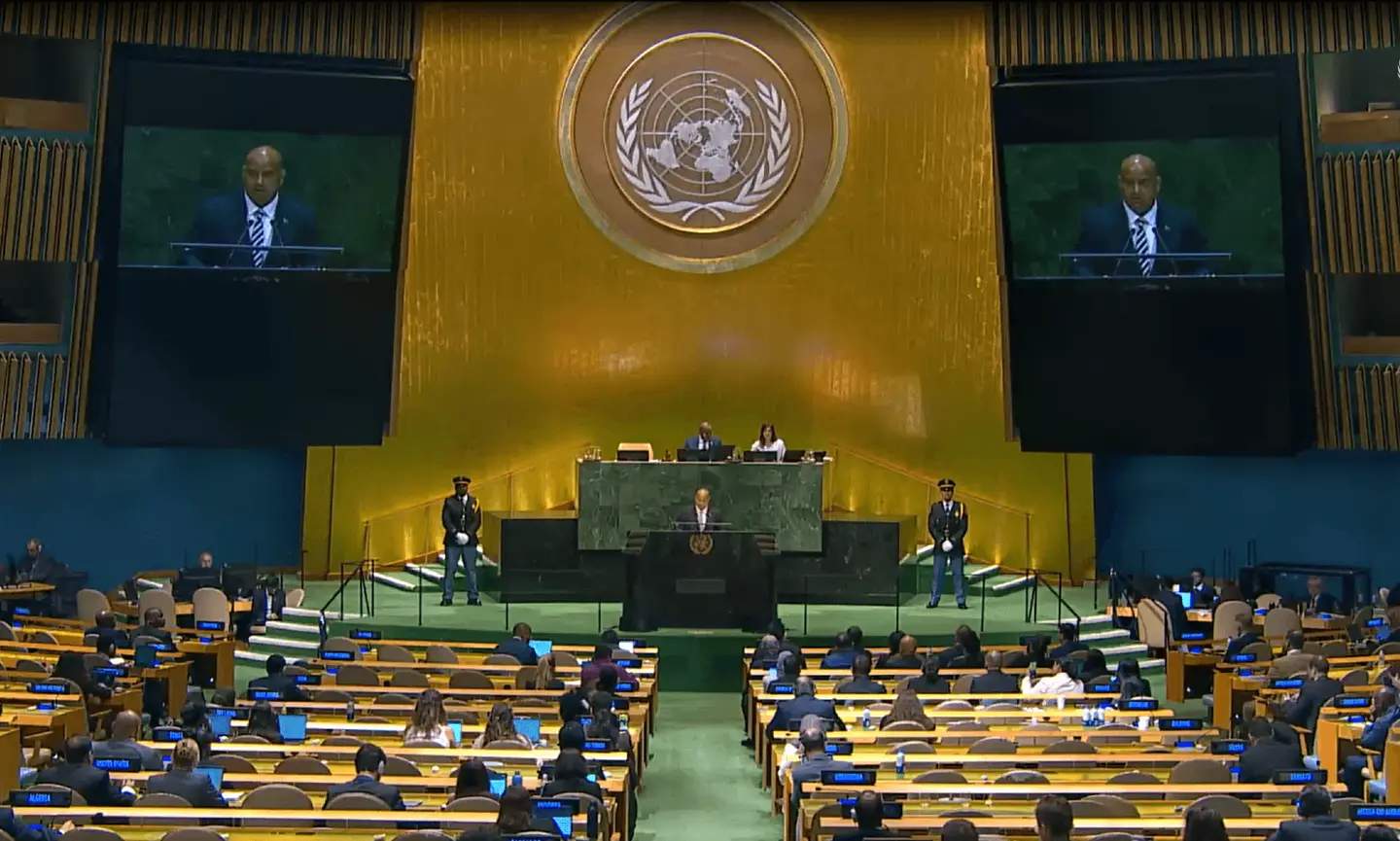
Naoero President David Adeang addresses the UN General Assembly’s General Debate in New York.
Nine of the 12 Pacific Island countries that belong to the United Nations spoke against geopolitical power struggles in their region during this year’s General Assembly General Debate, up from four in 2025, Oliver Hasenkamp wrote on the Devpolicy Blog.
Hasenkamp is a public relations officer for development, climate and sustainability at the United Nations Association of Germany, an associate at the GIGA Institute for Asian Studies and a board member of the German Pacific Network.
Member states delivered their annual high-level speeches in New York from 22 to 26 September and on 28 September 2026. What leaders raised, which partners they named and how they treated conflicts says much about regional priorities and geopolitics, Hasenkamp wrote.
Palau’s President Surangel Whipps said the Pacific was “our home, not a theatre for geopolitical competition”, and Naoero’s President David Adeang said his country would not be made to choose between partners. When addressing rivalry, however, leaders avoided naming the United States or China, Hasenkamp wrote, and Whipps was the only Pacific leader to comment on China’s ballistic missile test before the Pacific Islands Forum leaders meeting.
Positive mentions of traditional partners declined sharply. Japan and Germany were named more often than the United States, China, Australia or New Zealand, he wrote. The clear exception was Taiwan, which featured in the speeches of the Marshall Islands, Palau and Tuvalu.
Climate change and ocean governance remained central. Many countries praised the UN Declaration on Sea-Level Rise, adopted on the sidelines of the debate, which affirms that sea-level rise should not result in the loss of statehood and sovereignty. Tuvalu’s Prime Minister Feleti Teo called it a “monumental and gratifying achievement”.
Naoero, speaking under its new name for the first time, delivered the most striking Pacific speech, Hasenkamp wrote. Adeang was the only Pacific leader not to mention climate change, and he announced that Naoero would leave the International Criminal Court hours after US President Donald Trump called on states to quit the court. Naoero also joined Tuvalu and Vanuatu in criticising sanctions against Cuba.
Solomon Islands Prime Minister Matthew Wale called outgoing UN Secretary-General António Guterres a “true champion of multilateralism and of Small Island Developing States”, saying his repeated visits had shown the world that the Pacific matters.
Eight countries brought the Pacific Resilience Facility to the assembly, while five referred to the Forum’s Ocean of Peace Declaration, among them Fiji, Solomon Islands and Tonga for the second year running.
The Marshall Islands, Solomon Islands and Vanuatu raised human rights in West Papua, after no Pacific speaker did so in 2025. Raising such issues at the General Assembly takes more courage than agreeing to their inclusion in a regional communiqué, Hasenkamp wrote, though the Forum communiqué may ease the way.
Pacific countries said little about wars beyond their region, including Ukraine and Iran, and none declared solidarity with Israel this year.
Based on “What the Pacific UNGA speeches tell us about geopolitics and regionalism” by Oliver Hasenkamp, first published on the Devpolicy Blog (Development Policy Centre, ANU). Rewritten and shortened by Solomon Times. This version is shared under the same licence, CC BY-NC-SA 4.0.
Oliver Hasenkamp is a public relations officer for development, climate and sustainability at the United Nations Association of Germany (DGVN), an Associate at GIGA Institute for Asian Studies and board member of the German Pacific Network.
Disclaimer: Solomon Times Online may edit or delete your comment and cannot guarantee that all submissions will be published or remain online. The comments expressed on these pages are those of the authors and do not necessarily reflect the official policy or position of Solomon Times Online.