When o Barack Obama was negotiating a nuclear deal with Iran more than a decade ago, his team was headed by Secretary of State John Kerry. During the months-long talks, Kerry met with his Iranian counterpart on at least 18 separate occasions, often several times a day.
High-level nuclear diplomacy was a natural role for the head of US diplomacy, as indeed it was for the current secretary of state in America’s occasional major diplomatic challenges.
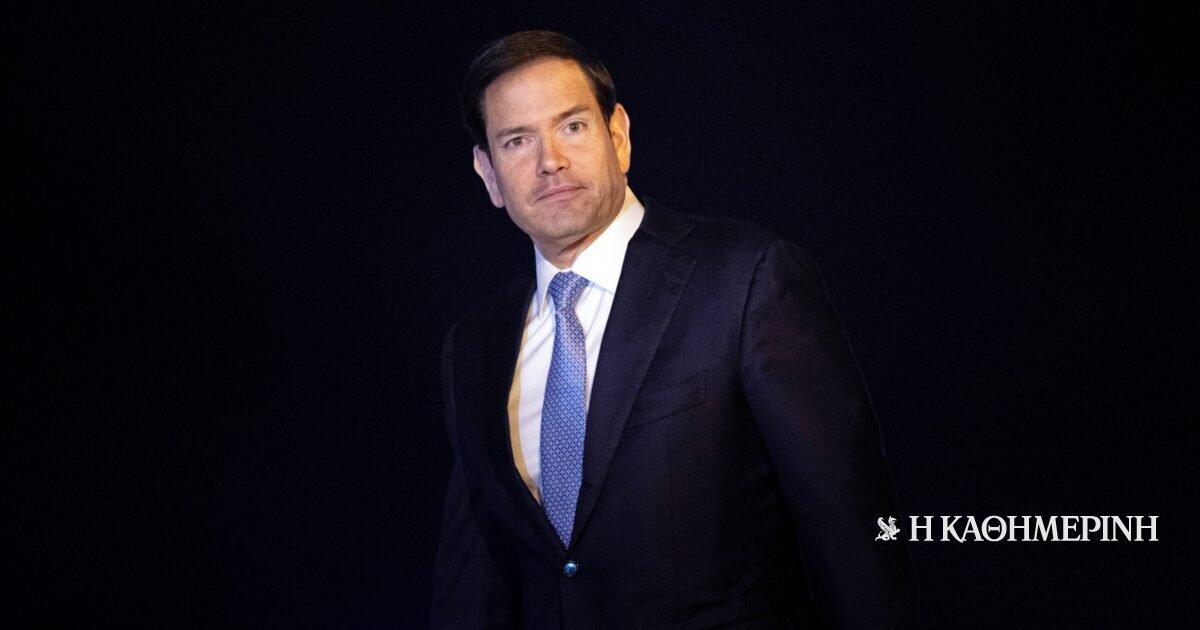
However, in the previous round of talks between the US and Iran in Islamabad, and the one planned for this weekend – before Trump decided to cancel the Witkoff-Kushner trip to Pakistan – the his secretary of state, Marco Rubio“he would remain where he usually is, in his home”comments a New York Times article.
Despite his multiple and pivotal roles in the Trump administration, that of Secretary of State and National Security Adviser, (who have elevated him as the “secretary of everything” in related memes), his absence from the biggest international crisis in the world right now, the war on Iran, is the most resonant.
The former Florida senator, whom Trump mocked by calling him ‘Little Marco’ when they were rivals in the 2016 election, “has impressed both his supporters and detractors during Trump’s second term“, notes a report from the Financial Times. And this “because of her of his undying devotion to the president — even if this means that he will remain in the background of the most important developments in the field of US foreign policy under the leadership of Trump.”
Strategic advantage?
However, as the article points out, for Rubio (who, like Vance, has presidential aspirations), his distancing, even against his will, from an unpopular war may also have strategic advantages.
“Rubio may have already realized that Iran is a lost cause, and the less he is associated with it, the better,” said Stephen Walt, a professor of international relations at Harvard University.
While Vance was emerging weeks ago from 21 hours of negotiations with Iranian officials in Islamabad without any progress, Rubio was with Trump in Miami, watching a UFC fight.
The paradox of Rubio’s dual mandate, combined with his limited use on important issues, is the subject of both derision and confusionit is pointed out in the publication.
“Only one other person has served simultaneously as Secretary of State and head of the National Security Agency (NSA): Henry Kissinger. However, the comparison stops there”, comments the FT.
“His authority was everything,” Daniel Drezner, a professor of international politics at Tufts University’s Fletcher School, said of Kissinger. “As for Rubio: he seems to have no authority outside of Latin America.”

However, other experts argue that the limited public role of the foreign minister is the symptom of Trump’s strategy of surprise military interventionsin contrast to the alliance-building strategy that characterized previous Republican secretaries of state such as Kissinger and James Baker.
“(This) signals the end of the American-dominated post-war world order. Not because they’re kicking us out, but just because we don’t want to do it anymore,” said Ryan Crocker, who served as the US ambassador to six countries in the Middle East and South Asia.
According to an FT analysis of his travel schedule, Rubio is also spending less time abroad than his recent predecessors. During his first 15 months in office, Rubio traveled for 71 days — fewer than any other secretary of state this century for the same period.

After losing to Trump in the 2016 primaries, Rubio, who was seen as a traditional Republican hawk, moved closer to Trump’s “America First” agenda. Much of Trump’s foreign policy in his second term stands in stark contrast to issues Rubio once championed in the Senate.
After Russia’s full-scale invasion of Ukraine in 2022, Rubio said the US should support Kiev “as long as they are willing to fight.” Three years later, he sat impassive on a golden sofa while Trump and Vance blasted Ukrainian President Volodymyr Zelensky in the Oval Office in an unprecedented attack.
This image of the idle, “invisible” Rubio was to become the source of endless memes.
“Nevertheless, he has managed, within the limits of presidential flattery, find ways to advance progress on issues that are important to him, but frame them in a way that is attractive to the presidentsays Jeremy Shapiro, director of research at the European Council on Foreign Relations.
In his second term, Trump is prioritizing the loyalty of his top aides. “That’s what Trump wants,” said Colin Dueck, a Republican foreign policy expert at George Mason University.
It’s a strategy that, for Rubio, seems to be paying off, as evidenced by polls. A recent informal poll of Conservative Political Action Conference (CPAC) attendees showed that while Vance remains the preferred candidate in the 2028 Republican primary, Rubio’s share jumped from 3% in 2025 to 35% this year.
Rubio also remains a trusted member of Trump’s inner circle. While at the same time it is the man often called upon to moderate and explain the chaotic and often contradictory flow of policy decisions from the Oval Office.
He was “the guy who was often called in to smooth things over,” Dueck says, while analysts point to his steadfast focus on Latin American issues.
“One could argue that Venezuela may turn out to be the only bright spot, or at least a partial success, in Trump’s entire foreign policysaid Walt, of Harvard. “Rubio would like to claim that success and not have any involvement in the rest of the issues.”
Denials
White House and State Department officials are dismissing as scenarios Rubio’s marginalization on burning issues of American foreign policy, such as the Middle East.
“Secretary Rubio is a trusted voice in every national security debate,” White House spokeswoman Olivia Wales said in a statement to the FT.
Tommy Pigott, a State Department spokesman, said: “Secretary Rubio is proud to be part of the team implementing President Trump’s policies,” adding that Rubio works “every day with the president and his team.”
It’s not uncommon for a U.S. president to appoint envoys or other senior officials to handle sensitive foreign policy issues that require special attention, Walt says, citing examples from the last Biden and Obama administrations.
“In general, it is wrong to combine the role of the Foreign Minister and the head of national security”, assesses for his part Matthew Waxman, who held high-ranking positions in the National Security Council, the State Department and the Pentagon during the administration of George W. Bush.
“However, it’s not necessarily a bad thing that Rubio, who has a dual role, is somewhat out of the public eye right now,” Waxman added. “With so much attention being paid to delicate diplomacy with Iran, someone has to manage foreign policy in relation to the rest of the world.”