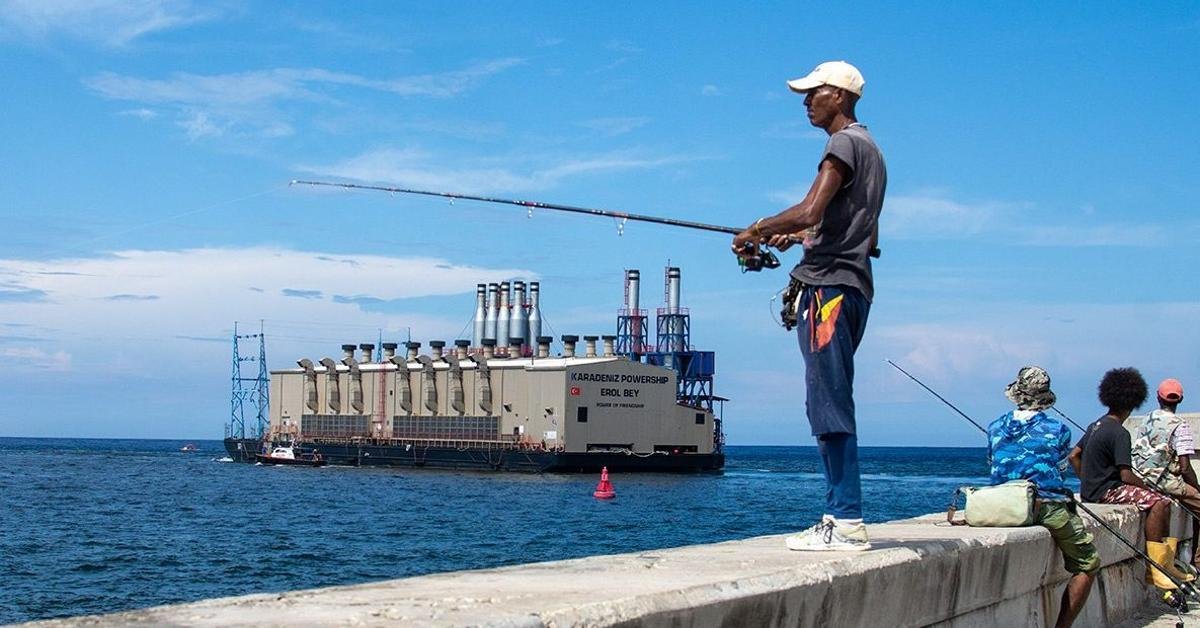
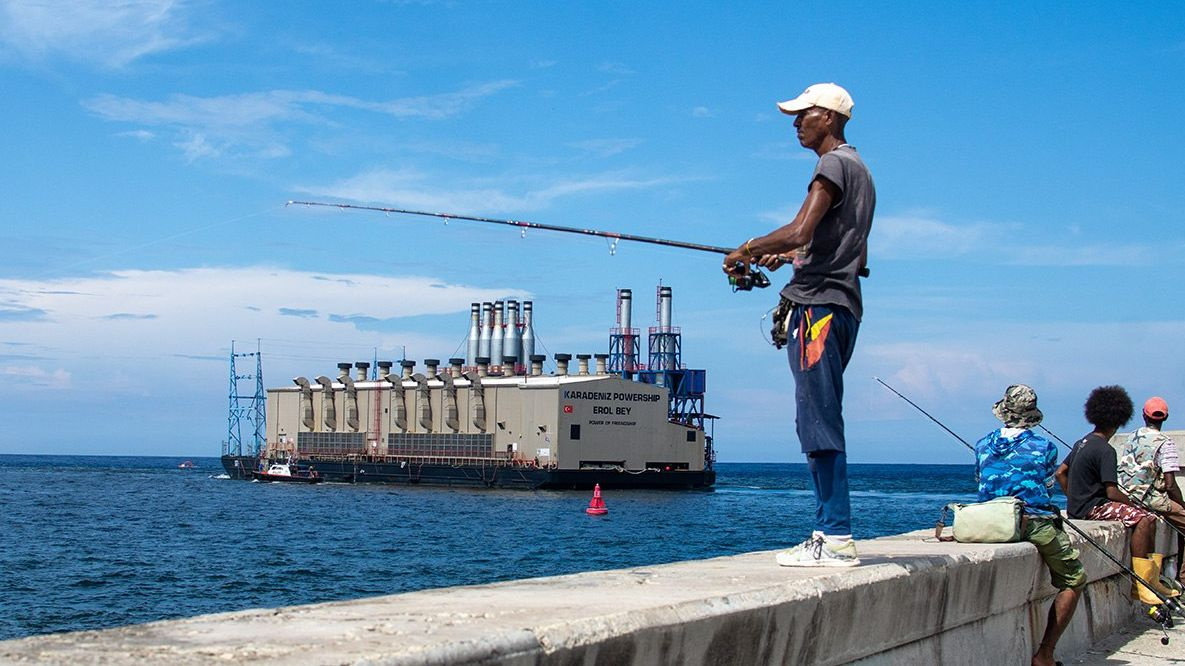
Havana/The Turkish floating power plant Erol Bey It left Cuba definitively this Monday, thus joining seven other units of this type that have left the Island in the midst of the energy crisis, as confirmed by EFE, although the Cuban authorities have not confirmed the departure. It was the last of these vessels with the capacity to generate electricity that remained in the country.
The patanawith a capacity of 63 megawatts (MW), left the port of Havana at approximately 2:30 p.m. local time. It had been paralyzed for several months due to lack of fuel.
In February 2024, 14ymedio identified the floating plant in the Guanabacoa cove, next to the Regla generating set, where it produced electricity and appeared in the generation reports of the Unión Eléctrica.
In February 2024, 14ymedio identified the floating plant in the Guanabacoa cove, next to the Regla generating set, where it produced electricity
Last April, the Ministry of Energy and Mines confirmed that only two vessels from the Turkish company remained in the Cuban capital: the Belgin Sultan and the Erol Bey. However, the first did not generate electricitysince it was used as a logistical support ship, so the second was the only generating plant from the departure of the others.
The latter temporarily produced electricity again in April, thanks to the arrival of the Russian oil tanker Anatoli Kolodkinwhich arrived in Cuba on March 31 with 740,000 barrels. On April 20, 14ymedio confirmed that the dump had once again emitted smoke, coinciding with the distribution of derivatives obtained from Russian oil. The reactivation lasted just a few weeks.
The plant was one of those contracted by Cuba to the Turkish company Karadeniz Holding, which since 2019 began bringing these vessels to the Island to inject electricity into the national electrical system (SEN).
The plant was one of those contracted by Cuba to the Turkish company Karadeniz Holding, which since 2019 began bringing these vessels to the Island to inject electricity into the SEN.
The cost of these contracts was never disclosed by the Cuban Government. In August 2023, 14ymedio estimatedbased on similar Karpowership (Karedeniz) contracts in the Dominican Republic, that the leasing of the floating plants could have cost about 109 million dollars for 42 months, equivalent to about 31 million annually. This was a comparative calculation, not an official figure on payments made by Cuba.
Between 2021 and 2023, more plants operating in Mariel Bay and Havana Bay were incorporated, adding more than 400 MW of power to the system. In 2023, the patanas contributed 4,494 gigawatt-hours, 23% of national electricity generation, according to figures from the National Office of Statistics and Information.
In August 2025, left Havana Suheyla Sultanone of the largest floating plants, with a capacity of 240 MW, in the midst of non-payments by the Cuban Government to the Turkish company. His departure left only the Erol Bey already Belgin Sultan.
In July of this year another floating plant arrived in Havana, Isabelafrom the Dominican Republic, where he had remained for decades. The Electrical Union He clarified that he would not join to electricity generation, but had arrived to receive maintenance at the Asticar dock.
Since mid-2024, Cuba has been experiencing a serious energy crisis that deepened with the oil siege imposed by the US Government since January, which cut off crude oil imports to the Island that were used to supply Cuban thermoelectric plants and Turkish floating ones.
The situation of the SEN is “critical” and “extremely tense”, as the Cuban Government has recognized, marked by Washington’s measures and by the obsolescence of the majority of its thermoelectric plants – responsible for 40% of generation – and which were built in the 60s and 70s of the last century.
The serious energy crisis has escalated to maximum levels in recent months and it is common for daily blackouts due to lack of generation capacity to exceed 20 hours in Havana and reach up to three days in a row in the other provinces.
The country has suffered eight total blackouts so far this year.
Cubans suffer, in addition to power outages, the almost total paralysis of public transportation, hospitals barely offer some minimal services and prices have skyrocketed across the board, especially for food and medicine in informal markets.