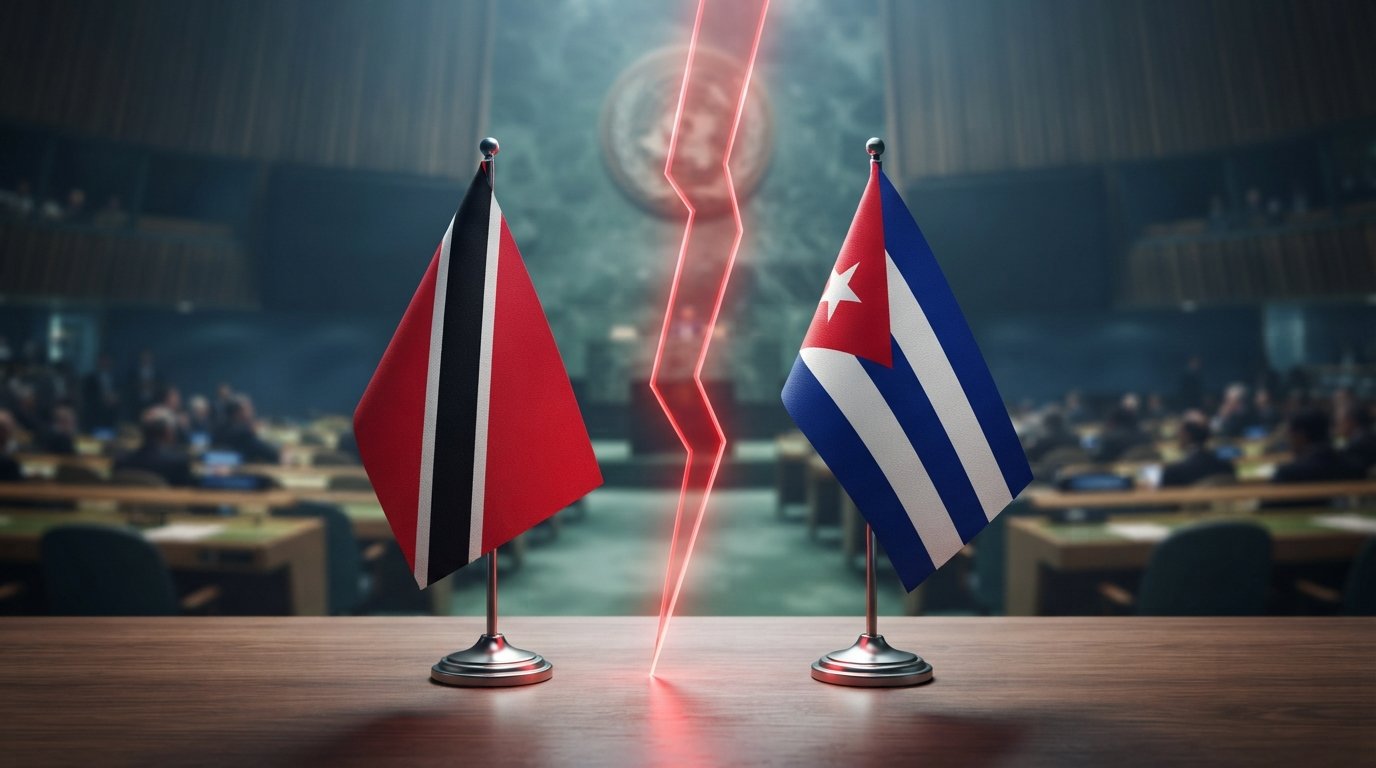
 In a historic departure from over three decades of foreign policy precedent, Trinidad and Tobago voted against a United Nations General Assembly resolution calling for an end to the United States’ economic embargo on Cuba.
The decision, which took place during the annual UNGA vote on October 28, 2026, marks the first time since Trinidad and Tobago initially abstained in 1992 that the twin-island republic has actively opposed the measure. The vote placed Trinidad and Tobago in a small minority of 17 nations—including the United States and Israel—that voted against the resolution. While the non-binding resolution was successfully adopted for the 34th consecutive year with 130 votes in favor and 25 abstentions, the overall support for lifting the embargo dropped to its lowest level in decades amid an aggressive U.S. lobbying campaign.
Following the vote, Prime Minister Kamla Persad-Bissessar and Minister of Foreign and CARICOM Affairs Sean Sobers strongly defended the country’s new alignment. In statements issued to the public and the House of Representatives, government officials asserted that Trinidad and Tobago’s stance is rooted in a fundamental commitment to democracy, political freedom, and human rights.
“The UNC [United National Congress] supports the Cuban people; we do not support a military dictatorship,” Persad-Bissessar declared, arguing that the ruling elite in Havana exploit ordinary citizens to fund lavish lifestyles while the population suffers severe economic hardships. Officials emphasized that the “No” vote was directed strictly at Cuba’s political leadership rather than its populace.
The sudden policy shift has triggered a wave of condemnation from regional diplomats, political analysts, and former government leaders who accuse the administration of abandoning longstanding principles. Critics highlighted that Trinidad and Tobago was the only CARICOM member state to vote against the resolution. While seven Caribbean nations supported Cuba, neighbors like Jamaica, Guyana, and Haiti opted to abstain, leaving Trinidad entirely isolated in its “No” vote within the regional bloc.
Former Prime Minister Dr. Keith Rowley fiercely rebuked the current administration on social media, describing the vote as “shameful” and calling the government “decisively disconnected from the people they are supposed to represent.” Further condemnation came from former Minister of Foreign and CARICOM Affairs Dr. Amery Browne, who labeled the vote “disgraceful” and noted that it undermines Trinidad’s historical commitment to the UN Charter principles of non-intervention and non-interference in the internal affairs of sovereign states.
Opponents of the decision also pointed to the timing of the vote, noting that it comes while Cuba faces a devastating humanitarian and energy crisis, with severe fuel shortages and widespread electrical grid collapses. Critics argue that by voting to maintain the embargo, Trinidad and Tobago has effectively made itself complicit in the ongoing economic strangulation of ordinary Cuban citizens.
While the U.S. Embassy in Port of Spain formally thanked Trinidad and Tobago for “standing with the Cuban people and their hope for freedom,” local detractors maintain that the administration has compromised its independent diplomatic judgment and severed decades of Caribbean solidarity to curry favor with Washington.