Abandoned roofs, some that serve as homes for people, and a danger that is becoming more and more latent: the recent rains in Lima or a large earthquake could be a great danger for all these areas. What happens when dishes and garbage accumulate in the upper parts of our houses and buildings?
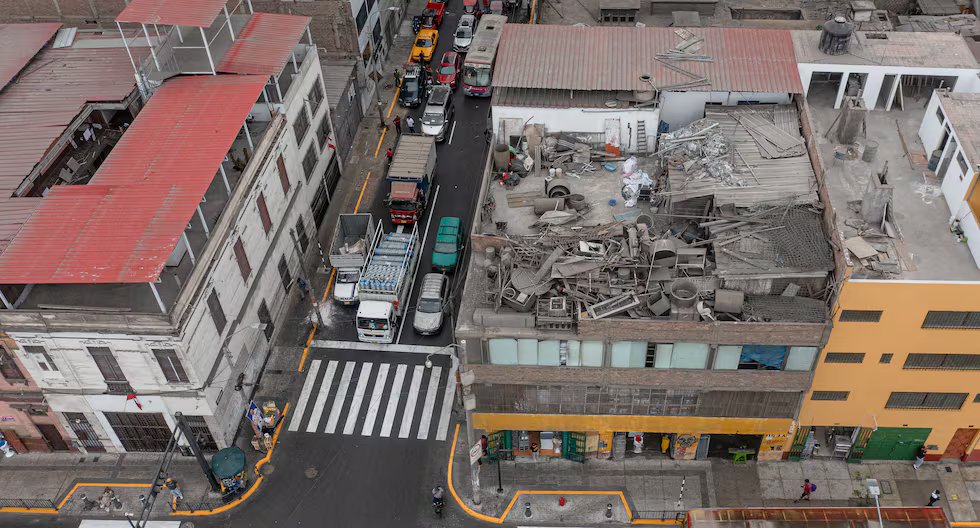
It is an ordinary day at the intersection of Av. Grau and Jr. Lucanas in Cercado de Lima. The drone takes flight and the landscape seems to be the same as always: vehicular traffic, street commerce, unplastered walls and a little – or perhaps a lot – of disorder. But something else catches our attention. An infinite number of useless, old and abandoned items accumulate on various roofs and terraced terraces. They can be iron, wood, tires, clothing that is no longer used, pieces of objects that were once useful, and damaged furniture. In one word: garbage.
With the arrival of the El Niño Phenomenon, different sectors will be vulnerable to inclement weather. And although the rains in Lima only go from light rain to others that are a little more intense, with thick drops, the frequency and duration of these will be decisive in understanding why there is a danger on the roofs of Lima that we are not yet dimensioning.
For this, we reviewed some images of the areas that our drone flew over and although they were always disused places, there has never been so much accumulated garbage as now. Galleries, warehouses and buildings where people live today show at their highest point the worst of each place. As if they didn’t want it to be seen. But you can see it, and it could be a time bomb.
In the event of a tremor or earthquakecrowded places will make evacuation difficult. Dishes could fall on people and this could trigger an even greater danger. In addition, the debris accumulated on the roofs can fall onto public roads and create a blockage for those units specialized in rapid response or first aid.
For engineer Nancy Barrenechea, president of the commission of technical inspectors in safety and buildings of the College of Engineers of Peru, it is almost “normal” for people to send their unused things to the roofs and rooftops. However, he noted that “All of this comes together with more things and reaches a point like the one we are seeing in the images. In a context of rains like the ones we are expecting in Lima (due to the El Niño phenomenon), this causes it to accumulate and make it very difficult to dry out. And moisture or stagnant rain can flow through cracks or small cracks into the structural steel of the roofs.”.
Grau Avenue is our first point. From the crossing with the Lucanas jirón you can see the clearing accumulated over the years. Wooden sticks, iron, broken and old furniture. There doesn’t seem to be anything that would help. And the panorama does not change much in other areas.

Lima September 11, 2026. Tour of roofs in poor condition in the central part of the capital, in some cases many things in poor condition store scrap metal. JR LUCANAS VIEW WITH AV GRAU CENTER OF LIMA Photos: Julio Reaño/@photo.gec
/ JULIO REAÑO

Lima September 11, 2026. Tour of roofs in poor condition in the central part of the capital, in some cases many things in poor condition store scrap metal. VIEW OF BUS STORES BETWEEN AV ABANCAY AND JR INAMBAR IN THE CENTER OF LIMA Photos: Julio Reaño/@photo.gec
/ JULIO REAÑO

Lima September 11, 2026. Tour of roofs in poor condition in the central part of the capital, in some cases many things in poor condition store scrap metal. VIEW OF BUS STORES BETWEEN AV ABANCAY AND JR INAMBAR IN THE CENTER OF LIMA Photos: Julio Reaño/@photo.gec
/ JULIO REAÑO

Lima September 11, 2026. Tour of roofs in poor condition in the central part of the capital, in some cases many things in poor condition store scrap metal. ABANCAY AVENUE BETWEEN JR INAMBARI AND JR LETICIA Photos: Julio Reaño/@photo.gec
/ JULIO REAÑO
Although it is known for being normally gray, with a lot of cloud cover and seasonal clouds, Lima is not in a rainy area like the mountains, where the roofs are sloping, the water drains and usually falls through gutters. Furthermore, in places like Cusco, Ayacucho or some other region of the mountains, all the rainwater goes to the evacuation points and does not accumulate.
“In Lima that doesn’t happen. In Lima we are not prepared for rain, we do not have rain and the roofs are flat. And most of the roofs we have are lightweight ones. We are talking about the vast majority, 90% of houses, have this type of lightened slabs. They are affected and we are not in the habit of putting protection such as pastry bricks on the roofs, which in some way protect and absorb this humidity.”says engineer Barrenechea.
Two of the possible risks in these situations have to do with the accumulated weight and the electrical connections. The first is that all the accumulated material, which can be wood, cardboard, furniture or old clothes, will become heavier as rainwater accumulates. This poses a risk because supporting the weight of the usual clearing is not the same as having the same amount of disused things but now with a higher weight.
On the other hand, there are usually exposed electrical connections or wiring, without gutters or protective tubes, which makes these places an imminent danger if prolonged and intense rains occur. Here The ideal is to have the entire electrical system safely and away from the points where the rain that comes with the El Niño phenomenon can reach.

Lima September 11, 2026. Tour of roofs in poor condition in the central part of the capital, in some cases many things in poor condition store scrap metal. JR PARINACOCHAS VIEW WITH AV GRAU CENTER OF LIMA Photos: Julio Reaño/@photo.gec
/ JULIO REAÑO
Those responsible for each of these spaces could, on their own, realize how much they have accumulated and begin to get rid of much of the debris or disused objects that they have accumulated for so long. In the event of any weather phenomenon or an earthquake or earthquake, everything seen in the images is a danger. In addition, municipalities have the responsibility to supervise and use all the tools at their disposal to solve this problem: clean roof campaigns, civil defense inspections, advise the owners of commercial and residential areas and enforce their ordinances through inspection and fines.
The specialist from the College of Engineers of Peru points out that the municipalities “They should have cleaning campaigns on the roofs so that people have the opportunity to eliminate those materials that they have accumulated or are out of use. It would be good to start campaigns through municipal ordinances, carry out cleaning operationsorganize the population so that they also do it and in that way we can take care of our properties.”