Almashi called the Kara-Kyrgyz Sunni Muslims, but their religiosity, according to him, is shallow. Most did not observe the five times prayer. His guide Attey, for example, before sunset, read all the prayers in a row with five-minute pauses. The author also found only fragmentary traces of old animism. He saw bakchi, a combination of a wandering musician, a shaman and a Muslim saint, only among the Kazakhs, including two in Karkar.
At the same time, the world of nomads, according to his description, is inhabited by spirits, giants, genies and monsters. He cites superstitions:
- the argali tongue protects the gun from misfire;
- kulja meat helps to ford rivers;
- eagle owl feathers protect the child from diseases;
- to jump on horseback over a lasso lying on the ground, unfortunately;
- Spitting on the fire in a yurt is also unlucky.
People from his caravan used stones to tell fortunes, but interpreted the result differently and argued. It ended with the words “You see for yourself, bye, good or bad.”
Funeral and commemoration. The burial took place without any special ceremony, usually the next day, according to Islamic rites: the body in a white shroud, without a coffin, in a shallow grave. Men participated in the funeral, and women in the village mourned the deceased, scratching their faces and chests. Almásy wrote down the text of the lament. In addition, a pole with a red or white flag or a horse’s tail was placed near the grave or yurt. The funeral ceremony was held on the anniversary of death, with a big bayga. The rich organized it on a grand scale, and in memory of significant people such a baiga was repeated every four years.
The culmination was a ritual that Almásy considers the most curious. Men entered the mourning white yurt (ak-uy) and took the red flag, women tried to protect it, and then the flag, along with the bones of the eaten horse, was burned in a pit. While the shaft burned, the women wailed at the grave. The author sees in this a symbolic burning of the deceased and suggests that in ancient times the dead were actually burned. He refers to the Persian author Gardezi (1051-1052), who wrote that the Kyrgyz burn their dead, considering fire to be the purest. Similar symbolic burnings, according to Almasy, are found among other Turkic peoples, especially among those least susceptible to external influence.
How to read these posts today
Almásy’s book is a traveler’s diary; he himself admitted that he did not see something or did not have time to study it.
His conclusions about the “character of the people” and “abilities” reflect the views of the early 20th century, and should be taken as assessments of the author.
However, the value of his records is in recording the daily life of the Kyrgyz people of that time. His data is a valuable source on the history and ethnography of the region for researchers.
* Almashi called the settled population of the cities and villages of Turkestan Sarts, primarily engaged in crafts, trade and agriculture. He noted that the word “Sart” has not an ethnic, but a cultural and historical meaning – that is, in his opinion, there is no separate people with that name.
He included among the Sarts both the Persian-speaking Tajiks and the Turkic-speaking inhabitants – the Uzbeks and the settled population of East Turkestan, including Kashgar and Aksu. At the same time, he noted that some people called themselves Sarts, not classifying themselves as either Tajiks or Uzbeks.
Almásy’s book “Vándor-utam Ázsia szivébe” was published by the Hungarian Academy of Sciences.
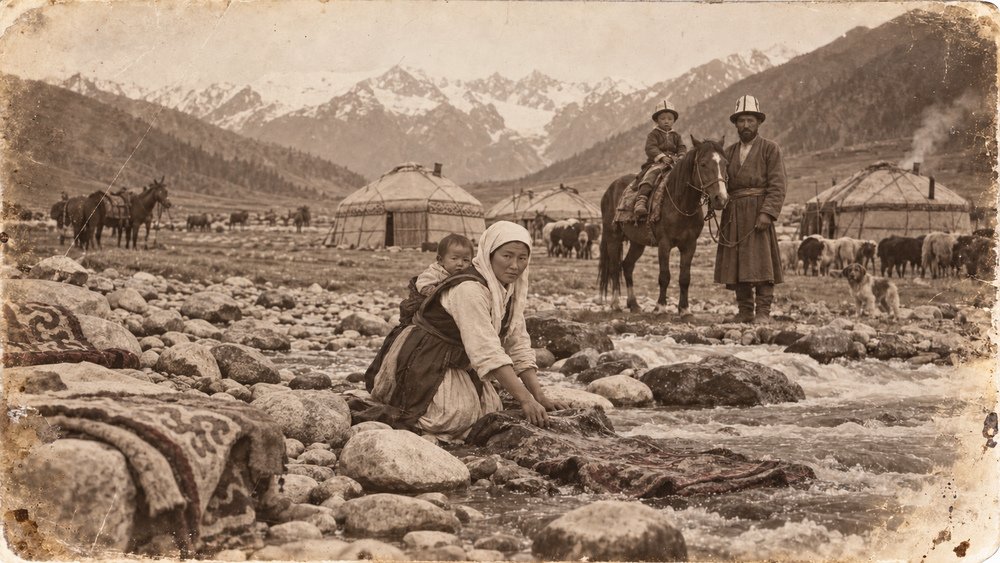
The illustrations are generated using artificial intelligence and are of a reconstructive nature.