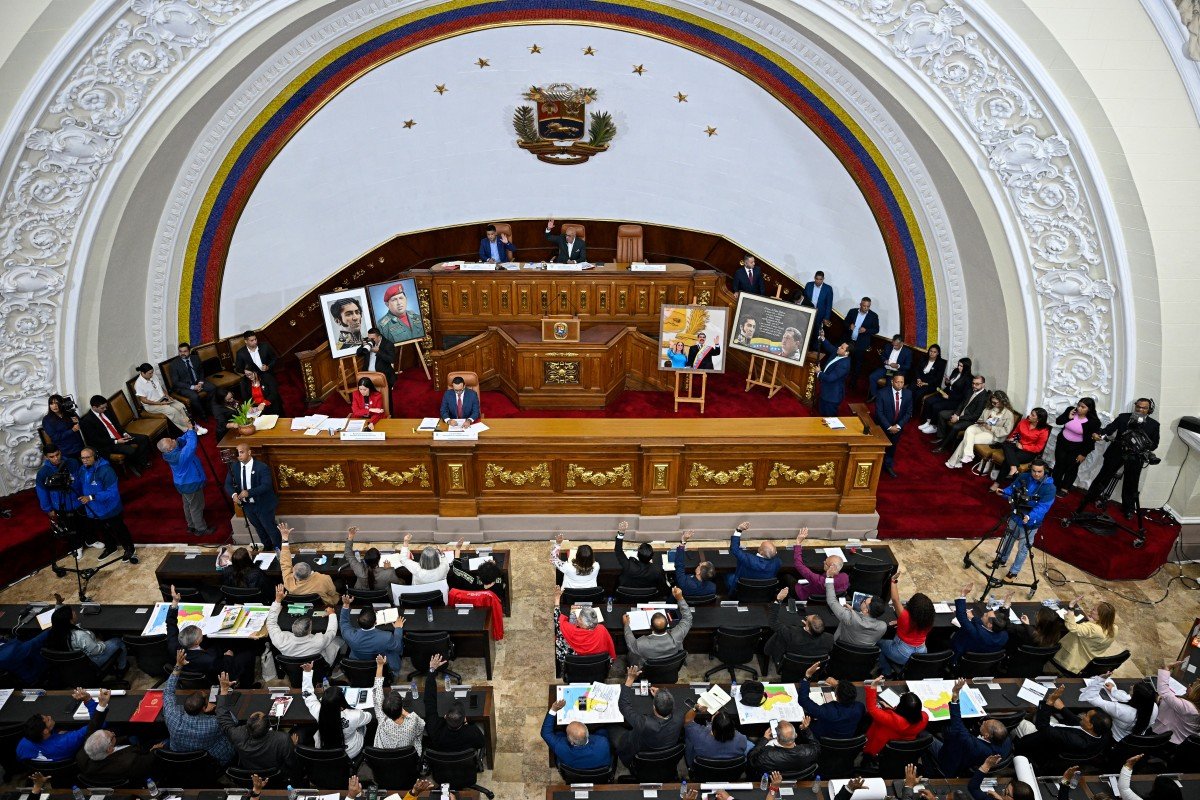
After a week of institutional evaluation and after the closing of the third round of political negotiations with key agreements on the re-institutionalization of the country, The National Assembly unanimously approved the appointment of the 12 representatives of civil society who will make up the Judicial Nominations Committee.
Public attention immediately focused on the credentials of those selected, in an attempt to project balance and technical suitability amid the debate over the impartiality of the Judiciary..
The chosen group shows a heterogeneous composition where sectors of national life converge: the delegation is markedly dominated by the legal and teaching areas, but also incorporates spokespersons from the medical-hospital sector, political science and the defense of human rights.
Seven of the 12 members are jurists with experience in branches such as criminal law and administrative law, supported by union and civil organizations such as the Venezuelan Association of Administrative Law, the Federation of Bar Associations and the non-governmental organization Foro Penal..
Academics with doctoral rank from the Andrés Bello Catholic University (UCAB) and the Central University of Venezuela (UCV) were added to this legal block, as well as service heads from the Vargas Hospital and the San Román Urological Hospital, configuring a multidisciplinary roster aimed at clearing up questions about the qualification of the evaluators.
Profiles and trajectories of the 12 selected
- Rosmely del Valle Flores Parras: Graduate in Administration and activist focused on defending the rights of people with disabilities. His application was presented by the organizations Movimiento Azul and Mi Mundo Neurodivergent. In 2023 he was part of the Electoral Nominations Committee.
- Clara Inés Casanova de Valecillos: Lawyer specializing in Criminal Sciences, Criminalistics and Procedural Law, whose candidacy was supported by the Federation of Bar Associations of Venezuela. She served as a judge in the state of Trujillo between 1970 and 2000, serving as judge of the Pampán municipality, second investigative judge, second first instance judge in criminal matters and first senior judge in civil, commercial, traffic, labor and minor matters. She was a professor at the Rafael Rangel University Center of the University of Los Andes (ULA) between 1990 and 2005, she presided over the Trujillo Bar Association in two terms (1985-1987 and 1997-1999) and is currently secretary of the national union federation.
- María Luisa Chacón de Aldana: Psychiatrist, teacher and scientific researcher. She serves as head of the Psychiatry service at the Vargas Hospital in Caracas and holds the vice presidency of the Venezuelan Foundation for the Advancement of Health Psychology (Funvepssa).
- Nancy Clara Castro de Navarro: Lawyer with specialization in Criminal and Criminological Sciences, with experience in legal and investigative practice. He has performed functions in the public legal sphere in Venezuela, serving in the past as a prosecutor of the Public Ministry and working in the jurisdiction disciplinary of the country’s courts.
- Mairim Girlens Ruíz Ramos: Free practice trial lawyer and judge for the protection of children and adolescents, nominated on her own initiative. In 2004 she served as head of the review service at the First Public Notary of Vargas state.
- Yrma del Valle Pazos Grau: Lawyer with specialization in university teaching and criminal sciences, with pedagogical activity in the area of legal sciences.
- Raquel Yadxani Sánchez Carrero: Lawyer with a master’s degree in Legal Sciences and representative of the NGO Foro Penal in the state of Táchira, a civil organization that promoted and supported her institutional application.
- Mauro Manuel Herrera Gutiérrez: Cardiologist, head of the Cardiology services at the Vargas Hospital in Caracas and the San Román Urological Hospital, nominated by the San Román Urology Medical Society. He was part of the Judicial Nominations Committee appointed in May 2026, which was formally revoked.
- Anthony Gerard Pérez Negron: Procedural lawyer and professor at the Central University of Venezuela (UCV), linked to the Legion Ucevista trade union movement. He served as a control judge in the Criminal Judicial Circuit of the Metropolitan Area of Caracas. Records of entities such as Transparency Venezuela They documented that he was on the payroll of the Executive Directorate of the Judiciary (DEM) at the end of 2018.
- Juan Domingo Alfonzo Paradisi: Lawyer specialized in Administrative Law, university professor and corporate legal consultant, formally proposed by the Venezuelan Association of Administrative Law.
- Guillermo Tell Juan Pablo Aveledo Coll: Political scientist and doctor in Political Science, essayist and dean of the Faculty of Legal and Political Studies of the Metropolitan University (Unimet), nominated on his own initiative. He was a member of the National Primary Commission (2022-2023) and is part of the IFIT Group of Experts on Venezuela. He is the son of former parliamentarian Ramón Guillermo Aveledo.
- Guillermo José Guzmán Mirabal: Lawyer and historian, doctor in History from the Andrés Bello Catholic University (UCAB), professor at that university and founder of the Venezuela History Network, who formalized his candidacy independently.

Integration with the 11 deputies
These 12 civil representatives will join the 11 parliamentarians previously designated by the plenary session of the National Assembly: Giuseppe Alessandrello, Pablo Pérez (Unión y Cambio), Gloria Castillo, Fernando Bastidas, José Villarroel, María Gabriela Vega, Carlos Mogollón, Jonathan García, Liliana García, Luis Florido (Un Nuevo Tiempo) and Félix Freites (Fuerza Vecinal).
In this way, the definitive mixed commission of 23 members is formalized, which will be in charge of evaluating and purifying the list of candidates to join the chambers of the country’s highest court.
The technical procedure and selection phases
After the swearing-in and installation of the committee with its 23 members, the process of pre-selection of judges will be governed by the periods and requirements established in the Constitution and the Organic Law of the Supreme Court of Justice.
Firstly, the body will define the scales of curricular scoring, technical suitability and ethical solvency, after which it will disseminate the public call on a national scale to open the period for receiving collections for 30 continuous days.
Once the document review and public interviews phase is completed, the committee will disclose the preliminary list of qualified applicants, beginning a period of five continuous days for the submission of duly founded objections and challenges by citizens.
Subsequently, the purified list will be sent to the Republican Moral Council for background verification before submitting the final report to the plenary session of the Legislative Branch, where the election of each magistrate will require the support of two-thirds of the deputies present.
The development of the committee will face scrutiny from observatories and independent organizations. Institutional oversight groups such as Transparencia Venezuela have warned about the need to shield the evaluation process from partisan pressures and prioritize strictly meritocratic criteria in the formation of the new judicial directive.