
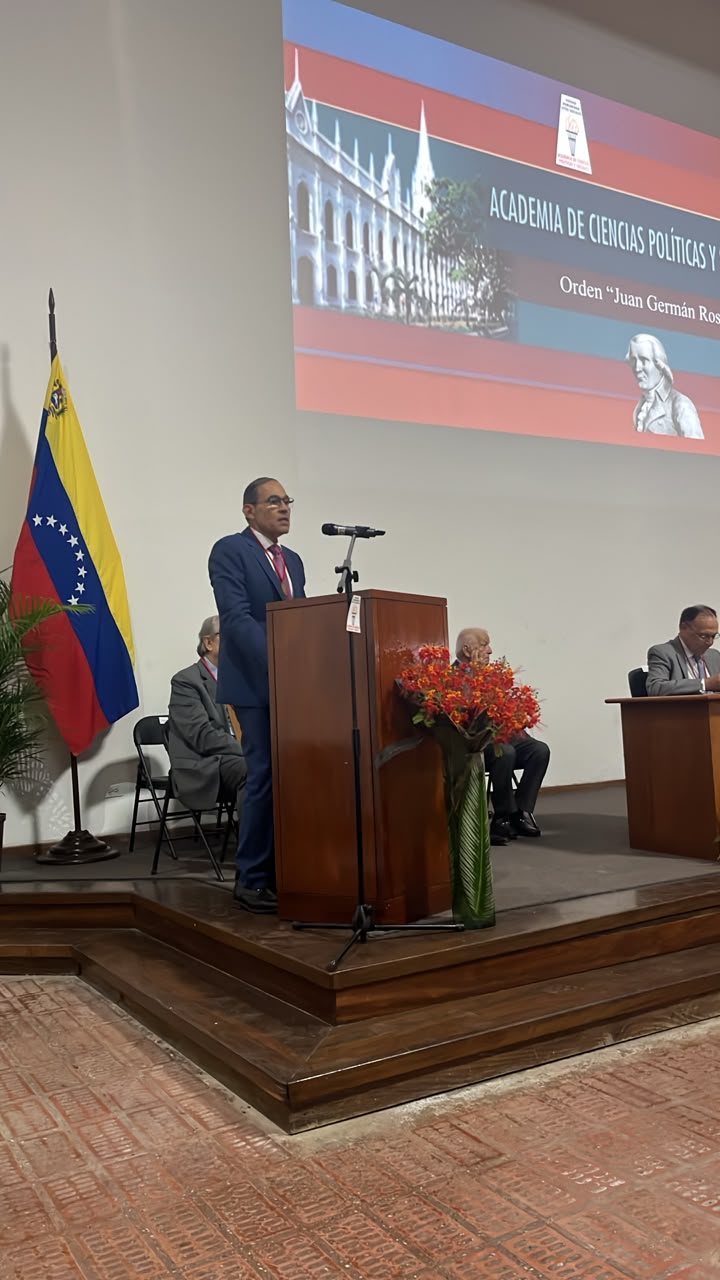
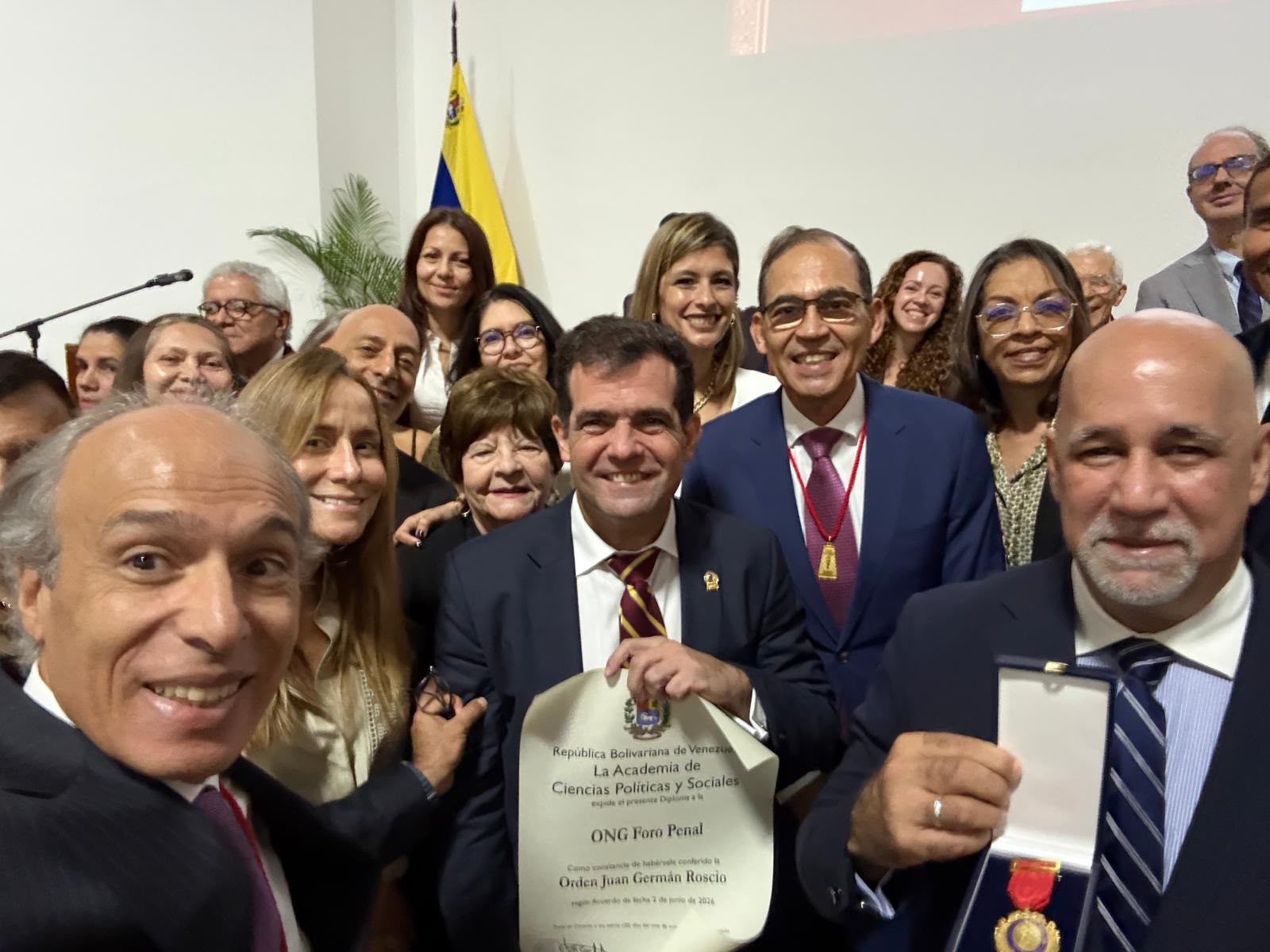
The president of the Academy of Political and Social Sciences, Rafael Badell Madrid, warned about the risks that political imprisonment, the instrumentalization of justice and persecution for political reasons represent for the Rule of Law in Venezuela, during the presentation of the Juan Germán Roscio Award this week, conferred on Foro Penal, represented by its directors Alfredo Romero and Gonzalo Himiob.
During the event, Badell warned about political imprisonment, the use of the judicial system to persecute adversaries, violations of property rights and the lack of judicial independence. Likewise, he urged the government to open channels of dialogue with all sectors of the country and to listen to human rights organizations.
The lawyer argued that the recognition of Foro Penal transcends the awarding of a distinction, as it reaffirms the Academy’s commitment to freedom, democracy, justice and human dignity. He also claimed the responsibility of legal institutions to prevent public power from acting arbitrarily and to guarantee that the Constitution and the laws protect citizens.
The academic recalled that the Juan Germán Roscio Award was created to recognize the merits of those who contribute to the development of law, political and social sciences, teaching, research and civic life.
The civil legacy of Juan Germán Roscio
Badell highlighted the historical importance of Juan Germán Roscio, jurist, thinker and civilian protagonist of Venezuelan Independence, whose contribution, he stated, has been relegated in the face of a narrative that privileges military exploits.
He recalled his participation in the events of April 19, 1810, his role in drafting the Act of Independence of July 5, 1811 and his contributions to the first constitutional instruments of the Republic. He also mentioned his performance as president of the Angostura Congress and vice president of Venezuela and Gran Colombia.
Roscio defended principles such as popular sovereignty, the separation of powers, the supremacy of the law and limits on the exercise of power. For Badell, his career shows that political independence is not enough if there are no institutions capable of protecting rights and guaranteeing freedoms.
The president of the Academy also recalled that Roscio suffered persecution, prison and exile, and that during his captivity in Ceuta he wrote The triumph of freedom over despotism. His experience, he noted, maintains the teaching that the law is only legitimate when it responds to justice and protects human dignity.
Political prison and the use of justice as an instrument of persecution
Badell described the deprivation of liberty for political reasons as one of the most serious expressions of the deterioration of democratic guarantees. He warned that detaining a person for their opinions, their legitimate political participation or their complaints not only affects their individual freedom, but also sends the message to the entire society that dissent can have consequences.
He also highlighted the effects of these arrests on the victims’ families, children, health, and personal and professional projects. He insisted that human rights and due process must protect all people, regardless of their ideology or the opinions they defend.
In this context, he addressed the phenomenon known as lawfareunderstood as the strategic use of legal procedures and institutions to persecute, intimidate, discredit or neutralize political adversaries.
As he explained, these practices can manifest themselves through selective investigations, accusations without sufficient basis, unjustifiably prolonged proceedings, disproportionate measures and campaigns aimed at destroying a person’s reputation before there is a judicial decision.
Badell warned that, when this deviation occurs, the process stops being a mechanism to establish the truth and becomes a form of punishment; The investigation stops seeking justice and begins to serve as an instrument of intimidation.
To illustrate the danger, he recalled the case of French captain Alfred Dreyfus, convicted in a trial marked by prejudice and irregularities and later rehabilitated by French justice. He also alluded to The process, by Franz Kafka, as a representation of the helplessness produced by opaque judicial systems.
Both examples, he noted, show the importance of having independent judges, committed lawyers and a society willing to demand justice.
Asset persecution and judicial independence
The speech also addressed the economic consequences of political persecution. Badell warned that businessmen, media owners, builders, bankers and producers may be affected by selective investigations, threats of arrest, occupations, confiscations or expropriations without due guarantees.
In his opinion, the impact of assets can be used to impose silence, punish independence or force a person’s submission. These practices, he stated, violate fundamental rights such as property, economic freedom, legal security and due process.
Faced with these risks, he defended judicial independence as a guarantee for all citizens, not as a privilege of judges or an exclusive demand of the opposition or the government.
Badell maintained that judges must be able to decide against the government or against any powerful individual when the law so requires. To this end, it considered it necessary to guarantee its stability, avoid pressure and reprisals and rebuild the institutional conditions that allow independent, impartial, transparent and accessible justice.
Penal Forum and the call for democratic dialogue
Badell recognized the work of Foro Penal in the legal defense of people deprived of liberty for political reasons, the documentation of these cases, assistance to victims and support for their families.
He stressed that an organization dedicated to the defense of human rights should not be considered an adversary of the State, but rather a legitimate expression of citizen participation and a contribution to the validity of democracy.
Recognition, he stated, should also serve to ensure that public institutions listen to the experience and approaches of the organization.
In the final part of his speech, the president of the Academy called for the recovery of trust in the institutions, respect for the constitutional order and overcoming political confrontation. To this end, he considered it essential that the government open communication channels with all sectors of society and, in particular, with Foro Penal.
He asked that his proposals be received, examined and considered seriously, especially in matters such as the review of arbitrary detentions, effective respect for due process and the restitution of violated rights.
“Dialogue is not a manifestation of weakness, it is an expression of democratic maturity,” said Badell, who defended the need to replace persecution with guarantees, exclusion with participation and the neutralization of the adversary with respect for citizen rights.
Finally, he reiterated the Academy’s willingness to contribute to the search for solutions to national problems, through proposals that strengthen judicial independence, protect human rights and restore legal security.
Badell concluded with a defense of a Venezuela in which no one is imprisoned for their opinions, the courts act without pressure, citizens can freely exercise their rights and differences are resolved through dialogue. The greatness of a Republic, he maintained, is not measured by the force with which its rulers exercise power, but by the freedom with which its citizens can live, think, dissent and participate in the construction of their destiny.
In this link you can download the full speech of lawyer Rafael Badell: His words address the defense of human rights, the rule of law, judicial independence and the need to recover democratic dialogue in Venezuela.