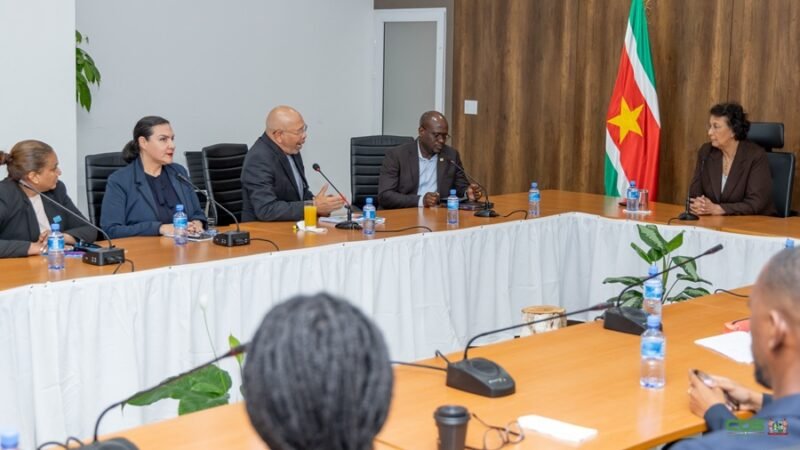
PARAMARIBO — “Having such a plan and a vision is fundamental to being able to start working on solutions. It is not enough, it is the foundation!” President Jennifer Geerlings-Simons emphasized this on Wednesday (today) when she was presented with the National Education Vision 2035 and the Education Action Plan Suriname 2026-2031. The plan is part of the educational vision for the period up to 2035 and is aimed at tackling issues within the Surinamese education system, explains the Suriname Communications Service.
According to the head of state, education is currently in a deep trough, both in terms of material and content. There are challenges in terms of school furniture, classrooms, staff and learning materials. She made it clear that a clear vision is necessary to tackle the challenges within the sector.
“Having such a plan and a vision is fundamental to being able to start working on solutions”
President Jennifer Geerlings-Simons
Geerlings-Simons emphasized that the innovation and improvement of education require joint efforts from the government, teachers, parents and the business community. She called on all those involved to maintain the shared vision and translate it into concrete improvements in education.
After receiving the documents, the president handed them over to Minister Dirk Currie of Education, Science and Culture with the assignment to start implementing the plans and measures included in the action plan. Although the head of state realizes that educational innovation cannot be achieved within a year, she believes that improvement must be visible every year.
Geerlings-Simons attributes “a central role” to teachers in realizing the educational vision. In addition to financial appreciation, their expertise and the position of the profession must receive more recognition. In the short term, she wants to continue working on secondary vocational training and connections with the business community, including gold and oil companies.
Concrete action points
Currie emphasized that the education plan should not remain limited to policy and theory, but must be translated into concrete action points. He pointed out that the implementation will take place in phases, because not everything can be achieved at once.
The minister further emphasized that the development of education is the responsibility of the entire society. In addition to the government, the business community must play an important role in guiding young people and creating opportunities for everyone.
Three pillars
Rebekka Brown-Kortram, chair of the National Education Congress presidential working group, explained that the plan is built around three pillars. The first concerns the preconditions necessary for stable education, including legislation, accountability, infrastructure and digitalization. The second pillar concerns the learning content and what students actually need in the period up to 2035. The third pillar focuses on inclusivity, where no one should be left behind.
According to Brown-Kortram, the handover marks the next step, namely the implementation of the proposed measures. The Chairman, who presented the plan to the President, made it clear that the working group is aligned with the government, which also contributed to the development of the plan.
Adriana La Valley, country representative of the Inter-American Development Bank and a representative of UNICEF were also present at the presentation on Wednesday.