We need to look for the unity that allows us to give life to something
new and constructive, while conflict leads to destruction
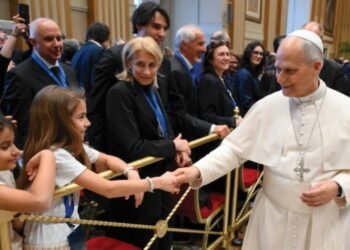
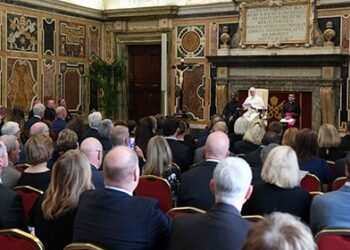
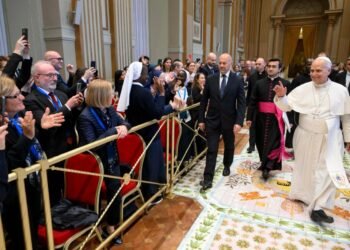
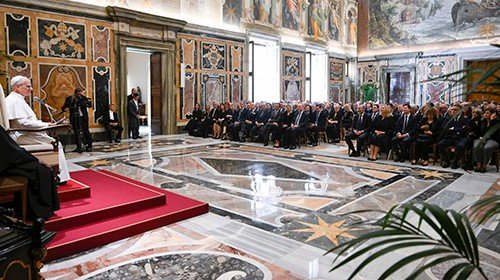
«The main task of every political action is to offer an ideal horizon» without «exalting an ideology», which «is always the result of a mystification of reality and violence against it». It is the delivery entrusted by Leo XIV to the approximately two hundred parliamentarians of the European People’s Party, received in audience this morning, Saturday 25 April, in the Sala Clementina. Also from the Pope is the invitation not to lose the link with the Christian roots of Europe. We publish below, in a translation from English, the Pope’s speech.
In the name of the Father, of the Son and of the Holy Spirit.
Peace be with you!
Distinguished Parliamentarians,
Ladies and Gentlemen,
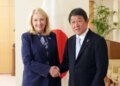
I extend a warm welcome to all of you at this meeting, greeting, in particular, your Chairman Mr. Manfred Weber and Mrs. Mairead McGuinness, Special Envoy of the European Union responsible for the promotion of freedom of religion or belief outside the European Union.
Our meeting takes place in the wake of those that took place with my predecessors Saint John Paul II and Pope Benedict XVI, as well as the message that Pope Francis sent you in June 2023, unable to receive you personally due to hospitalization. I am therefore pleased to resume the thread of this dialogue with the European People’s Party, which draws its political inspiration from personalities such as Adenauer, De Gasperi and Schuman, unanimously considered the Founding Fathers of contemporary Europe.
Like Benedict XVI twenty years ago, I too “appreciate your group’s recognition of Europe’s Christian heritage”. (1) The European project, which arose from the ashes of the Second World War, was certainly born from a practical necessity – to prevent such a conflict from happening again -, but it is equally imbued with an ideal horizon, that is, the desire to give life to a collaboration that would put an end to centuries of divisions and allow the peoples of the continent to rediscover the human, cultural and religious heritage that unites them. The Founding Fathers were animated by their personal faith and considered Christian principles a common and unifying factor, which could help archive the revanchist and conflictual spirit that had led to the Second World War.
Pope Francis coined a beautiful and simple expression that summarizes this idea: “unity is superior to conflict”, (2) since the search for unity has the courage to go beyond the conflictual surface and to appreciate others in their deepest dignity, (3) thus allowing something new and constructive to be given life, while conflict enhances divergences, the search and affirmation of power and leads to destruction.
The primary task of every political action is to offer an ideal horizon, since politics requires having a broad outlook on the future without the fear, when necessary for the common good, of making difficult and even unpopular choices. In this sense, it is the “highest form of charity”, (4) since it can be entirely dedicated (committed ) to the building of the common good.
Pursuing an ideal does not, however, mean exalting an ideology. In fact, the latter is always the result of a mystification of reality and violence against it. Any ideology distorts ideas and enslaves man to its own project, mortifying his true aspirations, his aspiration to freedom, happiness and personal and social well-being. Contemporary Europe arises precisely from the observation of the failure of the ideological projects that destroyed and divided it.
Pursuing an ideal means, recalling De Gasperi, placing the human person at the center «with its ferment of evangelical brotherhood, with its cult of law inherited from the ancients, with its cult of beauty refined over the centuries, with its will for truth and justice sharpened by a millenary experience». (5)
This is the horizon within which politics can still be practiced today and to which political activity must be brought back. You call yourselves the European People’s Party (European People’s Party ). The people are the center of your commitment and you cannot ignore it. The people are not just passive subjects, recipients of political proposals and decisions. It is first of all called to be an active subject, a participant in every political action. Presence among the people and their involvement in the political process is the best antidote to populisms that only seek easy consensus and to elitisms that tend to act without consensus: two widespread trends in today’s political landscape. A “popular” politics requires time, sharing of projects and love for the truth.
One of the problems of politics in recent years is the constant decrease in harmony, collaboration and mutual involvement between the people and their representatives. It is necessary to recreate a fabric of “people”, a personal contact between the citizen and the deputy, in order to be able to respond effectively in the light of the ideal horizon to the concrete problems of the people. Using a metaphor we could say that in the era of “digital triumph”, political action authentically oriented towards the common good requires a return to the “analog”.
This is perhaps the true antidote to an often shouted-out policy, made up only of slogans, incapable of responding to people’s real needs. To overcome a certain disaffection with politics it is necessary to win people back by meeting them personally and rebuilding a network of relationships in the area, so that everyone can feel part of a community and participate in its destiny.
What does this mean in concrete terms for those who refer to Christian-democratic values in their actions? First of all, rediscover and make your own the Christian heritage from which you come, without however losing “the necessary line of demarcation between the religious testimony of a prophetic nature – reserved for the ecclesial community – and the Christian testimony operating on the level of concrete political options”. (6) Being Christian in politics does not mean being confessional, but letting the Gospel illuminate the decisions that must be made, even those that do not seem to gather an easy consensus. It means working so that the connection between natural law and positive law, between Christian roots and political action, does not disappear.
Being a Christian involved in politics requires having a realistic outlook, which starts from the concrete problems of people, which is first and foremost concerned with promoting dignified working conditions which favor the ingenuity and creativity of people in the face of an increasingly dehumanizing and unfulfilling market; which allows us to overcome the apparently very European fear of starting a family and having children, to address the root causes of migration, taking care of those who suffer, but also taking into account the real possibilities of welcoming and integrating migrants into society. Likewise, it requires addressing in a non-ideological way the other great challenges that arise today such as care for creation and artificial intelligence. The latter offers great opportunities but is at the same time fraught with dangers.
Being Christians involved in politics means investing in freedom, not in a trivialized freedom reduced to taste, but in a freedom anchored in truth, which protects religious freedom, freedom of thought and conscience in every place and human condition, avoiding fueling «a “short circuit” of human rights», (7) which ends up leaving room for force and oppression.
I leave you these brief ideas, in the hope that they can constitute a basis for reflection for your commitment and, in expressing my best wishes for your service to the peoples of Europe, I willingly impart the Apostolic Blessing. Thank you!
1 Benedict XVI, Speech to the participants in the conference promoted by the European People’s Party (March 30, 2006): AAS 98 (2006), 344.
2 Francis, Exhortation. ap. Evangelii gaudium 228: AAS 105 (2013), 1113.
3 See ibid.
4 Pius XI, Audience with the leaders of the Catholic University Federation (18 December 1927).
5 A. De Gasperi, Our homeland Europe. Speech at the European Parliamentary Conference 21 April 1954, in: Alcide De Gasperi and international politics Rome 1990, vol. III, 437-440.
6 See Marialuisa L. Sergio in: Alcide De Gasperi, Diary 1930-1943 Bologna 2018, 24.
7 Speech to the Diplomatic Corps accredited to the Holy See (January 9, 2026).