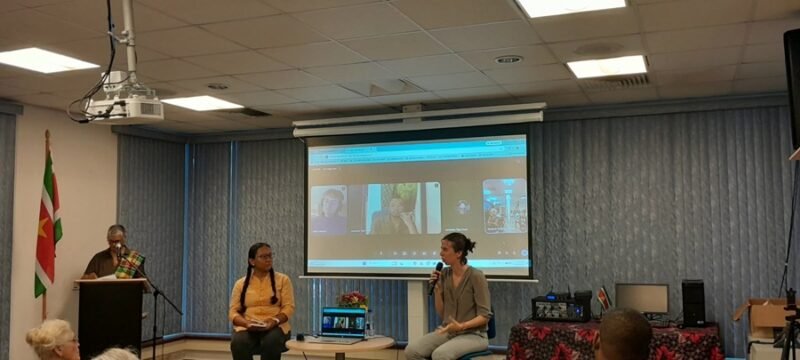
How different cultures can be is sometimes evident from the most everyday situations. So the simple question ‘How are you?’ in Suriname a self-evident greeting, to which the answer is usually a short ‘good’. However, in certain parts of the Netherlands and Belgium, the same question can have a much more personal meaning. Poet Stefanie Parisius-Sewotaroeno discovered during her international exchanges that even such an innocent greeting can lead to misunderstandings. It was one of the experiences that were shared on Saturday evening at the National Archives of Suriname during the panel discussion ‘Literary collaboration across borders: The Good, The Bad, The Ugly and how it works’.
Text and image Audry Wajwakana
Four makers from Suriname and the Low Countries (Netherlands and Belgium) shared their experiences with international collaboration. In addition to Parisius-Sewotaroeno, initiator of the discussion evening, Zoë Deceuninck (journalist and writer), Jonathan Tjien Fooh (poet and writer) and Helen Weeres (poet and artist) participated.
“I felt lonely”
Stefanie Parisius-Sewotaroeno
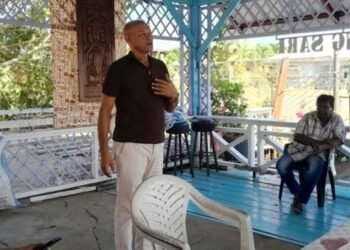
The discussion, led by Sylva Koemar, went beyond cultural differences. Unequal power relations, commercial interests and financial dependence were also discussed. The evening was interspersed with poems by Jeffrey Quartier and Layny Wirjotaroeno.
For the initiator, a two-week writer’s residency in Paris in 2024 not only brought new contacts, but also feelings of exclusion. As the only Surinamese participant, she experienced how differently makers from Suriname, the Netherlands and Belgium approach subjects such as colonialism and power relations.
During some conversations she did not understand her colleagues and she had the feeling that they did not understand her either. “I felt lonely,” says Parisius-Sewotaroeno. This often led to frustration and the feeling of not being able to fully participate in the conversations. Only after discussions with the Dutch Weeres, who also participated in the residency, did greater mutual understanding emerge.
This experience prompted Weeres to think differently about mentoring international makers. Participants should not only be given the space to write, but also to get to know each other. During residencies that she now co-organises, she creates moments in which makers share their personal values, backgrounds and sensitivities with each other. In this way, she tries to create a common basis for discussing differences and better handling conflicts.
Subjective assessment
For Deceuninck, the cultural differences are mainly reflected in the differing views on which stories from Suriname are relevant for the Dutch media. The Belgian journalist, who has lived in Suriname since 2017, noticed that Surinamese stories about economic problems, corruption and politics in particular received interest abroad.
The nuanced and personal stories that she found important proved more difficult to include in Dutch publications. “What Dutch people find interesting about Suriname is not what Surinamese people find interesting about Suriname,” she emphasizes.
Even with the publication of her book ‘Welcome to Dangogo’, not everything went as she had hoped. Although she preferred to present the book, in which she collected stories about her experiences in Suriname, in Suriname first, the first book presentation took place in the Netherlands at the request of the Dutch publisher. However, interest from the Dutch media failed to materialize.
The commercial side of being a writer is also a stumbling block for Sewotaroeno. She says that publishers rejected her work or did not respond to her proposals at all. At the same time, she understands that publishers must take the marketability of books into account. The challenge remains how writers can make a living without adapting the stories they care about to the expectations of a foreign market.
Exclusion
Tjien Fooh, who lives in the Netherlands, also struggles with the question of how he can maintain his own writing voice. During a one-year guidance program for children’s book writers from the Dutch organization Qissa, he worked under the guidance of a coach on a children’s book about Javanese contract labor in Suriname. He discovered how unknown Surinamese children’s book authors such as Gerrit Barron and Ismene Krishnadath were among fellow participants. Moreover, he regularly had to explain what certain Surinamese experiences and concepts meant.
The emphasis on age categories, marketing and accessibility for Dutch children complicated his writing process. He wondered how far he should go along with it without losing his own voice as a writer. Another disappointment was that he was not allowed to employ a Surinamese illustrator for his writing project. The conditions of the Dutch fund involved limited the collaboration to makers based in the Netherlands. This meant that a financing option also became an obstacle to working with makers from Suriname.
In the second part of the evening, various financing options and concrete opportunities for makers were discussed. The discussion also highlighted the need for a Surinamese literary infrastructure of its own. In addition to financial support, publishers and professional editors are needed to help writers further.
Parisius-Sewotaroeno simultaneously emphasizes that Surinamese writers should be able to access international funds. After all, due to colonial history, Dutch is also their language, while due to settlement conditions they are excluded from certain subsidy schemes.