Who is trying to steal Algeria’s heritage?
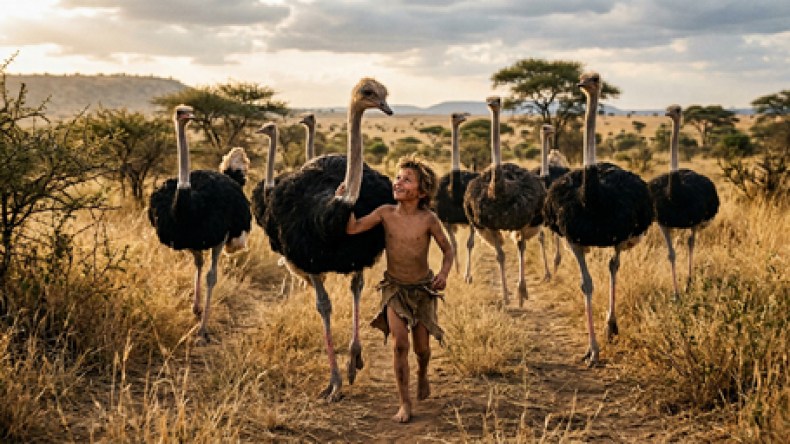
The Great Algerian Sahara is full of secrets and legends that go beyond the imagination of writers and filmmakers, but the biography of “Sidi Haddari” stands at the forefront of this unique human heritage. Unlike the fictional characters inspired by Western literature, such as Tarzan and Mowgli, Hadari’s story embodies a vivid, realistic experience of an Algerian infant who lived for more than a decade in the arms of ostriches, after getting lost in the Tindouf desert. Al-Shorouk Al-Arabi previously told the story in a literary foreshadowing of an oral tradition that fell victim to theft and violation.
The epic “The Ostrich Child.”“
The chapters of the story begin deep in the Algerian Tindouf desert, when the child “Hadari” lost his way, when he was not more than sixteen months old. In ancient harsh climatic and geographical conditions, it was common among the people that the infant had died, but the desert nature witnessed one of the strangest forms of innate coexistence. The ostriches embraced him and cared for him for more than twelve years. This historical incident, proven in oral memory because it took place on Algerian soil, proved the possibility of harmony between humans and animals in the harshest conditions of nature.
Cultural theft
The crisis of the “Hadari” story was not limited to local oblivion, but rather extended to become a clear example of the appropriation of the Algerian oral heritage and its stripping of its national roots. Parties outside the borders and Western literary institutions have exploited this unique biography, often attributing it to other geographical spaces, or presenting it as an “external discovery.” Reframing the story and turning it into products of international culture without explicit reference to its Algerian origin represents a form of cultural appropriation of national memory.
Marketing the story through the eyes of others
Swedish writer Monica Zak played a pivotal role in transferring the story to Europe, through her novel “Son of the Ostrich,” followed by international cinema and television projects, such as the movie “Desert Child.” Although these works contributed to spreading the story on a global scale, they were formulated with a non-Algerian vision, as the national identity of the story was absent, and it was reduced to the framework of a general desert adventure, which deprived the Algerian heritage of its literary and moral right to this international success.
Memory retrieval
Leaving popular biographies and oral histories without systematic recording or local artistic and cinematic production makes them vulnerable to extinction or plagiarism by others. The time has come for the cultural and media authorities in Algeria to restore the story of “Hadari” and return it to its original homeland, through works that prove its historical ownership and protect the national identity from any attempts at plagiarism and robbery…