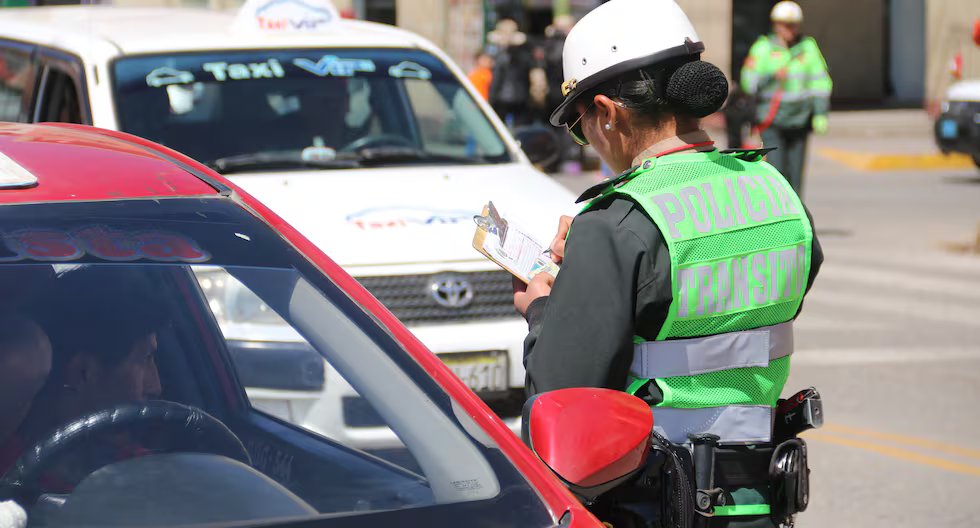
Various regulations issued months ago by the Ministry of Transportation and Communications come into force in October. One of them is the supreme decree No. 011-2026-MTC, which establishes two new violations in the National Traffic Regulations considered “very serious”, the M49 and M50, for those that do not respect the maximum height of the bridges and impact against the structures. This in the context of the constant accidents on the bridge located between Brasil and La Marina avenues, the Balta bridge (Vía de Evitamiento) and the Bajada de Baños bridge (Costa Verde).
Infraction M49 indicates that “not respecting the maximum height sign permitted on public roads” implies a fine of one UIT (S/5,500) and the driver accumulates 50 points. As a preventive measure, the retention of the driver’s license and the internment of the vehicle are established.
In the case of the M50, the penalty is greater, since it is specified that “not respecting the maximum height sign allowed on public roads, causing damage to the infrastructure and/or generating traffic interruption” entails a fine of one UIT, the suspension of the driver’s license and the imposition of 60 points on the driver’s record. The retention of the driver’s license and the internment of the vehicle are also adopted as a preventive measure.
The rule had been issued on April 21 of this year and a period of 120 days was given for it to be applied, so from October 6, fines will be applied to violators.

Bus crashes on the Brasil Avenue bridge are constant. (VIDEO)
Tolerance on speed limits
Supreme Decree No. 011-2026-MTC also establishes new tolerance margins for speed control. The standard indicates that “in the supervision and/or detection of violations of the maximum speeds allowed in this Regulation, a tolerance margin of 5 km/h is applied.”
In the case of land transport vehicles, when excess speed is based exclusively on the information recorded by control and monitoring systems through geolocation, a tolerance margin of 10 km/h is applied.
Points on driver’s license
At the end of May, Law 32616 was published, which reforms the Driver’s License Control System by Points. Offenses will continue to be divided into minor, serious and very serious, but from now on they must respond to criteria of gradualness, proportionality and level of risk for road safety. This rule will apply from October 12.
According to the aforementioned law, a minor infraction is punished with 1 to 10 points on the driver’s record; serious infraction, from 11 to 30 points; and the very serious infraction, from 31 to 70 points. In the case of criminal offenses, the license is cancelled.
It is also established that, upon reaching 100 points, the driver is subject to a 6-month license suspension in the first occurrence, then 12 months in the second, and definitive cancellation in the third.
However, drivers who accumulate 100 points for the first time will have the option to reduce the suspension from six months to just one month if they pass traffic safety courses, undergo psychological evaluations and receive ongoing training.
Score benefits are also granted to those drivers who have maintained “responsible behavior” for prolonged periods. Points are removed after two years.
They propose extending tolerance in the speed limit to 10 km/h for all types of vehicles
Karsten Kunckel, president of the Automotive Association of Peru (AAP)considered it correct to begin sanctioning drivers who hit the bridges with their vehicles, since it harms vehicular traffic by closing the entire road.
However, he stressed that the problem should be faced in a preventive and not punitive manner, which is why he proposed the placement of gantries before a bridge, so that the driver is given the possibility of leaving the road and not damaging the structure.
In addition, he recalled that, in accordance with the provisions of violation M50 of the National Traffic Regulations, the unit would have to be internalized, but he recalled that there is not much space to store vehicles.
Regarding tolerance in speed limits, Kunckel considered that 10 km/h should be applied as a tolerance for all vehicles and not only for land transport buses. “Exceeding 5 km/h is not a serious offense anywhere in the world, in Peru it is considered a serious offense and a penalty is applied that in another part of the world would only be applied when the maximum speed is exceeded by 20 or 30 km/h. This irrationality causes indignation among drivers,” he indicated.

The president of the Automotive Association of Peru (AAP), Karsten Kunckel.
/ JOHN REYES
He indicated that the fines should be much more burdensome for repeat offenders, but not for those who commit the offense for the first time. “Anyone who exceeds the speed limit by 20 km/h in the city must be penalized with 50 points,” he said.
The president of the AAP supported that drivers can reduce points on the record through the approval of courses. “These people stop violating traffic rules because they will not want to go through this procedure again and that is very effective. Many, when they see that their scores are accumulating, they begin to behave as they should,” he stated.
He considered that the authorities establish severe sanctions for 10% of citizens who do not comply with the rules. “90% comply with the traffic regulations, but 10% are the ones who do not comply, since they block the intersections, do not respect the speeds, do not respect the pedestrian crossing. That 10% is the one that causes the most incidents and problems, but that is why the 90% who, the vast majority, want to respect the traffic regulations cannot be punished with irrational fines,” he pointed out.
He asked to take into account that deaths from traffic accidents have not decreased in recent years, but, on the contrary, have increased a little, therefore, he considered it important for the MTC to consult civil society and experts before issuing regulations. “To date, everything that the MTC did regarding sanctions has not been useful at all,” he noted.
Not all fines for violations M49 and M50 may be applied, warns specialist
Franklin Barreto, specialist in traffic, transportation and road safety issueswarned that not all fines for violations M49 and M50 can still be applied, as he recalled that supreme decree No. 017-2026-MTC, issued during the administration of former Minister Rafael Rey, is still in force for 90 days, which establishes a 90% discount for transit tickets.
Said supreme decree determined that drivers who have fines pending the initiation of a sanctioning procedure, in process, final, contested or in coercive execution, as well as those that are imposed during the validity of the measure, may benefit from the exceptional payment regime. For this reason, the specialist indicated that “there is a crossing of norms.”
“The problem is that the supreme decree No. 017-2026-MTC, which was issued by this Government regarding the 90% reduction in fines, did not consider these infractions, M49 and M50, as part of those that did not have discounts,” Barreto told The Commerce.
“These infractions, M49 and M50, which have a fine of one UIT, equivalent to S/5,500, but with the application of the supreme decree in question have a 90% discount within the 90 days established by the rule and which expires in November,” he added.
He even highlighted that the MTC rule determined that fines canceled under the exceptional payment regime will not generate accumulation of points on the driver’s license nor will they be taken into account to determine recidivism or habituality. For this reason, he indicated that Law 32616, which will come into force on October 12, will have no impact.
They criticize entities for delay in deleting points
Martín Ojeda, director of the International Chamber of the Transport Industrypointed out that the sanctions and regulations that are promulgated in matters of traffic and transportation must be quick and easy to apply, since he recalled that in the country traffic accidents cause nearly 3 thousand deaths a year.
In this context, he recalled that many drivers took advantage of the 90% discount on the fine imposed, for which they paid 10%, but the benefit of deleting points from the driver’s record is not immediate, since the system takes three to four weeks to update the record.

Martin Ojeda. (Photo: El Comercio)
“The entities do not have the speed to make this effective. The drivers present their documents to qualify and do not have answers in three or four weeks, even though they have already paid 10%,” he explained.
“It is not fast. The driver accepts it, but in the system the points are not erased immediately, it takes three or four weeks,” he added.